Posted in Published Writing, Small Business Notes

And the Toxie Goes To…

600600p3069EDNmain633toxiesPhysicians Battle Toxic Cleaning Chemicals with a Hollywood Twist

For four years now, Californians for a Healthy Green Economy (CHANGE) and Physicians for Social Responsibility – Los Angeles (PSR-LA) have grown their multi-media campaign “The Toxies” to educate consumers about the hidden yet pervasive toxic chemicals that surround us every day at work, in the home, and outdoors. By putting an awards-show, red-carpet glamor on the annual awards event, the campaign gains both on-site public attention as well as a larger reach online to both the professional industries and the consumer.


Each year, at least one Toxie winner – often more – have come from the cleaning world, and the 2013 awards was no exception. Three rise to the top as major offenders among the various segments of the cleaning industry:

Yellow Soap – a powerful degreaser found most commonly in car wash operations, Yellow Soap is blamed for causing inhalation and contact-based chronic illnesses among professionals using the product.


Because Yellow Soap is not required to follow the US Hazard Communications standards – that is, Yellow Soap has no MSDSheet – the cleaning industry is having a difficult time identifying the specific toxins in the product. Worse yet, Yellow Soap is omitted from the currently Safe Chemicals Act under consideration by Congress, which means neither professionals nor consumers will be protected from it. Read more about Yellow Soap.

BPA – while the potential for damage by BPA to the reproductive system is increasing as common knowledge, the continued pervasiveness of BPA still catches many off guard. Many manufacturers have switched to BPA-free containers for their chemicals, but often equipment manufacturers don’t have that luxury.


BPA remains a common ingredient in many of the large containers, plastic handles, hand-held tools, and mechanical equipment used in the cleaning process. Read more about BPA that will surprise you.

Flame Retardants – Certainly our fire restoration specialists will be quite familiar with the dangers of flame retardants in their segment of the cleaning industry, but all segments that come into contact with fabric-based and upholstered furniture, draperies, and pre-fab furniture. Why? Because nearly all of it has been treated with flame retardant chemicals.


While adding a toxin may make it less likely that these items will contribute to a fire, that same flame retardant toxin is a regular hazard to the cleaning technicians and upholstery specialists charged with keeping those items maintained. Read more about the hidden dangers of Flame Retardants.

Other Toxie “winners” include several classic contaminants like Lead and Mercury as well as some emerging stars like the Fracking Chemical Coctail and the new pesticide Chloropicrin.


Click here to watch all of the 2013 Toxies Webisodes.

Originally published August 19, 2013 at CleaningBusinessToday.com.

Posted in Published Writing, Small Business Notes

Quantum Sweep: How to Choose Service Software for Your Cleaning Business

600600p3069EDNmain605quantum-sweep-300-x-250Because the ability to grow your cleaning business rests on your ability to deliver the customer service your client expects, and scheduling (or field services) software is a necessary component to knocking down barriers to growth.

JOIN ANY CLEANING INDUSTRY DISCUSSIONboard on LinkedIn, and chances are you’ll find scheduling software and cleaning job management programs among the top ten questions. Why? Because the ability to grow your cleaning business rests on your ability to deliver the customer service your client expects, and scheduling (or field services) software is a necessary component to knocking down barriers to growth.

Why Invest?

Pen-and-paper systems aren’t going to grow with your business or create efficiencies. They won’t help you drive growth and sustain the level of customer service you want to be known for. Most cleaning businesses seem to start off with simple, convenient and low-cost methods of scheduling jobs for clients. Even with the simplest calendar book, you might squeeze in three teams cleaning at the same time before you run out of room. Several online calendars, such as Microsoft Outlook or Google Calendar, allow you to automatically schedule recurring clients, which is the ideal in establishing a regular and predictable cash flow.

But the ability to get a client on the calendar correctly is just one small piece of the massive responsibility of “scheduling.” When you’ve selected the best software for your business, you can:

  • Enable planned and sustained growth by expanding your capacity to service more clients
  • Enhance customer service by reducing scheduling mistakes, overbookings, missed jobs, changes in day/time of services and or scope of work
  • Improve efficiency and save time by tracking customer information and running standardized work orders

We all know that time is money. That’s why making the investment in a piece of software designed to improve customer service is a critical investment that every business owner must make. It’s a leap of faith and finances, but one with thorough internal evaluation and realistic projections. Let’s look at five areas of analysis you need to invest time in before buying new scheduling software.

1 Function: What do you need the program to do?
Let’s get the price question out of the way with a hard reality: If the program can’t do what you need it to do, then it doesn’t matter how cheap it is; you’ll get what you pay for it. As CBT columnist Marilou Butcher Roth wrote in the May issue, “Take some time and evaluate what you truly enjoy and/or want to get done”. That’s perhaps the most important thing you can do in the process of choosing any tool to help you grow your business.

Start out by listing all of your complaints about your current way of tracking jobs, scheduling customers and keeping track of the responses:

  • What can’t it do?
  • What is more difficult than it should be?
  • What parts take more time than others?

Set yourself a time limit so you don’t dwell too long in the negative, but usually this transitions pretty easily into the wish list – the things you want an ideal program to do for you.

Armed with both lists, step back and prioritize your needs and your wants. Start with deal-breakers – functions you can’t live without – and branch out into the ideal wants from there.

If you have employees who do any part of scheduling and customer service, it’s essential that you involve them in this process as well. Their perspective can show you other places a program falls short or excels and can illuminate possibilities. This step will set you up for a more efficient program review.

2 Features: What can this program do?

The key to comparing a huge list of features is to figure out which ones are standard and which are truly special. Place your priority needs side-by-side with the features offered. CBT invited twelve field services and scheduling software providers to respond to a survey about their programs, and six responded: MaidBooks, Maid Easy, ScheduleView, Service Autopilot, ServiceCEO, ServiceTask and Thoughtful Systems.

The trickiest part of evaluating the features based on a checklist or comparison is that you still don’t know how good a program is until you’ve seen it and used it. But it’s reasonable to narrow the field for deeper testing.

Tip: don’t let sales hype on standard features be your decision maker; don’t let them sell you on standard features. These are basics that all field services software should be expected to have.

Whenever possible, try out a free trial of a program. Without your own actual customer data in there, it’s still just a test. You want to confirm that essential features are both part of the program and that they operate in the way you need them to.

Tip: don’t forget to test the reporting capabilities of a program. Check how deeply the reports dig for information that is useful to tracking costs, verifying ROI, calculating payroll, and more!

3 Fit: Does it match your specific needs?
No industry has a true “all-in-one” system that meets both function and business needs. But then you might want a program that is just okay at everything instead of superb in its area of expertise. That’s why “Fit” is such an important area of analysis: how will this new system integrate with your other process and programs?

If you started out with a thorough examination of your own business activities and systems, then you’ve already made your “Fit” analysis a little bit easier. Ask the software representative very direct questions about integration with programs that assist with:

  • Sales/Marketing
  • Customer Records and CRM
  • Accounting
  • Inventory
  • Employee Records
  • Online Survey Tools

Probably the most requested and expected integration is that with Quickbooks or a similar true accounting system, but there are any number of other programs you may be using that could integrate to improve efficiency. If you don’t see something listed, ask if an integration exists or if one can be created. Knowing a provider’s ability to grow in that direction can jump start your analysis of the future possibilities of the software.

4 Future: Where is the industry going?
With the rapid rise of technology-enabled workflows and business growth, there are two main areas of the future of the cleaning industry that you cannot afford to ignore. In business today, we are seeing two major leaps enabling better customer service and service delivery.

The first area you should consider is the shift from installed desktop applications, where you have to be on a specific computer to operate the program, to cloud computing, where the program and the data are online. When a program offers both an on-site and a cloud version of their platform, try to test both. Look for differences in functionality and features between the two versions, and weigh that against ease of information access and cost (fees PLUS employees’ time using the programs).

Related to cloud computing, mobile technology is increasingly used in nearly every aspect of business operations. Consider programs that already have an operational mobile application for your smart phone or tablet, as they are also looking toward the future. This also serves as an indication that a program is in constant development and is responding to the needs of the industries they serve, but you still want to ask about what changes and updates they’ve got in queue for continuous development and improvement.

If you’ve made the decision to go “cloud,” then you’re setting yourself up for the new opportunities and applications enabled by mobile devices: smart phones, tablets and more. Be sure to think through the impact this will have on your total investment and budget accordingly.

5 Funds: Does it fit your budget?
While a few options offer a one-time fee to purchase the software, most are based on a monthly subscription, which may be friendlier to your cash flow and allow you to make the investment more easily. As you consider the financial cost, look beyond the advertised pricing for other regular or periodic costs, such as upgrades, service fees, support fees and early cancellation fees.

Your time should also be accounted for, so ask what set-up services and support is offered and at what price. Be realistic about your ability to invest time in learning and setting up the system. Document those processes . That way you will be able to train a leadership employee to help you when your business has grown so much that you can’t handle all of the calls and support by yourself. After all, that is the goal, right?

Final Thoughts
Though it’s tempting to ask the open question on LinkedIn, “What’s the best scheduling software for a cleaning business?” and to think you’ll select whatever the industry superstars are using, it’s ultimately the wrong question. Best can only be determined by looking through the lens of your business goals, which are unique.

Originally published July 9, 2013 at CleaningBusinessToday.com.
Posted in Published Writing, Small Business Notes

PC Tips: Clean Up Your Deskwork with Keyboard Shortcuts

600600p3069EDNmaincomputer tips 200pxLike cleaning, computing with both hands saves time!

If you’ve taken Bruce Vance’s IICRC House Cleaning Technician certification class, then you’re well acquainted with the best practice of cleaning with both hands to reduce time and improve efficiency…both of which ultimately help your bottom line.

If you do the same at your keyboard during your desk work, think of how much more time and energy you save there as well! After typing text, the copy, cut, and paste functions are the most commonly used creative and revising actions in most any word processing program.


Copy Control + C
Cut Control + X
Paste Control + V


It seems simple and does take some practice, but just as using both hands in cleaning is more efficient and less tiring to your right hand/arm, using both hands in typing and office work achieves the same goal!

By the way, YES, these keystroke options for copy, cut, and paste work the same on a Mac computer as long as you know which key on the Mac is the Control key.

Originally published June 27, 2013 at CleaningBusinessToday.com.

Posted in Published Writing, Small Business Notes

Beware “The Cleaning Fairy”

600600p3069EDNmain299cleaning-fairyNew method for getting new clients isn’t exactly legal.

For a little over a year, independent house cleaner Susan Warren has been breaking into empty homes, doing some light cleaning, and leaving a bill. Her philosophy: many homeowners just don’t know how good it can be to have a house cleaner, so she feels they need to know first-hand; that will lead them to call her back and hire her officially to be their house cleaner.


Her biggest regret is that she didn’t prepare and leave a more professional invoice for her services.

Originally published June 22, 2013 at CleaningBusinessToday.com.

Posted in Healthy in Mind and Body, Published Writing, Small Business Notes

First Attempt at Comprehensive Database of Household Cleaning Products

healthy cleaningThe Environmental Working Group has been teasing us for about six months about their new Guide to Healthy Cleaning. EWG scientists have examined in the laboratory and rated for safety over 2000 household cleaning products, from laundry detergent to bathroom cleaner to air freshener. And, yes, some of these include the professional products used by the elite cleaning companies around the country.

So how does this new guide and database add value to the professional cleaning industry?

VALIDATION: Many in the cleaning industry have been citing medical and chemical studies that suggest the effect of cleaning products on the increased frequency and severity of many mutagenic diseases such as cancer and reproductive disabilities.

CONSUMER AWARENESS: The more a consumer feels he/she has control over purchasing and lifestyle decisions, the better decisions that consumer can make. One of those “better” decisions is to trust and employ the cleaning company who’s been saying this all along!

CHEMICAL FREE CLEANING: We’ve been advancing the study of safety and efficacy of many cleaning products and equipment toward the development of Chemical Free Cleaning…where no one would need a database like this because the only ingredient is tap water!

REFERENCES: When you search for a specific product or product line, not only do you get EWG’s safety ratings; you’ll also see a list of the ingredients and the various regulatory and/or scientific sources that list their effect on humans. These range from surface irritation to reproductive interruptions to known cancer effects.

CAVEAT: Just because the data revealed through the guide came largely from the science laboratory doesn’t mean that the recommendations come from cleaning professionals. We’ve already spotted a few recommendations that do more to advance home cleaning myths than scientifically validated cleaning or disinfecting methodologies. Here are two reminders just about vinegar…or maybe some new information for those who haven’t yet taken the IICRC House Cleaning Technician Certification class:

Vinegar doesn’t clean or disinfect: vinegar’s use in the cleaning procedure was born of the need to rinse clean the residue left from an alkaline cleaning solution, which is more commonly needed than an acidic cleanser. Vinegar’s acidity neutralized and rinsed clean the residue, leaving a nice, clear shine. Thus was born the legend of the vinegar cleaner.

Vinegar as a disinfectant is based on scientific supposition, not any actual disinfection studies; to be a preservative, vinegar must have some positive effect on keeping bacteria at bay, but as yet, no studies have shown that it actually sanitizes or disinfects to the level of making your counter safe from chicken juice bacteria.

Originally published June 10, 2013 at CleaningBusinessToday.com.

Posted in Healthy in Mind and Body, Published Writing, Small Business Notes

Profile of the Ideal Chemical Free Cleaner

600600p3069EDNmain83profile_seitzScientists and health professional still seeking the “perfect” disinfectant.

The healthcare profession has long held a reasonably common set of criteria for the ideal disinfectant:

  • be fast acting, even in the presence of organic substances, such as those in body fluid (resistant to inactivation)
  • be effective against all types of infectious agents without destroying tissues or acting as a poison if ingested (broadly active)
  • easily penetrate material to be disinfected without damaging or discoloring the material (not poisonous or otherwise harmful)
  • be easy to prepare and stable even when exposed to light, heat, or other environmental factors (penetrating; not damaging to non-living materials)
  • be inexpensive and easy to obtain and use (stable; easily prepared)
  • not have an unpleasant odor (not unpleasant to work with)

(quoted from the lecture outline of Stephen T. Abedon [Ph.D., Microbiology] of Ohio State University for Microbiology 509)

Veterinarian Dr. Shawn E. Seitz agrees in his 2012 white paper “The Ideal Disinfectant,” citing the same six plus a few more (highlighted) to consider:

  • Neutral pH (preferably 6.5 – 7.5)
  • Excellent cleaning ability
  • 1:64 concentrate (2 oz per gallon of water)
  • Cost effective
  • One-step functionality
  • Facility sparing – compatible with the composition of the surfaces you are cleaning
  • Hard water compatible
  • Ability to function in an organic load
  • Environmentally friendly – specifically friendly to the indoor environment and the air we breath
  • Safe – specifically safe in the face of accidental ingestion, inhalation, or absorption through skin
  • Ease of use
  • Pleasant fragrance
  • Spectrum of activity

The common thread – scientists, specifically health scientists, have developed a pretty clear goal that the evolution of cleaning and disinfecting products should keep in front of them. That’s why when Modern Cleaning began researching and testing products claiming to achieve cleaning and disinfection without chemicals, we developed this profile of the Ideal Chemical Free Cleaner:

  • Cleans as effectively as a well-tested and proven traditional cleaners using chemical detergents, surfactants, and/or disinfectants
  • Poses minimal risk to humans, indoor pets, and the indoor and outdoor environments
  • Has a small (or smaller) carbon footprint (from manufacturing through  disposal)
  • Rinses clean, leaving no residue
  • Quickly reverts to inert elements
  • Manufactured on site (at the cleaning event)

Despite the continual evolution of products and equipment that come closer and closer to meeting these ideals, to date “the ideal disinfectant doesn’t actually exist because the extremes of safety and efficacy are often at odds with one another in usage applications and during product development,” according to Dr. Seitz. What we know about particularly the manufacturing and shipping impacts on product development and what we know about the effects of the disposal process on our outdoor environment is largely speculative, as few have made such scientific inquiry a priority.

What we can test and measure is the influence of reduced chemicals on how clean the products and tools can leave the indoor environment and how much “less dirty” that same environment becomes from week to week when a chemical free cleaning procedure is used.

Originally published June 10, 2013 at CleaningBusinessToday.com.

Posted in Published Writing, Small Business Notes

Clean Up Your Cleaning Business on LinkedIn

600600p3069EDNmainLinkedInNetworking with the best on YOUR schedule

Have you seen LinkedIn’s new look? It’s subtle, but cleaner, especially at the top. LinkedIn is the premiere business network online, similar to Facebook, but focused on helping professionals around the country and the globe to share knowledge, experience, and expertise.


The new layout isn’t dramatically different. LinkedIn has tidied up the top operational menu of the basic account, leaving the News Feed and the sidebars largely untouched.


Update your profile today. Join some cleaning industry groups. Search the site or just one group for answers to questions. LinkedIn is a free network to help you get started in the cleaning industry and to grow your business beyond your dreams!

Originally published June 6, 2013 at CleaningBusinessToday.com.

Posted in Cooking, Healthy in Mind and Body

Butternut Squash Bliss

This weekend, my friend Sarah offered me her entire crop of butternut squash…because she didn’t know what to do with them. Sarah, you don’t know what you’re missing! This delicious squash has a simple, light, nutty butter flavor of its own but also provides a wonderful base for sweet or savory additions.

As we are on the cusp of Fall and the morning and evening temperatures are cooling, I’m ready to start on soups, and butternut squash soup is hands-down my favorite! Luckily it’s also the one I can’t seem to screw up despite the fact that I don’t measure…ever!

Here’s what you’ll need for my savory version of the soup:

  • Butternut squash: peeled, seeded, and diced
  • Sweet onion: peeled and quartered
  • Carrots: cleaned and chopped
  • Garlic: one whole pod peeled (not one clove, but the whole pod of 10-12 cloves)
  • Stock or Cream: up to 8 cups, depending on your preference
  • Spices: Salt, Black Pepper, Ginger, Cumin, Coriander Seeds

Get all the veggies cleaned and cut. I usually do this while watching a movie, a method I “developed” from my days living in a tiny Brooklyn flat with no kitchen counters. If you’re using fresh ginger, peel, dice, and add that to the roasting mix.

Spread them all out on cookie sheets, making sure everything is in just one layer. Dust with salt, pepper, and spices; use as much or as little as you like. Roast at 400°F for 45 minutes. Turn off the oven and let them sit for another 15 minutes.

Dump all the veggies carefully into a large stock pot. Here’s where I’ve got to talk you through some options.

Option 1: Stock or Cream

The difference between a soup or a bisque is the use of stock or cream as your thinning or thickening agent. There are a few other options besides cream for a bisque, but that’s the traditional one. Vegans can choose vegetable stock or soy or rice milk. For the least flavor interference, use homemade vegetable or chicken stock. For a richer, velvety flavor, use beef stock. For the sweeter version of this soup, use ham or veal stock. And you can always use just plain water, especially if you are looking for a thicker consistency and not worried about having to use too much.

Option 2: Blending Method

If you’ve watched chefs on cooking shows make soup, you’ve seen the two methods: blender or immersion wand. Both can achieve the same level of smoothness, but the traditional blender will get you there faster; just make sure the veggies have cooled to room temperature before using the traditional blender. Me, I like the convenience of the immersion wand because I can pretty much put all of the veggies in at one time and both see and feel the consistency as I’m blending; it offers a level of control that you don’t get with the traditional blender.

I like my soups with a strong “mouth feel,” which usually translates into thick or stew-like. I know it makes the blended soups look like baby food and/or baby poo, which, by the way, reminds me to tell you that this is exactly how to make your own baby food; studies show that children who eat the same food and same seasonings in their baby food as their parents have on their plates aren’t as picky during their formative years, making meal time much easier to deal with.

When my Mom insists on the sweeter version of this soup, it goes something like this:

  • Butternut squash
  • Carrots
  • Onion
  • Cream
  • Ginger, Nutmeg, Cinnamon, Brown Sugar (during blending)

This version comes out similar to sweet potato soufflé (aka sweet potato casserole) with Thanksgiving spices and sweetness. I just don’t happen to like that very much.

Note for Sarah: other ways I use butternut squash:

  • Oven or deep fried fries…similar to sweet potato fries
  • Winter Veggie Salad with b. squash, zucchini, carrots, onions (or mix with orzo or rice or risotto)
  • Mashed butternut squash
  • Ravioli or Lasagna filling
Posted in Cooking

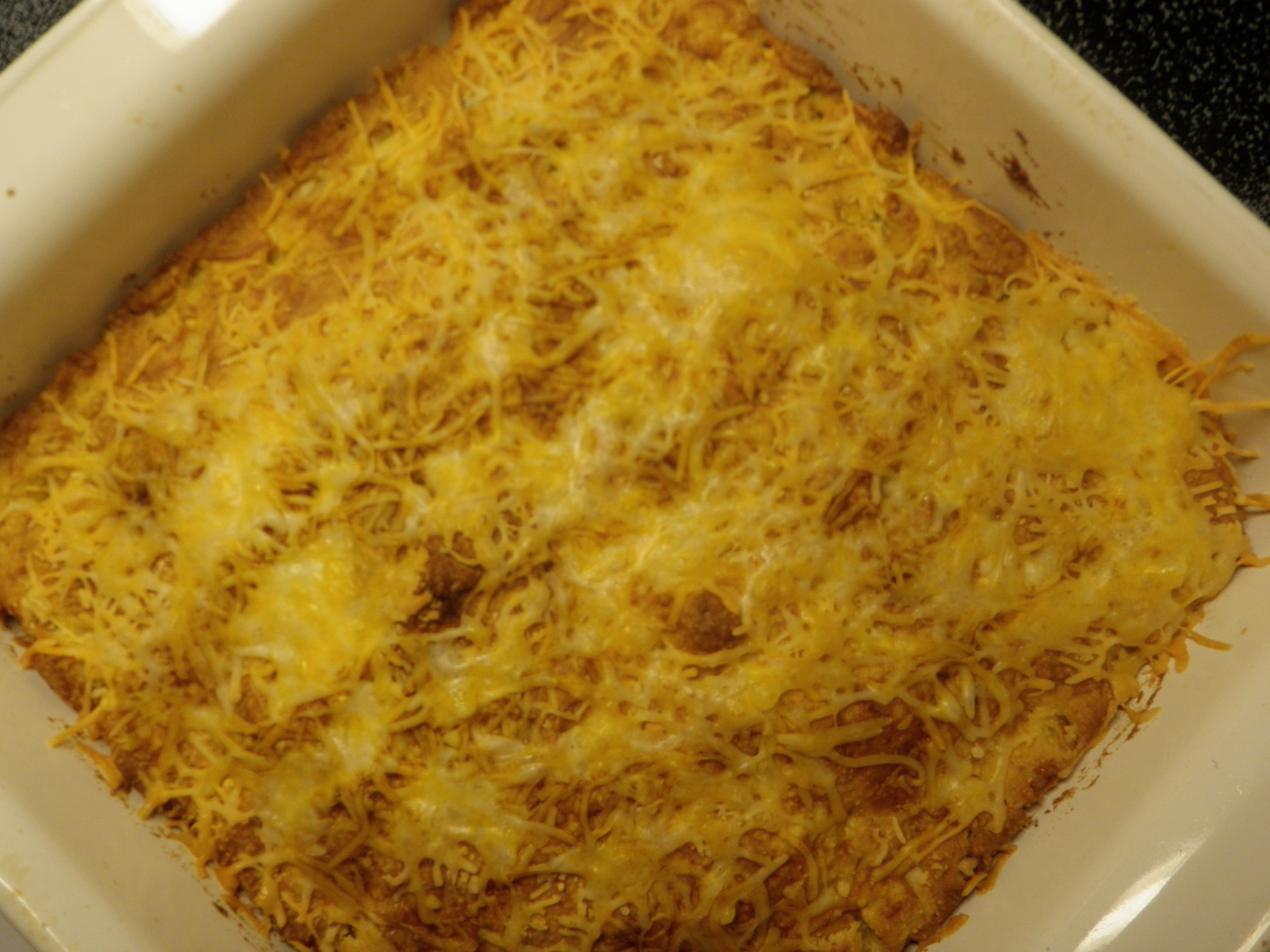
Mexican Cornbread

The day after Thanksgiving this year, I spent a wonderful day with a new friend…who couldn’t stop talking about this spicy Mexican cornbread that a work colleague is always bringing to him. The colleague finally shared the recipe, but my friend had never baked anything from scratch before; he had most of the ingredients, and some interesting interpretations of the measurements and proportions, but here’s how it all turned out:

Ingredients

  • Dry Ingredients: Jiffy Mix + All Purpose Flour

    2 regular (8.5 oz) boxes of Jiffy Corn Muffin Mix

  • 1 cup all-purpose flour
  • 1 cup of milk (1/3 for each box of muffin mix and 1/3 for the cup of flour)
  • 2 cans of whole kernel corn, drained
  • 1/4 – 1/2 cup diced jalapeños–we used sliced pickled jalapeño
  • 2 cups shredded cheese, divided into 1-cup piles–we used Mexican blend
  • hot pepper sauce to taste
  • 1 t salt
  • 2 t pepper

Instructions

  1. Dry + Chunky Ingredients

    Place two 8×8 baking dishes (glass or porcelain, not metal) into a 350 degree oven to warm up.

  2. In a large mixing bowl, dump all of the ingredients, reserving 1 cup of the shredded cheese for topping. Mix well with a spoon (we learned the hard way that a whisk makes this task harder than it needs to be).
  3. Remove hot baking dishes carefully and butter or spray fully–all the way up the sides!
  4. Divide the cornbread mixture evenly in the two dishes, smooth out the mixture, and put in the 350-degree oven for 50 minutes.
  5. Top with remaining shredded cheese and splash hot pepper sauce on top–as much or little as desired.
  6. Bake for 10 more minutes.
Dry + Chunky + Wet Ingredients

What you’ll taste is a smooth, sweet, low-level spicy cornbread. The flour helps to smooth out the sometimes grittiness of cornbread and helps it to be more springy like a cake than dense like a brick. The corn is what adds the sweetness to balance the spicy from the hot pepper sauce and the jalapenos.

But even as good as this cornbread is–by itself or as a partner to chili, sausage and cabbage soup, or any ham dinner–the best part of making this Mexican cornbread was helping my friend bake his first dish (we even had to buy baking dishes because he didn’t have any).

Posted in Everyday Musings

Redneck Lessons (or Observations of a City Girl)

So a few months ago, some friends of mine in Kershaw began my official “redneckification,” an official course of study with courses and everything (I usually don’t know I’m in class until I do something unexpected that they think is cool). My curriculum currently consists of 4wheeler riding (mostly), dirt track, gun shows, shooting, and hanging out. To date, my study notes go something like this:

  • Don’t call a shotgun a rifle; you will definitely fail the course…and get to…I mean “have to” repeat the course.
  • A full night of riding requires at minimum two sets of clothes: the ones you’re wearing and ones to change into when you get wet, muddy, or both. Change of shoes optional depending on your personal preference.
  • Drivers (as opposed to passengers like me) will be honest with you and tell you when you need to get off the 4wheeler for safety…or so they can do some really crazy trick.
  • Don’t tease your driver about how muddy he is…or he’ll sit on you and squish the mud all over you too.
  • Cell phones are an essential tool on a ride; not only can you follow the weather and get away from the creek in lighting, you can also upload instant hilarious photos!
  • Girls will take a shower, do their hair and makeup, and want to look cute for the meet-up and photos. By the time the ride is over, no one cares what you look like.
  • Kids have some insane ability to stay awake and keep on riding…into the wee hours of the morning.
  • There are three ways for a passenger to sit: on the back rack (easy while riding, hurts like hell parked), on the back rack with a pillow (little more comfy, but slidey), and in a seat (a little raised up and a little more secure for bumps). In order of preference, I’ll take the pillow, the bare rack, and maybe the seat.
  • Find a way to wear your hair up, not down. When dry, it’s painful to brush out at the end of the night. When wet, you might as well not even try.
  • Goggles may look funny, but trust me when I tell you crying from dust and debris flying in your eyes looks even funnier.
  • Rain just might be the most painful natural event while riding…must be what being stoned (in the biblical sense) feels like. Is there such a thing as rainburn?
  • Take a snack pack…somehow. It’s no fun to be on an 8-hour ride with a hunger headache.
  • Trust your driver…and make sure he knows you do. He’ll tell you when you screw up his driving, and you’ll be thankful even if he’s snarky about it.
  • Ask questions if you don’t know something and want to. And be truly interested in the answer.
  • Your bra can keep your phone safe from getting rain soaked (at least mine can).
  • Mud is good…and best found and played in right after a storm!
  • Don’t play or ride near the creek when there’s lightning.
  • When your driver has to pee, hold on tight cuz he’s gonna stop fast.
  • Learn the basic operations of the 4wheeler; you never know when you’re gonna want/need to stop or move it…even if you’re just the passenger.
  • Ride with a man with a gun; he can shoot the snakes and bad people!
  • Don’t get your fur up when you’re called out. It’s either in jest so you laugh with it, or it’ll save your life so you’re thankful!
  • Snakes are bad. Run ’em over now so they don’t bite you later.
  • Guns fired at night make little fireworks. Get excited and keep shooting for extra credit!
  • The Monday after a great weekend will hurt, especially for a city girl who never gets a chance to get used to riding all the time. Smile through the pain and think of the fabulous time you had earning every bump, bruise, and scrape!
  • Be fearless for yourself and careful of others. You know what you’re willing to risk but you can never know how far the other person will go.
  • I LIKE shooting guns, and I’m not a half bad shot either.
  • Sooner than you think, you’ll see someone flip their 4wheeler; stay calm and let them freak out if they need to.
  • Everyone expects Sunday dinner at Mawmaw and Pawpaw’s house, even if they’re not home. Plan accordingly.
  • Do not expect real mud to come out in the first washing, so don’t dry it ’til you check it.
  • Sometimes you just don’t feel like riding, so you go to dirt track instead.
  • The country is the perfect place to just be quiet…no tv, no talking…just sitting together thinking your own thoughts or better yet, none at all.
  • Food tastes better in the country, even if you cooked it yourself.
  • It’s easiest to pay someone back in shrimp.
  • The ride schedule is always Friday and Saturday night at 7; meet at Joey Tolbert’s unless otherwise posted. Sunday and weekday rides are a bit more casually organized.
  • Sometimes it’s a good thing I ride without my glasses; I can pretend the snakes aren’t there.
  • Definitely…call the 4wheeler a “chariot” and ask your driver to bring it around; guaranteed to get a call and a laugh 🙂
  • The best time to go riding is right after the ladies have a sex toy party…yeehaw!
  • If you improvise a classic redneck solution–such as a trash bag and tape cover when your cooler hinges break–you only get half points for using packing tape instead of duct tape. “My office didn’t have any duct tape” isn’t a valid excuse because you should have had some of your own in the car.
  • The best archery teacher is a 6 year old 🙂
  • A pig takes a long time to cook, so be sure to bring roast oysters, bring your bows and guns, sing songs by the fire to keep from being bored.

I’m sure there are more lessons to be learned; I get a few every time I go up to the country for a weekend! I’ll add them as I learn them…and boy, will I have fun learning them!

Off for a Friday night ride in the creek!

It’s a dirt track night, and I’m melting in the stands. Another hour or so before the sun goes down behind the trees and we can cool off!