A response to Oxford’s World Happiness Report: three “happiness questions” that assume you’re partnered, trusting by default, and flush enough to give — and leave the rest of us out.
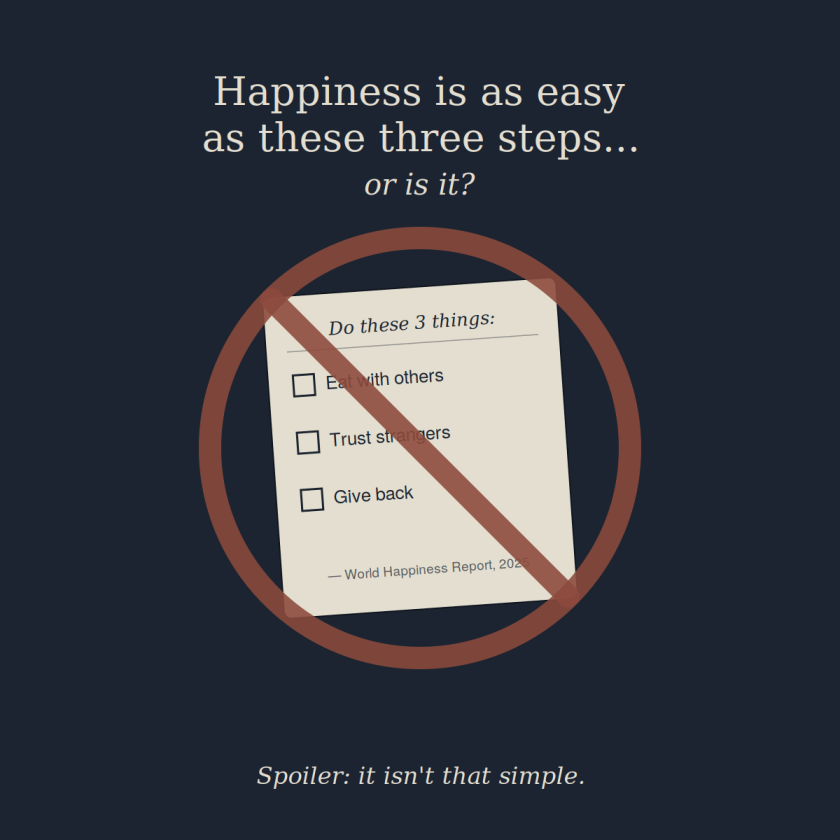
Inc.com ran a piece this week distilling the 2025 World Happiness Report into three questions that supposedly predict life satisfaction better than money or success. Eat meals with other people. Expect strangers to be trustworthy. Do things for other people. Answer yes to all three and, according to Oxford’s data, you’re happier than the people chasing a raise.
I read all three and thought: this is a survey built by and for a very specific person. Partnered. Extroverted by default. Financially stable enough that generosity is a free choice rather than a math problem. Socially trusting because nothing ever taught them otherwise. That’s not most people. It’s certainly not me.
Question one: eat with other people
No.
Eating alone, in public, with no one to coordinate around, is one of the more reliably pleasant parts of my week. The article frames solo meals as a loss — missed connection, missed networking, missed happiness you didn’t know you were leaving on the table. What it doesn’t count is what a shared meal actually costs to produce. Making plans and then having to break them. Working around someone else’s dietary restrictions or medical needs — timing a meal around a dining companion’s diabetes management, for instance, means the food itself becomes a coordination problem before anyone’s taken a bite, because insulin gets dosed against what’s actually delivered, not against what the menu implied it would be. Add in managing conversation, gauging whether the other person’s having a good time, and reading a room while also trying to eat in it.
Then there’s the part the survey has no column for. I’m a recovering anorexic of almost forty years. Eating in front of someone is never just eating. There’s a background process running the entire meal, tracking whether the person across from me is clocking what’s on my plate, whether they think I should have ordered something else, whether they’re doing math about my body while I’m doing math about my body. That process doesn’t turn off because the research says shared meals correlate with happiness. It’s exactly the mechanism the research is asking me to opt back into, framed as self-improvement.
Solo meals aren’t a consolation prize. For a lot of people, they’re the only version of eating that isn’t also a performance.
Question two: expect strangers to be trustworthy
What.
I’m Gen X. Stranger danger wasn’t a suggestion, it was the entire curriculum. Nobody under fifty was raised to assume the person they don’t know is safe by default, and treating that instinct as a happiness deficiency gets the causality backwards. The examples the article reaches for — ride-share, in-home services, marketplace platforms — aren’t evidence that people trust strangers. They’re evidence that an entire economy got built specifically because people don’t. Uber doesn’t run on faith. It runs on ratings, GPS tracking, background checks, and a review layer that exists precisely so nobody has to extend blind trust to anybody. That’s not trust. That’s trust infrastructure, built by companies that understood the default answer was no and monetized closing the gap.
Conflating “I’ll use a platform with five layers of accountability built in” with “I generally expect strangers to be trustworthy” is doing a lot of quiet work in that research question. They’re not the same disposition. One is caution with guardrails. The other is the thing I was specifically trained out of by 1985.
Question three: be kind to others
Here’s where the neurodivergent point comes back around, because it always does: volunteering, donating, and “helping strangers” all assume a baseline of social bandwidth and extroverted engagement that isn’t universal, and treating that baseline as the default path to happiness quietly pathologizes anyone whose brain doesn’t run that way.
But set that aside, because the bigger problem is economic, not psychological. This research keeps getting used as a stand-in for the happiness of the average person at the exact moment the average person is single, in a K-shaped economy, watching the middle class shrink in the rearview mirror. Prices are outrunning inflation. Compensation is lagging behind it, even for people who did everything right and stayed salaried. Benefits are getting trimmed. Pricing structures across housing, insurance, and household costs were built around two incomes and haven’t adjusted for how many people are now running a household on one. “Live within your means” only works if your means hold still. When price keeps outrunning what you’re paid, your means shrink every year — a second job, a side hustle, just to keep living within them. Eventually the means shrink enough that you can’t even afford to move somewhere cheaper. There’s nothing left over for a place where donating feels like an option again.
Telling that person their happiness is one volunteer shift away isn’t wrong because it’s unkind. It’s wrong because it’s not describing their economy.
The gap
Three questions, one implied profile: partnered enough to always have a dinner companion, safe enough in their formative years to default to trust, and flush enough in time or money that generosity is a choice rather than a luxury. Introverts, single people, independent people, and anyone currently underwater just don’t show up in that model — not because they’re less happy, but because the questions were never built to find out.
Fifty, done with organized religion, and finally naming a lifelong pattern of choosing solitude, judgment, and mortality on her own terms. One woman’s case for the crone.
Earlier this week I was talking to my neighbor (F, 25-ish), who is roughly half my age, about what I’ve been watching lately. Vampire Diaries. I’m nearing the end of the series. She lit up — oh, you have to watch Originals next, oh, you have to watch Legacies. I told her I’d already seen both. In fact, I’d seen them first. I watched Legacies before I ever touched Vampire Diaries, got curious about Klaus Mikaelson’s backstory, went to Originals, and only then worked my way back to the beginning. I’ve been going backward through the whole thing on purpose, which is apparently not how anyone else does this.
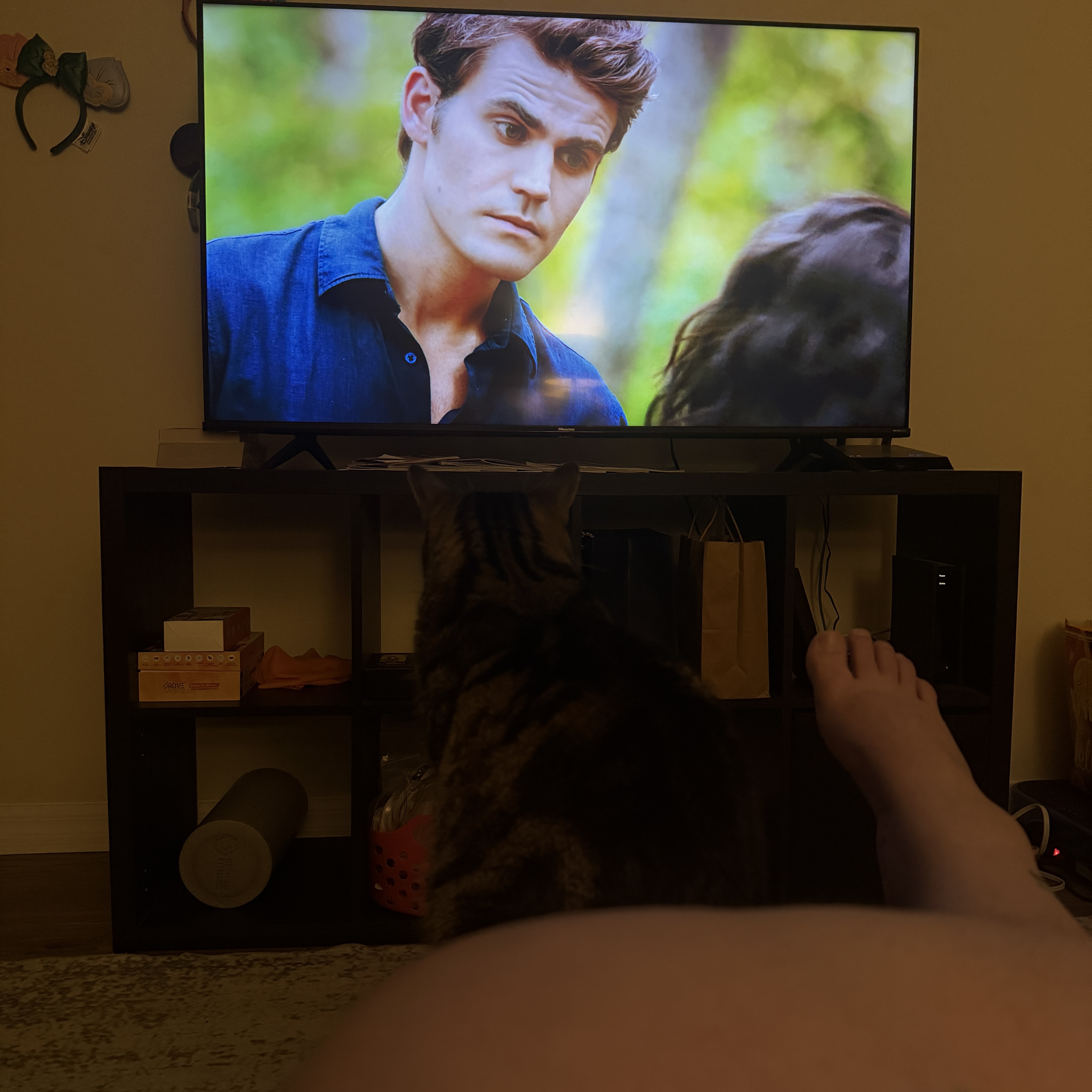
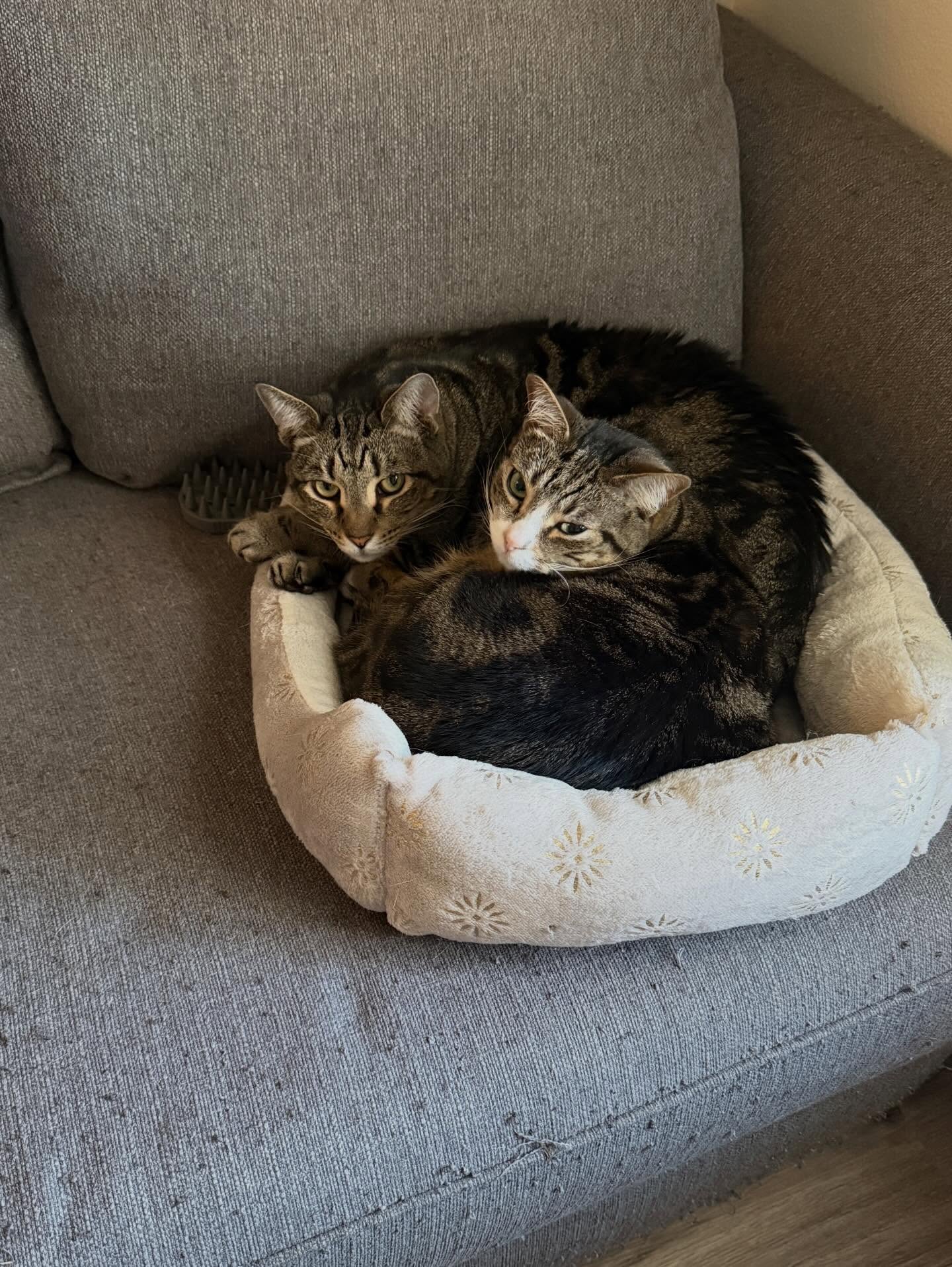
Zoe (on the stool) and me watching a later season episode of Vampire Diaries.
She also asked if I’d seen Gilmore Girls. I told her that one aired a little after my time as a young adult — I was already past the demographic it was written for when it aired. Now I have to go back and watch it anyway, because I’ve spent twenty years watching most of that cast grow up and get better at their craft in other things, and there’s no reason not to close the loop.
None of that is the point. The point is what happened after she left: I sat with the fact that a conversation about teen vampire shows had somehow confirmed something I’d suspected for a while.
I don’t think I’m entering my crone era. I think I’ve been in it since I was much younger, and I only just found the word for it.
What Crone Actually Means
The maiden-mother-crone triad shows up across a lot of pre-Christian and folk traditions as a way of mapping womanhood in thirds, roughly tied to a woman’s relationship with fertility rather than to age or ungendered life experiences. The maiden is beginning — curiosity, discovery, a life not yet spent on anyone else. The mother is the productive middle — creation, caretaking, output, whether that’s children or work or anything else built for others to use.
The crone is the third phase, the one that arrives after the culture stops expecting fertility and production from a woman, and it gets read two very different ways depending on who’s doing the reading.
The unflattering version, the one baked into most fairy tales, treats the crone as used up — a woman past her use, cast off, shriveled, dangerous in a bitter way. The older, more honest version treats her as the one who’s finally free of the expectations that ran her first two-thirds, and dangerous in a completely different way: she has nothing left to prove and nothing left to lose, which means her judgment finally belongs entirely to her. She knows things because she’s outlived the point of performing for anyone. She’s associated with wisdom, with the ability to sit with death without flinching, with cutting straight past politeness to what’s actually true.
That second definition is the one I mean. Not withered. Unmanaged. I’m not describing a phase I’ve entered at fifty. I’m describing a way of operating that the culture doesn’t have a slot for until a woman is old enough that it stops trying to sell her something.
Judgment Is Not for Rent
I read constantly as a kid, which in the capital “S” Southern culture I was raised in meant one thing if you were a girl: you were going to be an English teacher. Not asked. Told. By everyone. I started college in that degree program, got into the program, and hated almost every minute of it — not the literature, the bureaucracy of the K-12 education system. A room full of people who had never met me deciding how I was supposed to think and what I was supposed to do with a skill I already had. I left the systemic education path but continued on exploring language and literature. The teaching I did in higher education and the teaching I do now in business, much later and in a completely different form, is mine.
There’s an older, heavier version of that same expectation that follows a lot of women: you are the eldest daughter, so you will be the one who manages your aging parents, financially and otherwise, no matter what that costs you. I’m not going to get into the specifics of that one here. What I’ll say is that I looked at what was actually being asked of me, weighed it honestly, and said no. That decision cost me a relationship a lot of people would have kept out of obligation. I don’t regret it.
Somewhere in between those two things sits something much smaller and much more physical. A few months after I turned fifty this year, I stopped shaving. Legs, underarms, all of it. I’d already been drifting that direction for a decade — weekly, then biweekly, then monthly — but this year I just decided to stop doing it at all. The hair grew in sparser than I expected and softer than I expected. I don’t feel it unless the wind picks up. I’m not making a statement when I shower. I’ve just stopped thinking about it, which might be the most honest measure of how little it ever mattered to me in the first place.
Even punishment when I was a kid came with an expectation attached, and I never met it. Getting grounded is supposed to feel like a loss — kids are supposed to want to run around and make noise and messes, want the TV, want the phone, and sulk when all of that gets taken away. Instead, grounding meant a closed door and permission to read in silence for as long as I wanted. When they took the phone away too, it barely registered.
None of these three things are the same size. But they’re the same shape. Somebody hands me an expectation with their confidence attached to it, and I check whether it actually serves me before I put it on.
Trusty Old Reruns
The shows and movies I go back to on purpose have a pattern I hadn’t clocked until I said it out loud: Big Bang Theory. Charmed. The old Roseanne, before the reboot muddied it. Hackers, from back when being a teenage computer expert on dial-up was genuinely disruptive. Goonies, because I had that exact childhood — a pack of kids building forts in the marsh behind our neighborhood and disappearing into our own version of an adventure nobody adult had sanctioned. Fast and Furious. Pitch Perfect. Harry Potter and the unfinished Fantastic Beasts run.
What ties them together isn’t nostalgia for its own sake. It’s that almost all of them center people who are marginalized, odd, or building something outside the system they were handed — witches, hackers, outsiders, a family that doesn’t look like the sitcom standard — and I go back to spend more time with them on purpose. Watching a show out of publication order, it turns out, was just a streaming algorithm doing its job. Rewatching is the actual habit, and it’s not about knowing what happens next. It’s about choosing, deliberately, whose company I want to keep for a few more hours.
I’d rather stay in on a weekend night in pajamas with a rerun with a predictable story arc and ending than go out for the sake of going out.
I know that reads as introverted at best and neurodivergent at worst to some people.
I’m fine with both readings.
The Church I Was Handed Back
Part of why this has been on my mind this particular week: the drag performer Jinkx Monsoon made news arguing that children shouldn’t be raised inside a single religion at all — that they should be left alone to explore belief once they’re old enough to actually choose it, with real consent, instead of having a faith installed before they’re capable of agreeing to it. The word doing the work there is “consent.” Every infant baptism, every confirmation, every first communion is a parent deciding what’s right and then installing it in a child who has no vote. That’s not a technicality. It’s the actual mechanism.
I’ve watched this play out at both extremes. One person close to me was raised Catholic, later questioned her gender identity in a way the church wouldn’t accept, and was rejected outright for it — a door closed permanently over something she didn’t choose and the church refused to make room for. Someone else I know spent years questioning his own gender identity and left religion early in life partly because of it, then later in life settled into a more traditional identity, got married, got baptized, and now practices comfortably. I’m not saying either path is wrong, or that you can’t leave and come back. What unsettles me is the size of the gap between those two outcomes and the question sitting underneath it: is a return to religion, at that point, a genuine belief, or is it the price of being accepted somewhere? “Acceptable” and “true” aren’t the same word, and I don’t think organized religion has ever reliably known the difference between them, especially not with children too young to ask the question themselves.
There’s one expectation I left out above because it’s bigger than the others and it deserves its own room: I was raised in the church, and I don’t practice any religion now. For clarity, I define “religion” as a systemic and observable set of rituals and doctrines accepted as fundamental to identifying as a [name of the religion or religious sect]. Religion is not limited to Judeo-Christian options or even to theistic options.
I was baptized as an infant into the Evangelical Lutheran Church in America, and raised in one of the oldest continuously operating Lutheran congregations in the country, in Charleston. My mother’s family were Southern Baptist for generations before a family friend brought her to that Lutheran church instead, and it stuck hard enough that it became the church she was married in and the one she raised us in. My father, Southern Baptist by birth, never practiced anything in my lifetime; in him I have a model for agnosticism sitting across the dinner table from me my whole childhood, and he’s a perfectly good person. I was born on October 31, which is Reformation Day — the anniversary of Martin Luther nailing his complaints to a church door in 1517 and launching the protestant reformation that would result in the establishment of the Lutheran church — and my mother took that as confirmation, literally, that she’d picked the right religion.
So I was raised to be Lutheran the way most kids raised in liturgical traditions are: infant baptism, Sunday school, no vote in the matter. In ninth grade I ran a small project, half school assignment and half genuine curiosity, visiting other kids’ churches and talking to their families about what they believed and why. That was the beginning of treating religion as something to investigate rather than something to inherit, though I didn’t have that language for it yet. And it’s a key reason that after confirmation, instead of continuing on into high school Sunday School and the youth group, I joined the choir instead — a small, quiet redirection that in hindsight was the first step out the door rather than further in.
College made it even more obvious. I went to a Lutheran college, one my home church had helped found, in a town built around it. I stopped going to church entirely. Not the weekly campus chapel, not a local church, nothing. I came back to church four years later while in my first bought of graduate school; again I joined a choir in a church I chose myself, and reconstructed years later how much of that was actually about the music. The second time I went through graduate school at that same university, I didn’t go back to church at all, for three years, and nothing about my life felt unfinished.
When I moved to New York, church became a way to build a social life in a city where I knew no one, and it worked, mostly through the choir again — the friends I made there were fellow paid singers, not members of the congregation. I even served on the church council and substituted as worship leader and sermonizer twice. I was good at it. The service is so patterned it’s easy to run once you know it. I can still recite the entire liturgy from memory. I can sing the cantering without opening the book. That’s pattern, not faith. Being good at leading it and finding it meaningful turned out to be two completely separate things, and I knew that even while I was up there doing it well.
The clearest moment came when I moved back to South Carolina to help with my parents and was expected to return to the church I grew up in. I couldn’t. Not because of doctrine — because of identity. To that congregation, I wasn’t a person; I was Marsha’s daughter, expected to be a younger copy of my mother. At a women’s retreat, someone called out that they needed Marsha’s daughter to come lead a song. I stood up and walked out. That was the hard stop. The next time I went to church, I had found two workable substitutes after that: a paid singing position at a Presbyterian church, which was a job, and membership somewhere large and casual enough that no one would ever ask me to lead anything or know who my mother was. Both let me be present without being claimed.
Then in 2020 I moved during COVID, and church simply stopped. No congregation to return to or establish a connection with, easy livestreams to half-watch instead of attend, and once that habit of engagement broke, it never came back. Two more moves came and went — a couple of visits in North Carolina, none at all in Virginia — and by the time I landed in Florida I was watching family navigate their own version of this: they’d left one church over its stance on nontraditional life choices and found a Lutheran congregation that welcomed the same people fully, in membership and in leadership, which mattered enough to them to make the switch. I went with them occasionally, filled in as the responsible adult getting the kids to church when their parents traveled, and enjoyed all of it exactly as much as you’d enjoy a pleasant, low-stakes social occasion. When those same kids, no longer needing the Lutheran church’s acceptance, drifted back toward the Catholic church that had pushed them out in the first place, I didn’t go with them. By 2025 I was telling my family plainly that I was done with church, even for the occasions they considered significant. My local family has accepted my choice.
What replaced it started around my fiftieth birthday in 2025. My birthday, that same October 31st my mother once read as proof of her own correct choice, is also Samhain — a pre-Christian holiday marking the turn toward the dark half of the year. I don’t celebrate it. I don’t ritualize it. But sometime around turning fifty I started taking seriously an idea I’d been circling for years: that the word “magic” and the word “faith” describe the same thing, and the only difference is which one your culture has agreed to protect.
Consider this example: Rose quartz is supposed to open you up to love, and I can’t prove how, scientifically, and that gets called magic. Wine and a piece of bread are supposed to become the actual body and blood of a man who never handed either out at a table for people to eat, literally or otherwise, and that gets called faith.
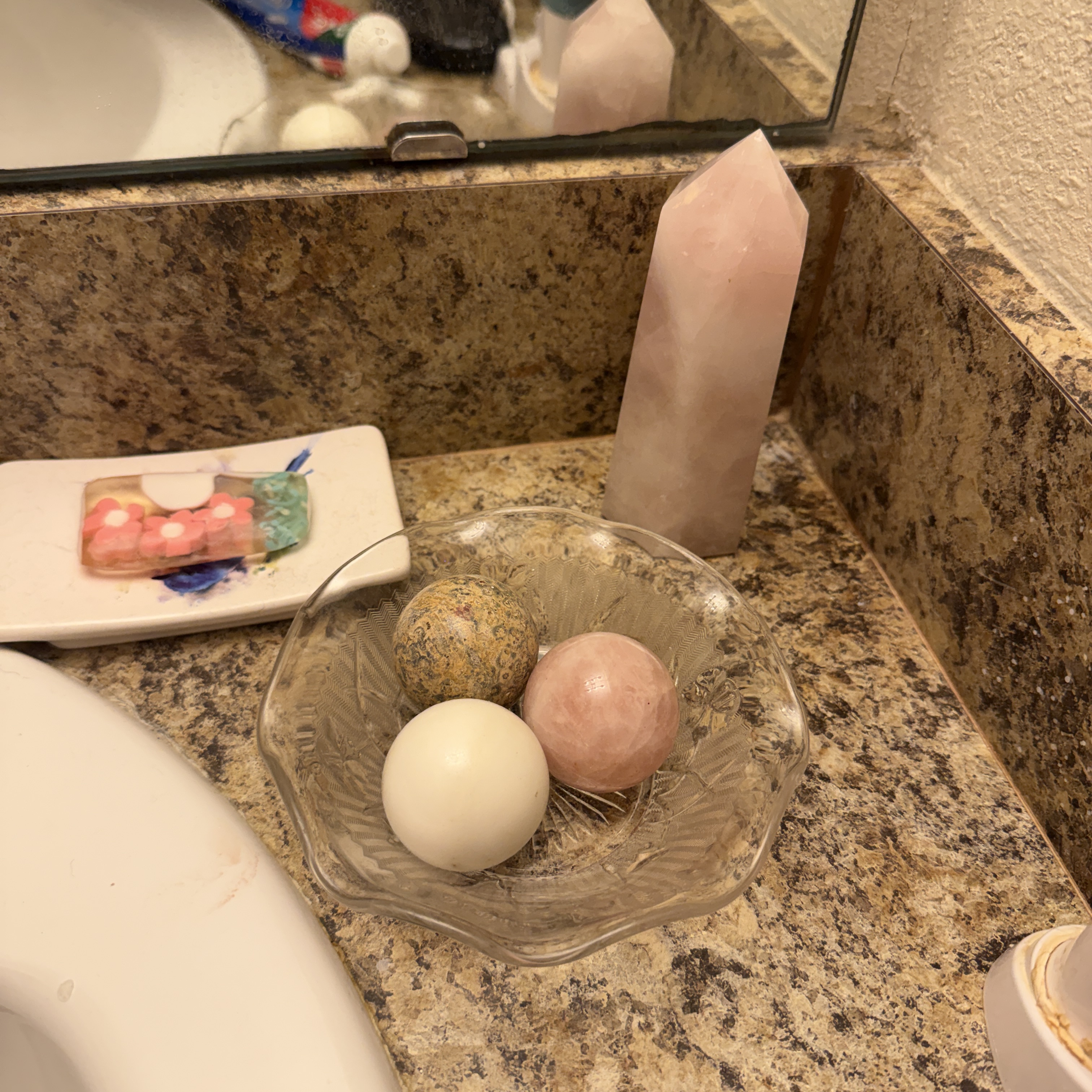
The rose quartz tower and rose quartz, white jasper, and ocean jasper spheres I have in my bathroom to help me start my day with love.
Both are claims about the unseen that nobody can produce evidence for. One of those claims used to get women burned. I’ve never been able to unsee that asymmetry once I saw it, and I have no patience left for a culture that spends December insisting one specific unprovable belief is the reason for the season while treating every other unprovable belief as a threat.
I used to think this started in the last year or two. Looking back at the ninth-grade project, I think it started closer to age fourteen or fifteen.
Domestic, Witchy, Wild — Same Thing
This year I expanded from quick refrigerator pickling, which is really just a fast infusion, into actual heat-processed canning/pickling and fermentation. Shelf-stable, not quick-fix. Partly that’s for its own sake. Mostly it’s practice — I’m preparing for a more frontier-oriented life in Alaska, where the growing season is short and intense and everything after it depends on what you preserved while you had the chance. But sometimes I find myself self-identifying as “the witch in the woods” when I’m doing things like this.
I don’t draw much of a line between domestic, witchy, wild woman, and frontier woman.
People sometimes hear “domestic” and picture a fifties housewife with her makeup on before her husband wakes up. That’s not it, and it’s not close. What I mean is something more basic: paying attention to the physical world around you, understanding what it offers, and bringing it into your house and your daily life instead of outsourcing all of it to a supply chain.
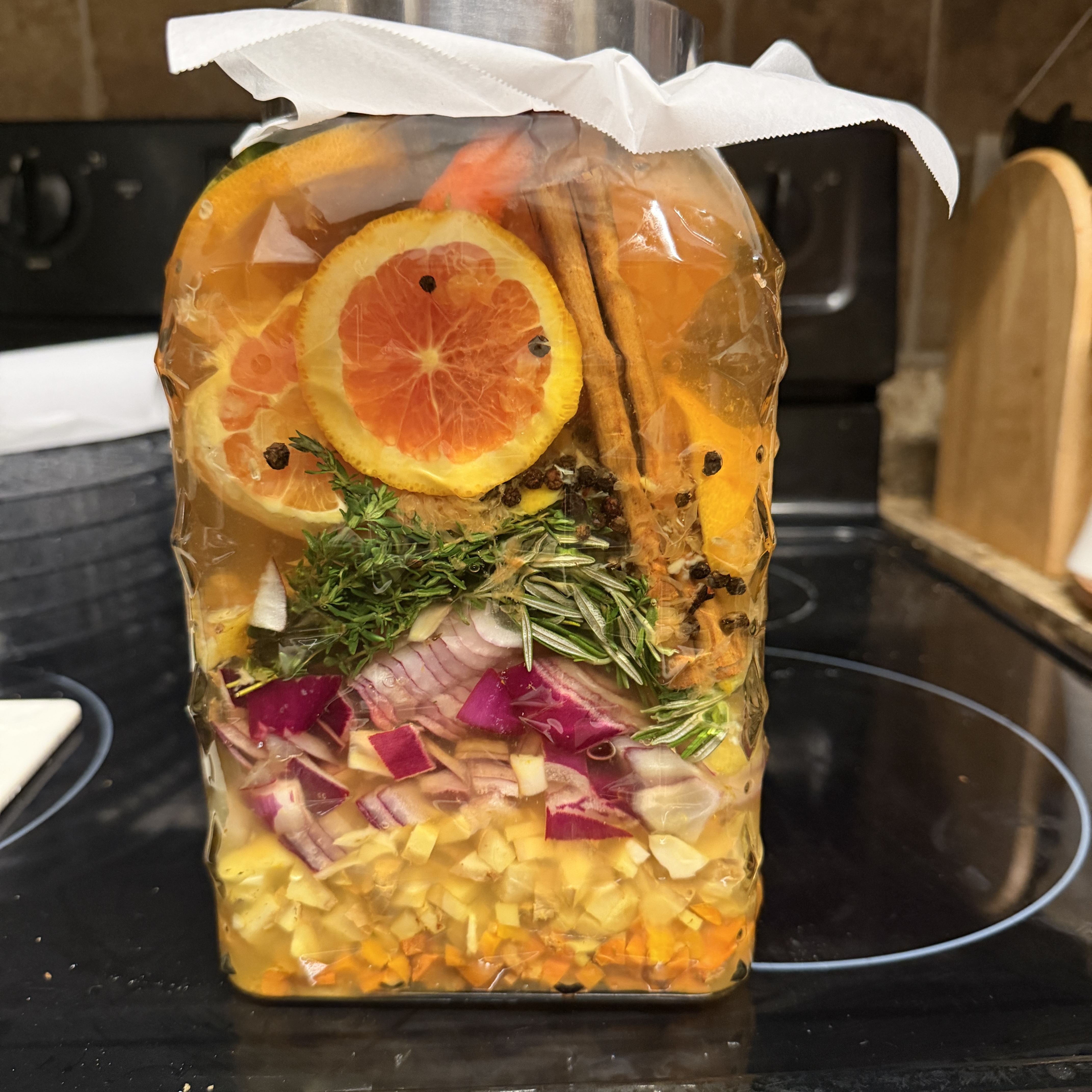
This week I made fire cider for the first time — the kind of thing that sits exactly at the intersection of all four of those words. It’s a folk remedy, it’s fermented, it’s built from what you have on hand rather than what a store sells you, and it assumes you’d rather understand how to take care of yourself than default to someone else’s version of the answer. It fit into the same week as a jar of something else preserving on the counter, which is more or less how my kitchen runs now.
Fire cider made 9/5/2026: tumeric, ginger, garlic, red onion, rosemary, thyme, lemons, oranges, cinnamon sticks, black peppercorns, whole cloves, apple cider vinegar.
The Ending Is a Fact, Not a Crisis
Here’s the part that actually convinced me the crone era isn’t a 2026 development.
In 2000, my grandfather was in a coma. The adult members of the family took shifts sitting with him. Eventually the hospital raised the question of turning off life support, and the decision landed on my grandmother, who couldn’t make it. It passed to her two daughters, who couldn’t agree with each other. As the oldest grandchild, it would have come to me next. When I understood where things stood, I said it plainly: if the decision comes to me, I will turn the machines off. His life was over. Keeping the equipment running past that point wasn’t kindness. It was practical, humane, financially sane, and true, all at the same time.
I’ve since told other people, in other families, that I’ll be that person for them too — the one who says the sentence out loud when everyone else is too tangled in their own grief or love or guilt to say it. That’s not coldness. It’s that I don’t carry the same emotional fog most people carry around death, so I can see the decision clearly enough to make it.
This week alone, Dolly Parton died, Tim Curry died, and Gloria Steinem died, all in their eighties or nineties, and the reaction online was somewhere between shock and outrage, as if any of that should have been avoidable. It wasn’t. Bodies end. Most of what we call medicine is organized around postponing that fact indefinitely, which is, by definition, insane — doing the same thing repeatedly and expecting a different outcome, when the outcome has never once been different for anyone. The mind isn’t bound by that. Whatever people mean when they talk about someone’s spirit or their work outliving them, that part isn’t made of the tissue that’s going to fail. The body is a different category, and I’ve never had trouble telling the two apart.
I have benchmark ages where I stop and take stock of where I am — not to fix a number for my own death, but to check whether I’m still living the life I actually want. The next check-in is sixty, a little over nine years out. Between now and then, the job is to make sure that when I get there, I can genuinely be at peace with however much closer I am to the end. That’s not morbid. It’s the only planning that’s ever made sense to me.
The maiden-mother-crone framework predates the religion I was handed at birth by a long way. So does the version of me that walked out of a women’s retreat rather than answer to my mother’s name, that had already decided to turn off a machine when two grown women couldn’t, that decided a rose quartz and a communion wafer are making the same unprovable claim and only one of them gets protected. I didn’t arrive at any of this in 2026. I just spent forty-nine years assuming it needed a better explanation than the one I already had. It didn’t. It needed a name, and the name is crone — not a phase I’ve entered, but the thing I was doing the whole time, before anyone had agreed to let me do it.
In late October 2021, I lost Shadow suddenly to cardiac arrest. For the first time in fifteen years, I had no cat in my house at all. I didn’t know how long I’d need before I was ready to look again — it turned out to be about a week.
I logged onto the Orange County Animal Shelter’s website, where they post photos of the cats available. I was specifically looking for an adult — didn’t need to be a senior, just not another kitten. My first three cats, Miles, Angel, and Shadow, had all come to me as brand-new babies, and after having Shadow as a solo cat for so long, with a rhythm I’d come to love, I was only thinking about bringing home one more.
That’s when I saw him: a cat named Richard. Of all the names you could give a cat, Richard stood out. I had no real commitment to adopting that day — I just thought, why not go meet him?
So my niece and I drove over. When I told the shelter staff I’d come to meet Richard, they seemed surprised and a little excited, though I didn’t understand why yet. In the meet-and-greet room, I noticed — just barely, in the back of my mind — that there were two cats in the little holding cage.
They brought out Richard first. He was standoffish. Not scared, not aggressive — just reserved. Behind him in the cage, I could see another cat pacing, watching, active.
As we were getting ready to put Richard back, I asked some questions, and the man helping us said: “This is Zoe. Richard’s part of a bonded pair. So far we only have applications on Richard — we hold bonded pairs for forty-eight hours to see if anyone wants both.”
I’d never heard the term bonded pair before. He explained: cats who become so emotionally attached that separating them changes their behavior — they can act out, decline quickly, even get sick and die from the separation of the bond.
That sounded significant. So I said, let’s meet Zoe. If Zoe and I click too, then it’s fine.
Zoe came out and was an instant love bug — she’d never met a stranger, hugging on me the way Shadow used to. I thought, no big deal, I’ll take them both. Because I was willing, I brought them both home that same day.
While I was still at the shelter, I learned something else. Richard had been at that shelter once before, as a kitten, and they still had his old intake record — including a birthday: October 31st. My birthday. They don’t do rigorous verification on a kitten’s exact birth date, but it was close enough.
Zoe didn’t have an original record like his, so nobody knew her real birthday. But since they’d always been brought in together, and had been surrendered a week before October 31st, the shelter had simply given her the same date on her paperwork. Another October 31st.
The story behind why they’d come back to the shelter as adults was simple and sad: their owner had died. Neighbors across the street took the cats in temporarily while the family came to settle things, and when no one in the family wanted them, the neighbors surrendered them.
Between the name, the bonded pair, and two cats who — one way or another — shared my birthday, it felt like too many signs to ignore. It was just easy.
The shelter adopted both of them out to me for the price of one, sent us home with food and toys, and I loaded two very unhappy, crying cats into carriers for the thirty-to-forty-five-minute drive home. One of them — probably Zoe, who still gets carsick from stress — pooped in the carrier. I filmed the unboxing when we got home, so somewhere I still have that first footage of the two of them, fresh out of their boxes, becoming part of my life.
The First Eighteen Months
Coming home that first day, it was easy to assume the roles: Richard, a giant twenty-pound (slightly overweight, but not really) boy, must be the dominant one. Zoe, a teeny seven or eight pounds and still kittenish enough that I wondered if her age had been overestimated to match his, must be the follower.
Eighteen months in, I understood it was the opposite. Zoe was the one taking care of Richard. Zoe had adopted him.
During that first year and a half, I started paying close attention to Richard’s behavior — even posting some of it on Facebook at the time — because I came to believe it told a story. Not one of active abuse, but of neglect and isolation.
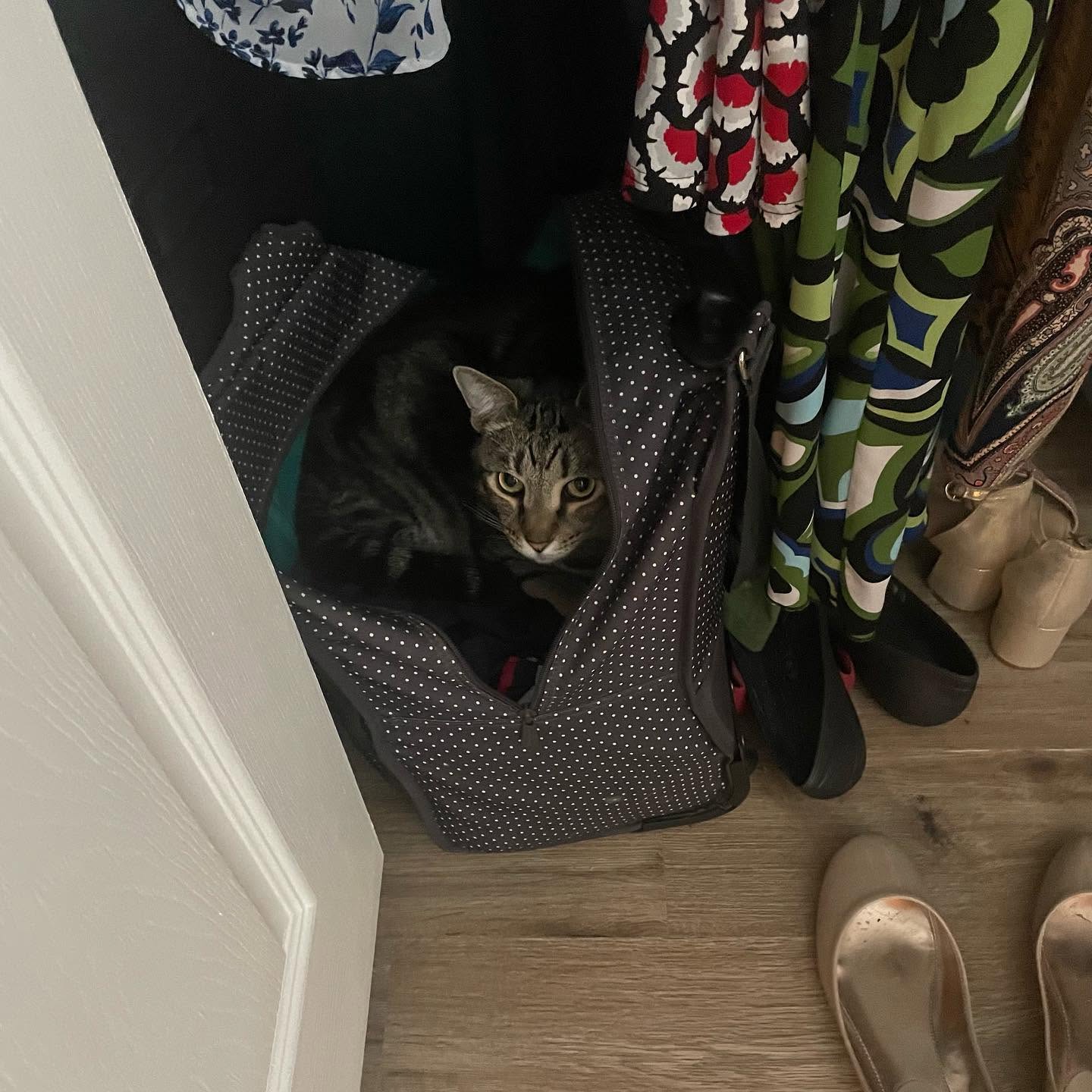
There was a clear line between his daylight self and his nighttime self. During daylight hours, I’d find him in one of three places. If he needed to fully disappear, he went to the bottom shelf of my closet, tucked behind and underneath my hanging shirts where he couldn’t be seen. He wasn’t cowering there — he’d curl up and actually sleep.
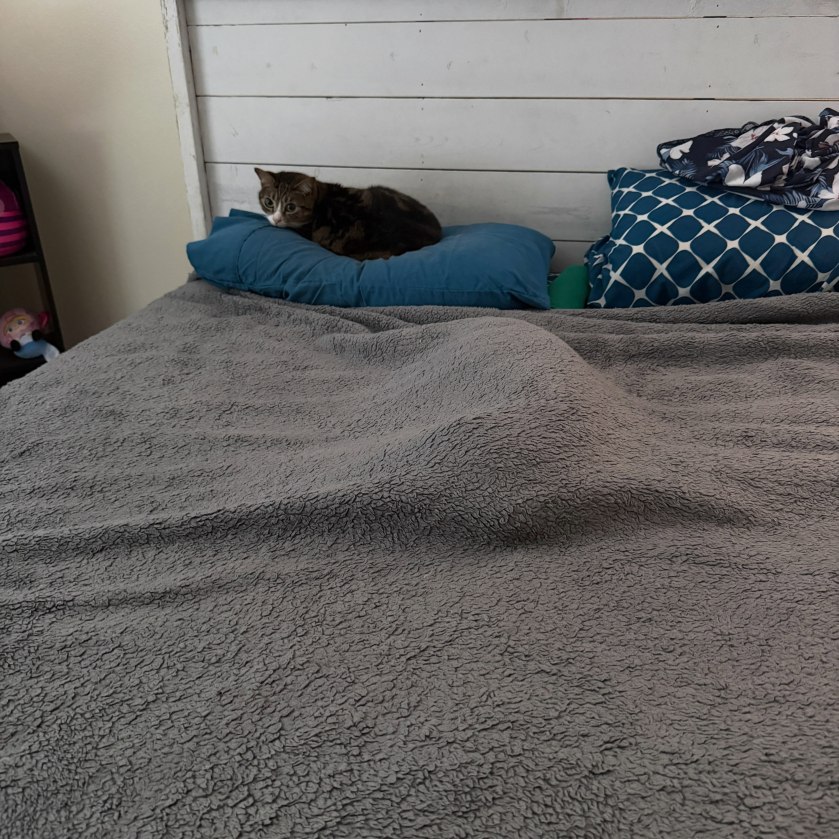
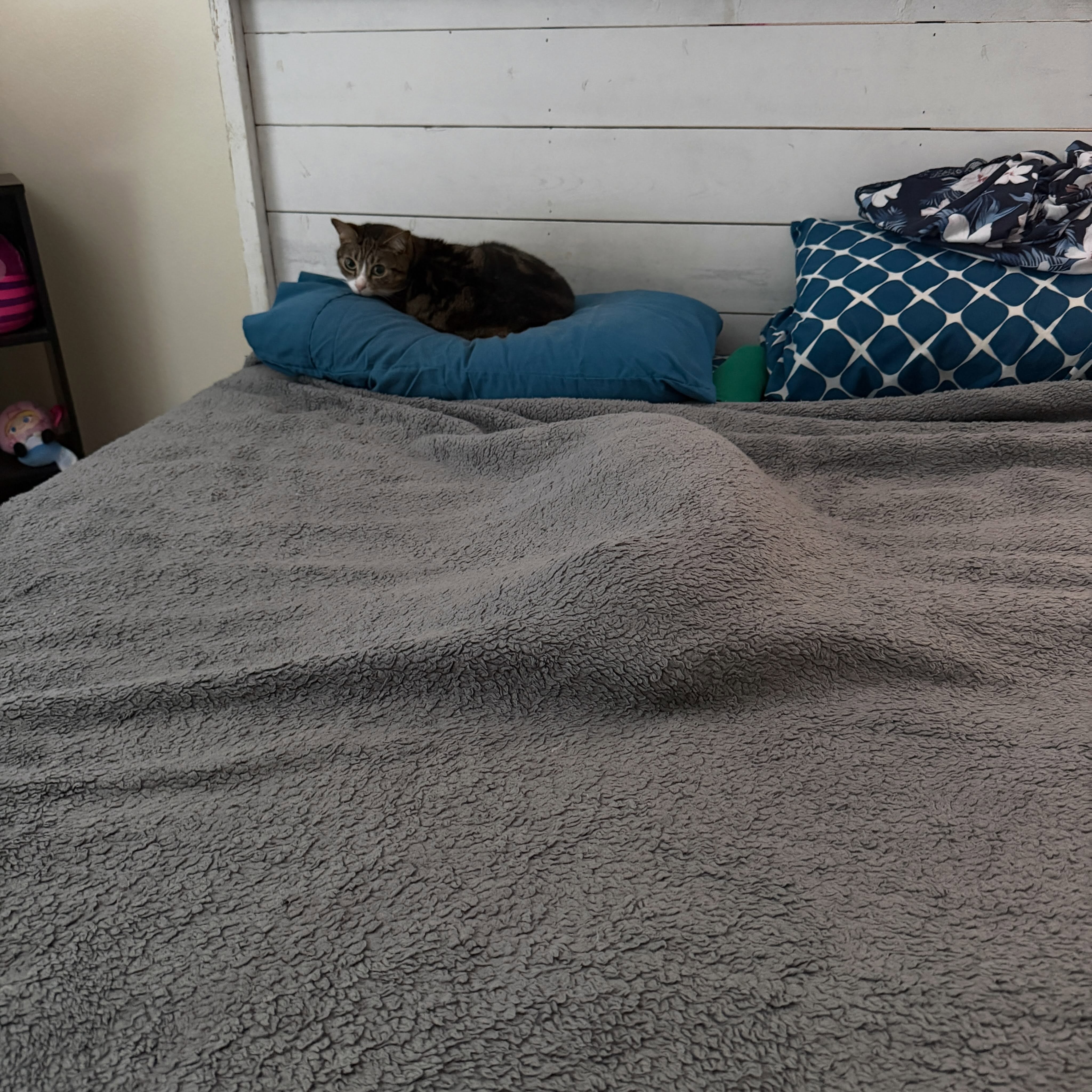
When he felt a little braver, he’d wedge himself between the top blanket and the top sheet of my bed. I called him “the lump in the bed.” That became his standing afternoon routine — reliably there between about one and five o’clock. But once it hit five, especially once winter made it dark by then, he’d start to emerge.
His third spot was the bathroom — the darkest room in the house. He wasn’t squeezed behind the toilet or hiding in a cabinet. He’d just lie out in the open, on the rug, in the dark. That one always read to me as isolation rather than simple hiding — like he might once have been shut away somewhere dark and alone.
Zoe never did any of this. She was always visible — on the pillow if she slept on the bed, on top of everything if she slept on the sofa. The only time she ever got under the covers was to snuggle next to me once I’d already covered up myself.
My guess is that Richard had spent real time as a solo cat, and this was how he’d learned to cope with the loneliness.
Learning to Trust
It took about eighteen months for Richard to fully come out of his shell — and the first real sign of him accepting me came around the six-month mark.
It always happened at night, in the dark, while I was asleep — sometime around two or three in the morning, based on the couple of times I woke enough to notice. However I was lying, he’d come and snuggle against my back. He still wasn’t ready to be touched or played with on demand; he wanted to control the interaction. But he chose to be there, against my back, in the dark hours before sunrise, and I loved it.
A few months after that came a rarer, second stage — maybe a couple of times a year, I’d wake up and find him curled against my front instead, right against my torso and arms, close enough that all I had to do was twitch my fingers to start petting him. That was one of my favorite ways to wake up.
Toward the very end, as he got sicker, that spot against my torso became something he asked for as soon as I got into bed each night — sometimes for twenty minutes, sometimes thirty or forty. One of the last nights, he stayed there a long time, wanting those pets.
Around eighteen months in, he also started joining me on the loveseat where I spend my evenings — my dinner spot, my TV spot. He’d jump up onto the open seat beside me and curl up to sleep. He wouldn’t want to be touched, tolerating maybe a couple of pets after he’d settled, but mostly he just wanted to be near me on his own terms. That became part of our routine, and it eventually grew into him actively asking for affection.
That asking evolved over time, too. First it was just sitting and staring at me. Later, a light paw tap on my arm — no claws, just a signal. Eventually it became headbutts, sometimes paired with a gentle reach-and-grab with his claws to pull my arm toward him.
The Butt Pats
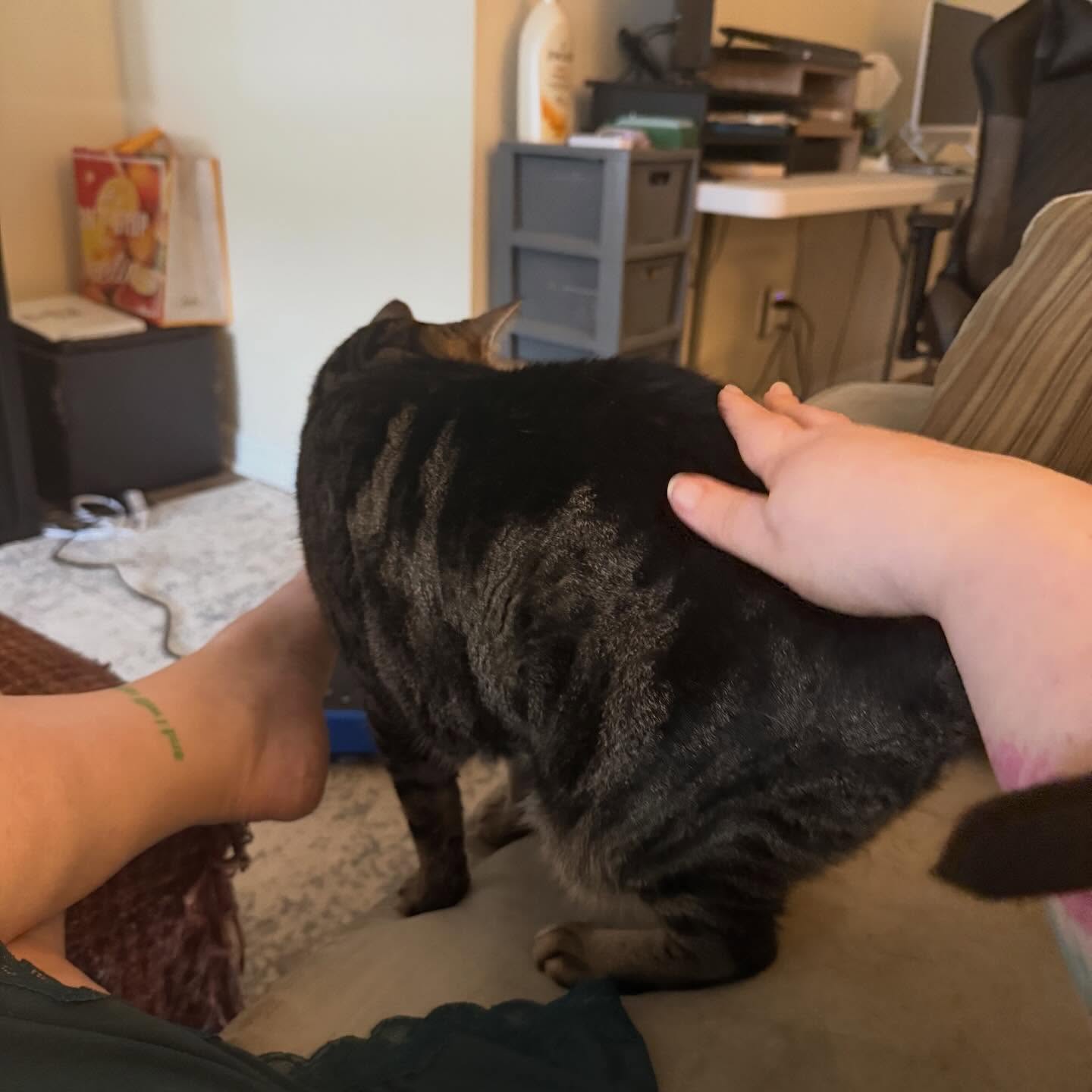
Richard loved having his butt patted — that dopamine hit cats get — more than almost anything else, and it always came bundled with another ritual: smelling my feet and legs to check where I’d been.
If I’d been out of the house, the moment I walked back in, he wanted both: sniffing my feet and shoes to see if I’d been “stepping out on him,” while I patted his butt at the same time. If I’d been gone a long stretch, I’d actually sit down on the floor so he could sniff up my whole legs before he was satisfied.
The same combination showed up in two other regular spots. If I was sitting on the toilet, he expected butt pats while he confirmed my scent around my feet and lower legs — sometimes rolling onto my feet afterward and asking for belly rubs. And on the sofa, the same ritual would turn into him wanting to smell my feet, which meant crossing my legs to bring one foot up close enough for him.
In his last couple of weeks, this became one of the ways I checked in on him throughout the day. I’d lightly tap his butt — if he lifted or moved even a little, I’d keep going. If he didn’t respond at all, I took that as a sign of how much discomfort he was in, and I’d switch to just gentle regular pets instead.
Health
Richard came with a couple of ongoing health issues I managed with the vet over the years. He had a persistent yeast infection in one ear — he both loved and hated the cleanings, hating the liquid and the swab, loving the relief once it was over.
One of his canine teeth was compromised, though it never fully infected. It gave him occasionally terrible breath but never once stopped him from crunching his favorite treats.
The Cat Bed
Any time I was pulling clothes out of my closet or dresser to donate — even freshly washed, straight out of the laundry — I’d find Richard curled up in the box. No matter how many times you wash something, it still smells like you, and he wanted to be in it.
Around the same time, I’d left a couple of empty shipping boxes out after ordering something online — Zoe-sized boxes. I’d put a blanket in one and some packing paper in the other, and Zoe claimed one of them as her sleeping spot. It made me wonder if she’d actually like a proper cat bed, so I picked up a five-dollar one at Five Below, figuring it was cheap enough to try and lose nothing if it didn’t work out.
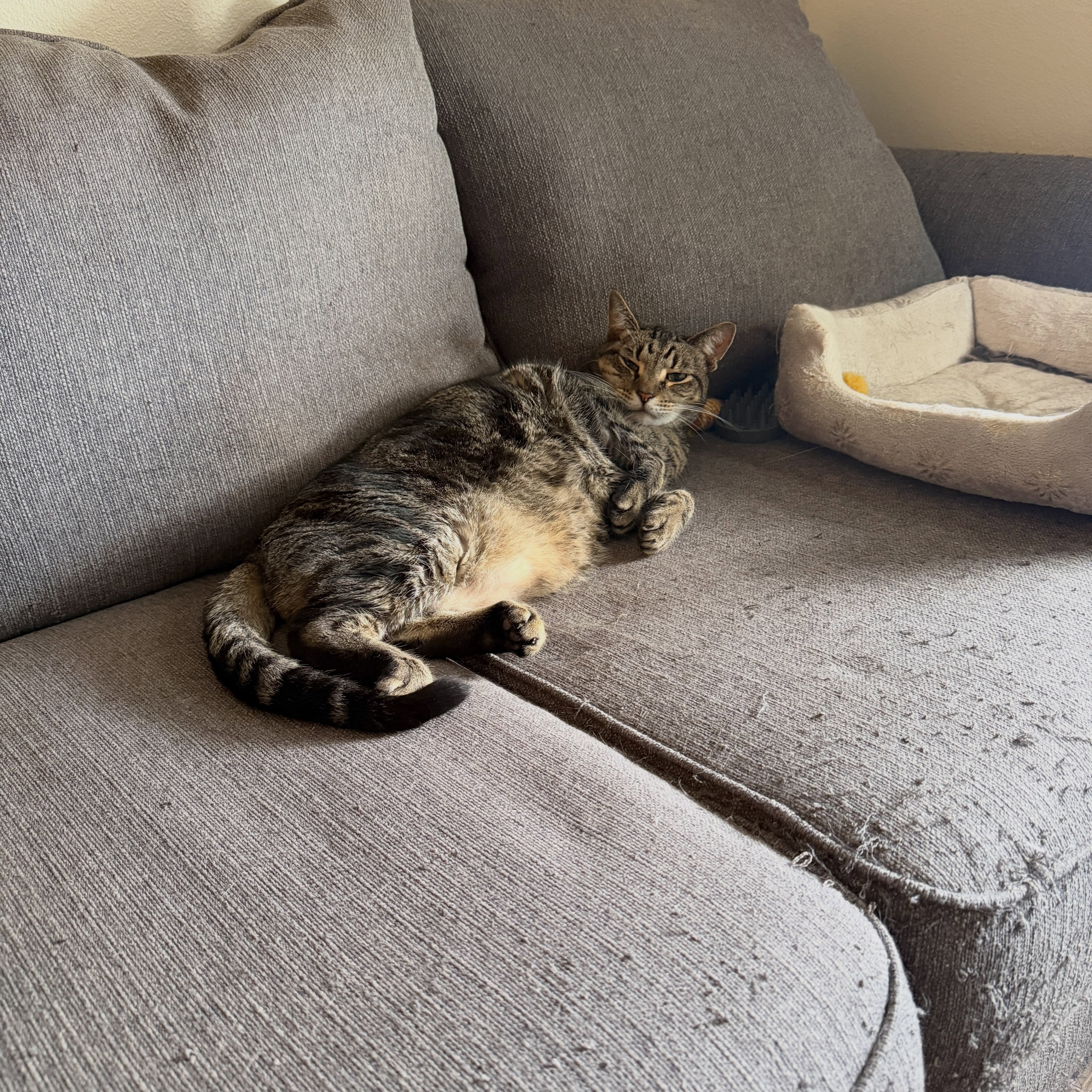
The next thing I knew, Richard was the one in it. A cat who almost never used a clothes box, who preferred sleeping tucked under covers, in a closet, or in the bathroom, had suddenly claimed this small bed I’d bought for Zoe. And then, more often than not, I’d find them both in it together — one of the most adorable things about their bond was how they slept curled up in that little bed side by side.
Since Richard died this week, Zoe hasn’t touched that bed. She hasn’t even gone up on the sofa it sits on — the same sofa where the two of them used to sleep before the bed even existed. It turns out that bed was really his all along, and Zoe was just a guest who dropped in now and then. She’s still got toys scattered through it that Richard never once played with. It’s one more way he surprised me, and one more thing I didn’t expect to learn about him only after he was gone.
Play, Water, and Food
Richard was about three when I adopted him — young enough to still be kittenish, the way Zoe very much was — but he rarely showed it, except every so often when I’d catch him going to town on one of Zoe’s toys. The second a camera came out, though, he’d stop. I have almost no footage of him playing.
The one thing he’d never back down from, even with Zoe around, was rugs. Lift the edge of a rug with a foot or hand, bounce it lightly, and he’d go wild — chasing it, grabbing it, pulling up the edge. We had one long runner rug that, curled up like a tunnel, he’d jet straight into every time.
He loved water in a way that never quite made sense for a cat. Mornings, he’d sometimes climb straight into the shower before I turned it on, and stay there while the water warmed up, as long as the spray didn’t hit him directly. After my shower, he’d get in and lick up the leftover droplets. He’d sit in the kitchen just to listen to the sound of running water while I did dishes — though the moment an actual drop touched him, he was gone. And on Fridays, when I filled the pitcher to water my cat-safe houseplants, he’d come running to watch the water pool on the glass catch-plate underneath and drink it straight from there.
Food was a harder subject by the end, because it was what first told me something was seriously wrong — a day of sudden, repeated vomiting, until he associated eating with getting sick and stopped eating altogether.
But when he was well, he loved seafood without question — salmon, tuna, sushi the moment I opened the container, shrimp most of all (I learned fast to always save him one). He wasn’t especially food-motivated otherwise; that was more Zoe’s department. He did love soft cheeses — American, Havarti, Fontina — in tiny pinched-off bits, and hot dogs, the meat itself rather than the bun Shadow used to beg for.
His Last Three Weeks
There was no warning. On a Tuesday, Richard ate his regular breakfast like any other morning. Then, out of nowhere, he threw up a massive puddle of partially digested food — something I don’t think had ever happened with him before. He went back and ate again. He threw it up again. That was the first signal, and it echoed the exact same first signal my very first cat, Miles, had given me when he first got sick years earlier.
The timing couldn’t have been worse. It was right before the Fourth of July weekend, when vets and animal hospitals are closed. We couldn’t get seen until the Monday after — almost a week from when the vomiting and the not-eating first started.
We limped through that week however we could. We tried churros for the first time, and for about two days it was the one thing that got food into him without it coming back up — until it just stopped working, and he wouldn’t touch another one. Otherwise, he’d lick the juice off his favorite canned foods but leave the food itself untouched. The one time he actually ate some, he threw it up almost immediately. He’d clearly connected eating with getting sick.
When we finally got in and ran diagnostics, we found a massive tumor in his liver. I’d been through something similar before, with Miles — digestive organ compromise, the surgeries, the supplements, the force-feeding pills, the stress on their small bodies — and Miles never got a lovely long life or a real recovery out of that fight. I wasn’t willing to put Richard through that same road for the same likely outcome. I chose supportive, palliative care instead, and my vet was fully on board with that decision.
We came home with supplements and appetite stimulants, and for a couple of days it seemed a little easier. But he never really got back to eating — maybe a tablespoon of his regular dry food once, otherwise just licking the juice from a can. I tried a whole rotation of new brands and flavors, since even the wet foods he’d loved for years weren’t working anymore. He did get back to peeing normally, but in three full weeks, that poor cat only pooped once.
The liver damage was already so advanced that one of his test readings came back higher than the test was even able to measure. We were past any chance of a material recovery.
Still, he rallied a little in the second and third week — coming out more, asking for pets, snuggling again for a bit. Zoe noticed the rally too, but she read it as things going back to normal. She’d kept her distance the whole time he was actively sick, only snuggling with him at night in bed, sensing that he didn’t want to be touched or bothered. But during the rally, she started trying to go back to him, rubbing against him playfully. He yelled at her. He hissed at her once. That’s when I knew he was done.
I made the decision to keep him with me through that final weekend and take him in on the Monday afternoon, on purpose — I didn’t want work as a distraction, I wanted to be fully present. Maybe that was selfish of me. I’m okay with that. I watched him closely those last couple of days. He’d still come up onto the sofa, but he wouldn’t curl up anymore — it wasn’t a comfortable position for him. He wasn’t asking for pets either, because being touched didn’t feel good anymore. He’d just sit and look at me. And I knew that look was him telling me he was ready. It turned out I had the timing exactly right.
His Last Day
That last morning, we got up when it got light out, and he sat in the front window watching the world start its day — people on their morning walks, cars pulling out for work, the sun coming up, the birds and the bugs. He took his usual nap tucked under the covers. We had some sweet, quiet moments together. At one point, he held my hand.
Richard and Zoe are the first cats I’ve had with no overlap with the ones who came before them — no crossover time with Miles, my first cat, or Angel, my second, or Shadow, my third. So that last day, while he slept, I talked to him more than once. I told him to go find Miles, because Miles had gone through this same thing at almost exactly the same age, and Miles would know what he was feeling. I told him to go find Angel, because Angel was so much like Zoe and would want to take care of him, snuggle him, make him feel loved. And I told him to go find Shadow, because Shadow loved being outside in a way Richard never got the chance to safely enjoy, and Shadow would teach him to climb trees.
As the sedative started to take him under, I told him once more: go find Miles. And after the doctor confirmed there was nothing left, in the quiet of that room, I said it to him one final time. I know it was just a reflex, nothing more, but it felt like Richard gasped. I needed him to have that instruction, that connection, so that when he crossed over, there’d be somebody already there waiting for him.
When I got home that night, I put the shirt I’d been wearing that day on the bed, not knowing what Zoe would need. I left his pillowcase and bedding out too, keeping his smell close by for Zoe. She hasn’t seemed troubled by any of it. I think, somehow, she already knew.
Coming Home
Every pet I’ve had before Richard went to communal cremation when they died — I got back a small nose print and paw print stamp, shared with other animals, and that was enough. This time was different.
While we were in the vet’s special room for passings, Richard walked over to a shelf where there were end of life brochures and different urns and boxes. I held them up, one at a time, and Richard looked right at them — and at me — and very clearly signaled the one he wanted by reaching out with a paw and pulling it to him. So this time, I chose individual cremation, with a plaster paw print made just for him.
I picked him up this past Friday, July 24th. He’s home now, urn and paw print both, with me and Zoe. I’ll figure out how I want to display him, and I’ll add a photo here once I do — but for now, he’s just home.
Thirteen years ago (2017), I applied to an MBA program. Now at that time, I already had 3 bachelor degrees, 1 masters degree, and 1 PhD. I was accepted without reservation, but one of the reviewers who knew my dad from a social club told him “she’ll have trouble with the math.”
What?
You see, that reviewer, who funnily enough specialized in the leadership classes of the program, assumed that 2 bachelors degrees in music (yep, not a single digit of math there) and a PhD that was 1/3 logic (nope, no math fundaments there) couldn’t possibly include basic, much less analytical mathematics.
I’d already taken and earned As in graduate level statistics not once but twice by that point. And I was going to have trouble with the math.
I get it. He – yes, it was a he – saw the department names “English,” “Music,” Linguistics,” and “Composition and Rhetoric” and heard only the “school of humanities.” Ahhhh, the old division of arts and sciences, right? Well, I’m the one with a foot in each, successful professionally – yep, paid in both arts and sciences!
Fast forward 13 years, and I’m 9 months into being the CFO for a 3-branch real estate brokerage in a luxury-heavy market. I move millions of dollars each month. And am held accountable for it weekly and monthly through an official review processes. Had a great conversation with our CPA Friday afternoon; she loves me.
I had this moment today – Sunday, August 16, 2020 – where I had a bit of a “take that, jackass” moment. You see, a colleague had asked for help in one of our online forums with explaining a financial outcome in a way the boss would understand.
I hopped on a call, checked the math formulas, matched them up with the company policies, and viola, explanation. And among all of that made a friend, mostly because I offered to figure it out with her, not because I knew the answer.
I spent an hour talking through financials without even having a statement in front of me – mine or hers – for reference.
All of this after being the very first CFO to pass the new CFO approval process for my region – the third most profitable region in the world for my company. All because I could explain the logic behind every single number and math output of the financial statements. Where I move millions of dollars each month.
She’ll have trouble with the math.
I already had 5 degrees. I’d submitted transcripts showing 2 As in statistics already. So what’s left is “she.”
It’s not often that I pay attention to sexism against me. I’ll fight you if I see/hear you apply it to someone else, but I just don’t care enough when it’s directed at me. And then I think of what it might have cost me.
It’s not often that I pay attention to sexism in my dad’s favor. But that’s what happened. I was given a “pass” because my dad is a graduate of the same school, an all-male school when he and the reviewer attended back in the day. I was a “good risk” because I had earned credentials, and I had existing connections with the school.
I’ve been having increasing challenges keeping my cool and reacting in my traditional, normal rationale (if sometimes dispassionate) way to regular and surprise life – noticeably and almost measurably for the past two weeks.
It got so bad that I had to ask for a perspective check this week on how sensitive I was being, as I’d taken a colleague’s question as an attack – that I wasn’t doing my job, or at least that I wasn’t doing it well enough. And this was from a colleague whom I know to be my (second) biggest fan.
And then last night I had a dream that was dark and kept spinning out even after I woke up.
The Dream
I was at a night-time church service. I was sitting with the worship leaders I’d worked with, served with, led worship with for over 9 years. It’s a liturgical service, with the same basic pattern every week.
The pastor leans over to me and asks me to go up to the lectern ahead of my part and do one of the scripture readings. I agree. No worries. I can’t remember the last time an in-service change or “mistake” actually felt like a problem.
I get to the lectern and pick up a hand-held, corded microphone, lean down and extend my finger to mark the beginning of the scripture reading so I can track what I’m doing…
And I can’t read the words. The entire Bible is in wingdings.
I look back at what the bulletin says is the scripture, to make sure I’ve got it right and to hope that the bulletin has the scripture printed (sometimes it does), and the scripture there is also in wingdings. The rest of the bulletin is in regular English, but the verses are in wingdings.
I squint, thinking it’s my eyes. I search my brain for what I remember of the passage, even if I have to paraphrase, and nothing comes to mind. I pray that a hymn verse or some anthem excerpt comes to mind so that I might at least sing a portion of the message.
Nothing.
I have nothing original, nothing scripted to provide support or direction or even a starting point.
And no one helps. No one offers to help. The entire worship team sits silent and waiting behind me. And the congregations sits silent and waiting in front of me.
And in that moment it feels like even God has left me to flounder.
Some Context
I grew up in the high German Lutheran liturgical church of the ELCA and rose to worship leadership quickly after college; I even dabbled in theology classes with the thought of becoming an Associate in Ministry (AIM).
I have served various liturgical churches as a professional singer and worship leader for over 20 years: Lutheran, Anglican, Presbyterian, Episcopal, and Methodist. Only the Catholics have never hired me ;-).
I’ve coached ordained ministers and career church musicians through the nuances of different liturgical services when they’ve filled in for another liturgical denomination.
I’ve trained churches through liturgical worship revisions and re-launches.
Knowing, following, understanding, working within the pattern of worship is kind of my thing. It’s what I would have specialized in as an AIM – worship practice and leadership.
Even beyond that, I think of the times when my choir director calls me as I’m literally driving to a Sunday morning service to tell me that the guest soloist isn’t going to be there and now I’m going to be singing a solo – in a style that doesn’t suit me terribly well – that I’ve never sung or practiced even as a lark – and doing so in about 30 minutes with maybe one run-through. Even that doesn’t phase me.
I’ve completely rewritten children’s sermons on the way to church because something happened on that drive that was even more powerful than what I had planned.
You might say vamping for God is something I do quite well.
So upon my first wake-up at 5:30 am, I turned on my peppermint diffuser, heated up my flax seed pillow, tucked back in with my pillow weighting down my eyes, and went back to sleep – with the objective of turning off those awful thoughts so I could wake up with a clear(er) mind.
And it worked – three hours later I woke to snuggle with Shadow and try hard not to be mad at myself for oversleeping my planned early morning hike before the rain.
Dream Reflection
For me to be so completely stifled, silenced even, is so far out of character, out of reality that as I woke the first time, the film in my mind kept going.
It’s been a really long time – probably a decade or so – since a dream kept going. It’s happened before, yes.
And it was the second wake-up – beginning with such disappointment in myself for not meeting a self-imposed commitment – that started my epiphany.
So here’s where I wound up – in case you’re ready to jump to another blog or head back to Facebook for a baby goat video – the change in interaction, in daily communication with certain people, the loss of feedback in visual/physical methods, these are affecting my personal ability to know that what I’m doing is
enough
valued
productive
helping others
And that last one is the real kicker. Between my 99S (DISC) and responsible, relator, and connectedness strengths (3 of my top 5 CliftonStrengths), that helping others and that what I’m doing is valued by others (useful to) are what’s critical to my ability to keep calm, prioritize and re-prioritize efficiently, to know and have confidence in what I’m doing and that I’m doing it well.
These are the foundational elements of my measure of my own self-worth, self-value. I *need* to know that what I do matters. It never needs to be helpful to me. It’s always about how helpful it is to others. That 99S is a doozy!
You see, the messages I do get are at cross purposes
you have to do this by x date – and “you” is specifically named me by name or by job title
you have to give yourself grace if you can’t get it all done
you still have to meet all of the deadlines, without fail
and you have to take care of yourself
you have to delegate some of this stuff to others
your leverage options are full and you don’t get any more (at least right now)
So the short is that I’m expected – expressly so by others and by extension myself – to do everything and more. And I simply can’t. Yes, there is a point where all things are NOT possible. There are literally not enough minutes in a day even when I work a “normal” 10-hour day.
Add to that the fact that my co-leaders have equally over-full plates. That’s where the not asking comes into play. Why on earth would it be logical for me to add to their plate? To burden them with my job when it’s my responsibility to figure out how to get it all done. They are at least equally as burdened as I am.
And therein lies the opportunity (because by biggest fan hates the word “problem”):
For decades, I’ve been the person who does and usually can say yes and get it done, even when I don’t have to be that person. It’s a natural part of my responsible strength.
I need to become the person who says “not now” and sometimes “no.”
I need to become the person who says “let me figure out how to make that happen” rather than simply assuming the assignment/request myself.
It feels mean. It feels like I’m letting others – and by extension myself – down. It feels like I’m not doing my job – or worse, dumping my job on someone else’s plate. That last is a HUGE piece of the mindset, much bigger than most believe.
And yet it is normal, it is human, and it is necessary. It’s called leverage, and for the person who’s spent decades being the leverage, it’s impossibly hard on a basic level.
How I Connected the The Dream and the Epiphany
So you’re wondering how I got from a wingding Bible to quarantine self-doubt, yeah? It’s a six (or seven) degrees of separation thing, I think:
In a context where I know and feel complete confidence because of my long-term knowledge, experience, and expertise
Asked and agreed to jump in the way I have a million times before – no worries
Failing completely at that last minute request – and especially in a way another expertise (linguistics) would normally have supported me
Recognizing that I’m in a new job not quite 5 full months AND a new role – from leverage to leadership; the job has woefully inadequate training and a high degree of inconsistency across the corporation in how it’s perceived and used
Not having the knowledge and experience long enough to feel confident on a foundational level – as a leader in “normal” times
Feeling not recognized and valued as a leader by others in leadership – specifically being treated as not important in the big discussions and decisions, only in a data entry role
Being deprived of the feedback, conversations necessary for me to know where I and the work I’m doing stand – knowing that I’m succeeding, somehow, in a role where there are very few standards or benchmarks
Is it any wonder I’m suffering from self-doubt in my abilities, in my achievement of success and standards, in my leadership attempts. Heck, I don’t even really know where I’m actually failing because I’m not getting enough of that communication either.
Is it at least 50% my fault? Yes. I have a responsibility to ask for the communication, the feedback, the evaluation, and the help that I need, especially since I’m well conditioned to project a ridiculously high degree of capability.
It’s at least another 20% my fault for, by default, not answering the question “what can I do for you today” with an answer other than “I have what I need from you.” And I give kudos to both my leadership and my staff for asking this. It’s my fault for not thinking about the answer more carefully, or even anticipating it and having things to leverage appropriately.
Oh who am I kidding? It’s 100% my fault for not speaking up and telling the people I’ve trusted to lead me and coach me that I need them to see these things and coach me on them. Push me to acknowledge that I’m doing it again. Stand with me to make better choices. I have to teach them my weaknesses, my challenges, if I’m ever to expect them to help me.
And therein lies the conflict: teaching them this and laying an expectation on them to help me fix my problem is that “burden” that chains the toxic habit to me.
Probably the most important “general” lesson – mantra – that I can take from the quarantine experience is goes something like this:
Bad habits are learned in good times while good habits are learned in bad times.
It’s not quite the right expression of the saying; it is as close as I can get as I’m wrapping up this post. And I’ve written it on my bathroom mirror because there is no day that goes by without me seeing myself in that mirror.
NOTE: these are thoughts in progress, a journey.
Books this reflection has prompted me to reach for include
I really want to give you a history of the term “social distance” as folks are really getting spun up in the nuances, but that’s not what this post is about. It’s about new things I’ve learned about myself in the past week of #socialdistancing.
1) I’m naturally a social distancer.
When you accept that social distance is a term and phenomenon from the early 1900s – when even telephones couldn’t keep anyone other than the very rich connected – it makes a bit more sense to think about the physical space part of this notion.
There have been 7 humans in my personal space – my apartment – since I moved in 3.5 months ago:
the 4 men who moved my stuff in from my moving truck (about 2 hours)
the 2 friends who drove my car up from Charleston as part of my move (about 30 minutes)
the 1 wifi installation tech (about 1 hour)
Me and Shadow, we go out for walks to interact with the world, and keep our space private.
Even at the office, my office is pretty tightly organized, with chairs on the other side of the desk. There’s only one person with express permission to invade my side of my desk, and it’s a teaching/demonstration thing when I invite someone to watch over my shoulder to learn how to do something.
I stop and talk to everyone who walks in, but I do expect them to stay on their side of my desk. It’s a physical distance, not a social distance.
2) I’m a big social sharer – follow me on FB or IG (not so much TW)
Turns out sheltering in place hasn’t slowed that down one bit. If anything, it’s amplified it. I’m here for it.
3) I’m *more* likely to sing over a Zoom than in person – karaoke WIN
Confession time: despite being a paid, professional singer – soloist and chorister – for over 2 decades, I’ve been terrified of karaoke since college. I LOVE going to karaoke and supporting my friends and even singing along, but I always say NO to actually going up. Sometimes I’ll pick songs (Wilson Phillips’ “Hold On” has always been a super favorite), and still I never actually do it.
Until Virtual Karaoke last night, hosted by my a colleague from work. All her idea. And her invitation included just listening and cheering others on. That’s what I planned to do. And then she asked me for the cat song. She’d listened to one of my YouTube videos of me doing the Rossini “Cat Duet” and wanted to hear it in person. Okay, comfort zone city – give me opera any day, and I can do it. It was weird to try and do it without someone singing the other part, and I still I could do that without fear.
The realization: it’s the thought of sounding like an opera singer singing popular songs and making them weird to others that is my block.
So while my first song was technically opera, and my second song came from The Sound of Music, after that it was good classics like “Hold On,” Otis Redding’s “Dock of the Bay” followed by the Pitch Perfect Riff Offs and Hamilton’s “You’ll Be Back.”
4) I’m not the introvert I thought I was – and you may not be either.
This one stopped me cold. I’ve spent years labeling myself an introvert, explaining away my need for controlled personal space, my preference for one-on-one over crowds, my careful management of who gets access to my world.
This past week quietly introduced another possibility: what if it was never introversion at all?
Later Addition one day when I was reminiscing on past posts: For me, this moment was the beginning of a journey — one that eventually led me to seek a formal evaluation and, ultimately, an autism diagnosis. The label didn’t change who I am. But it reframed everything about how I’d always moved through the world, and gave me a language for things I’d never quite been able to explain.
Whether you’ve self-imposed a quarantine or your state has mandated it, we are all about to find out where our real thresholds lie. Stripped of routine, performance, and the noise of regular life — what’s left might surprise you.
What have you noticed about yourself this week? What will you do with that?
So in early January 2011, I had my first invitation ever to go wedding dress shopping with a friend. Woohoo! Fabulous! Can’t wait! Isn’t this every woman’s dream? To go wedding dress shopping? To imagine and dream of that one perfect day when she is a true princess, looks gorgeous no matter what.
Yeah, right.
Just a few minutes in the first shop, and I wanted out. While my friend tried on dresses (and I wrangled one of her two children), I walked around and looked at the dresses. At least, I tried. So many styles, colors, embellishments. It’s truly overwhelming…even more so for a woman (uhum, me) who hates shopping for clothes.
Nope, this is not the dress she picked for her vow renewal, though it was one of my favorites on her!
Don’t get me wrong. I LOVE to dress up and look good and be really stunning on occasion as well. But when faced with the pressure…heck, just the thought of the pressure…of finding that one perfect dress that will do all the right things and not even think of the wrong things for that one perfect dream day, well shit. That is definitely enough to turn this old, hardened realist into a coward.
And then the truth was forced out of me. I’d never even tried on a wedding dress. You know, like that episode of Friends where Monica, Rachel, and Phoebe all go get a $99 sale dress from Kleinfeld’s (when it was still on 5th Avenue in Bay Ridge Brooklyn) and just hang around the apartment all day, pretending.
And then I made the mistake of posting said admission on FaceBook, which netted me a slew of commented, texted, and even called-in astonishments and dares.
And I can’t resist a dare.
So at the last store…David’s Bridal…yes, I tried on a dress. And damned if it isn’t THE ONE. Simple, fitted, with just a bit of bead embellishment on the top and straps. And best of all, it fit in my exact dress size, not the few sizes up that wedding apparel seems to run. And the bonus: under $500 regular price. Huh, not bad for a girl who started the day terrified of doing more than offering my opinion on the dresses my friend was trying on.
NOTE: I originally wrote this post on January 6, 2011 though I didn’t post it until January 31, 2020.
I started a new job six weeks ago. An amazing job. A dream job. An exciting job.
And in classic CeCe fashion, I’ve given it everything and more: 10 hour days, nights in front of the tv, weekends. I truly do love it and am enjoying the many ways I get to help others through this job.
Yet no matter how much I love it, it still wears me out…every day.
So last week when my co-leader caught me rubbing my eyes just after lunch, he started a campaign to send me home early, take some time off. Even if I hadn’t been working long days, I’d certainly accomplished well more than expected in a short time and had earned some extra self-care time.
So I left at noon on Friday only to realize I had absolutely no plan for self care. And it didn’t take me long to remember that when that question came up in my interviews, my co-leader had noticed…and noted…that I didn’t have a good answer for what I do for fun (self care).
So I gave myself permission to treat myself to some things I used to do regularly, a long time ago, that had somehow fallen off of my schedule:
massage – for the gift of touch, of meditation, of being present and focusing on the real needs of my physical body, of my acceptance that I can’t will away the tired when my body really needs rest
my favorite coffee – for the uniqueness, the spice, the warmth, the moment of earthiness with the first sip
my favorite handmade soap/shampoo/lotion store – for the indulgence, the expense, the luxury, and the promise of a bath rarely prepared
my favorite clothing store – for the self-expression through clothes that I’ve discovered only with age and acceptance of my body and my inner weird
my favorite rock – for the gift of stability, a place to sit, the elevation above the ground so I can see farther and more clearly whatever I’m looking at
my favorite church – for the blessing of my God, the comfort of a familiar place to worship, the words of prayer and absolution, the message I need to hear whether I like it or not, the safe place to cry it out in frustration, pleading, or thanksgiving
cooking – for myself to make intentional choices about how I feed my body and mind, for others to care for them
blogging – for sharing how my brain works things out, not always problems – more things that intrigue me, challenge me, seem important even when I don’t yet know why
Things I didn’t do that might also become part of my self care:
read a book or listen to a podcast – a devotion, a memoir, I think of this as something soul-feeding rather than mind-feeding, though certainly I’m happy for it to do both
hike a trail or waterfall – the mountains call to me, so that’s where I instinctively head for quiet time; and I wasn’t in the mountains this weekend
paddle a dragon boat on the lake (coming in spring)
meditate – something I’m trying out with a group starting 1/14
I have so many questions about what and how, all because I got out of the habit:
What do you do for self care that I might add to my try it out list?
What are you looking to achieve with self care?
What hasn’t worked for you, and why do you think it didn’t work?
I’d love to read what your self-care experiences have been.
So what do I want to achieve in 2020? Here’s my #2020BucketList – and these are in importance order:
find a church and faith community where I can continue growing
celebrate my 45th birthday at Harry Potter World 10/31/2020 – with my nieces and anyone else who wants to join!
add 5 states/countries to my list of places visited (get a map to start tracking and planning this; get a National Parks Passport): Maine, New Hampshire, Vermont, Rhode Island, and Spain – this covers 2 vacations this year
go on one big hike each month (join a hiking group/meetup?)
get my real estate license (for referrals, y’all!)
write to the people who live in my house in Homer, AK to start working on buying my house
pay off planned debt reduction (part of larger financial plan)
save/grow at least $15K (part of larger financial plan)
enjoy a full year’s subscription to Sparkle Hustle Grow – and the books and growth training included in that!
design and get my fireweed tattoo
PS: my bucket list for work is different. How? It goes on a Growth Plan as my focus for each month – ways to ensure that I am constantly in a system review and quality improvement mindset.
Oh, and the best part: I give you permission to hold me accountable. To text me and ask where I am in accomplishing one or more of these goals. I mean, you read this far, so deserve that permission. Make it count!
I’ve never chosen a word for the year. In fact, for the past 8 years, my word has been chosen for me as I picked a star out of a basket on Epiphany Sunday at church. And now that I’m in a new place and a new job and headed down a new-ish path, I’m taking charge.
As of New Year’s Eve 12/31/2019, I had the following “short list” of words for 2020:
brilliant
rescue
feed
heart
love
present
be
abundance
joy
open
yes
answer
All of these words came from prayer and meditation on the classic word-choosing questions:
What did I enjoy receiving or giving in the last year?
What did I *need* more of?
What did I *want* more of?
What did I *not* want any of?
And then I gave myself one last night to sleep on it and my #firstdayhike to make my final choice. I’m still not quite sure if I chose it or it chose me. Either way, it was immediate and confirming, and I have no doubt this is my word for 2020.
The moment I saw the heart-shaped rock in my path, right where my footstep would naturally land, I stopped and picked it up. It was freezing cold, as I expected and hoped it would be; I love the way rocks hold cold and are cold even when the world around them is warm.
I held that rock in my palm the rest of my hike. It fits perfectly. And it’s pretty close to the same size as my heart rock from Homer, AK, though a completely different stone.
Why “heart,” you ask? Especially since I’m not particularly fond of the shape!
I’ve heard people – lots of people – tell me in the past year about how they can see my heart, that it’s a big heart, and a good heart. I think it’s a result of being authentic, and I want to be intentional about it – not accidental – because I truly don’t know what I’m doing, when I’m doing it, that shows my heart.
And I want to be intentional about helping others find ways to show their heart and to know their heart is seen and valued.
It sounds so simple when I put it like that. Simple, but not easy, right!?
So you’ll help me, yeah? Tell me when I’m doing it!








 I’m a #
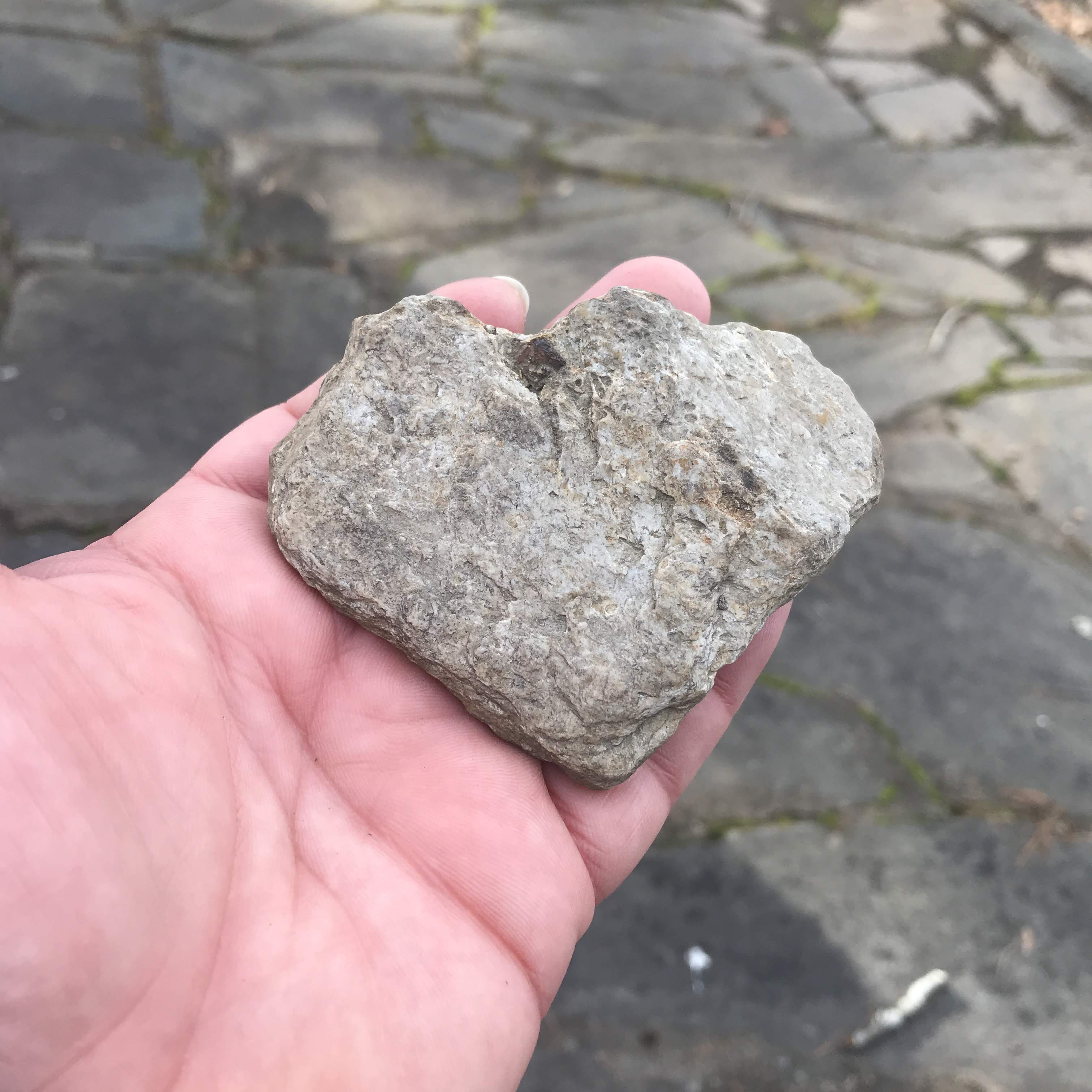 The moment I saw the heart-shaped rock in my path, right where my footstep would naturally land, I stopped and picked it up. It was freezing cold, as I expected and hoped it would be; I love the way rocks hold cold and are cold even when the world around them is warm.
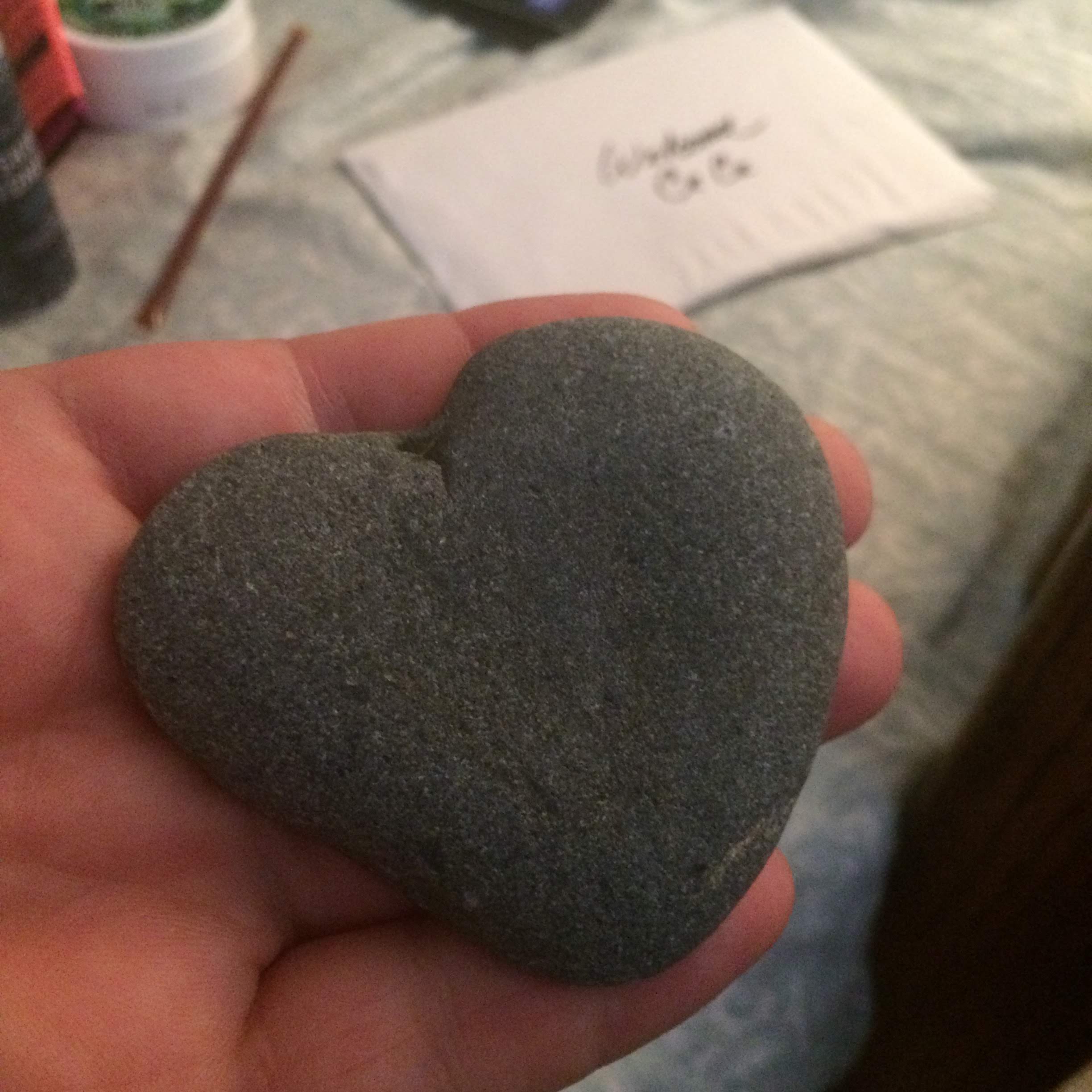 I held that rock in my palm the rest of my hike. It fits perfectly. And it’s pretty close to the same size as my heart rock from Homer, AK, though a completely different stone.

