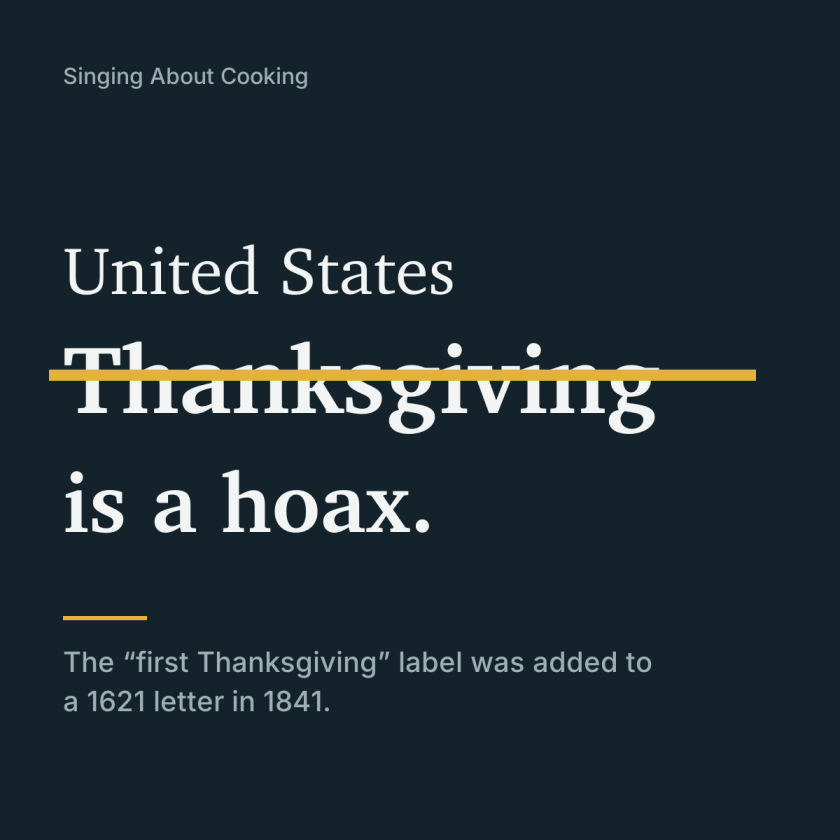
Start with the word. “Holiday” is a blend of “holy” and “day,” from the Old English hāligdæg. We apply it to secular observances and religious ones alike, and that is not insignificant. The word carries its religious origin into every use, and it followed the cultural immersion of a dominant Judeo-Christian culture, which is white more than anything.
A day called a holiday borrows sanctity from the vocabulary itself, and that is part of why United States Thanksgiving is so hard to criticize.
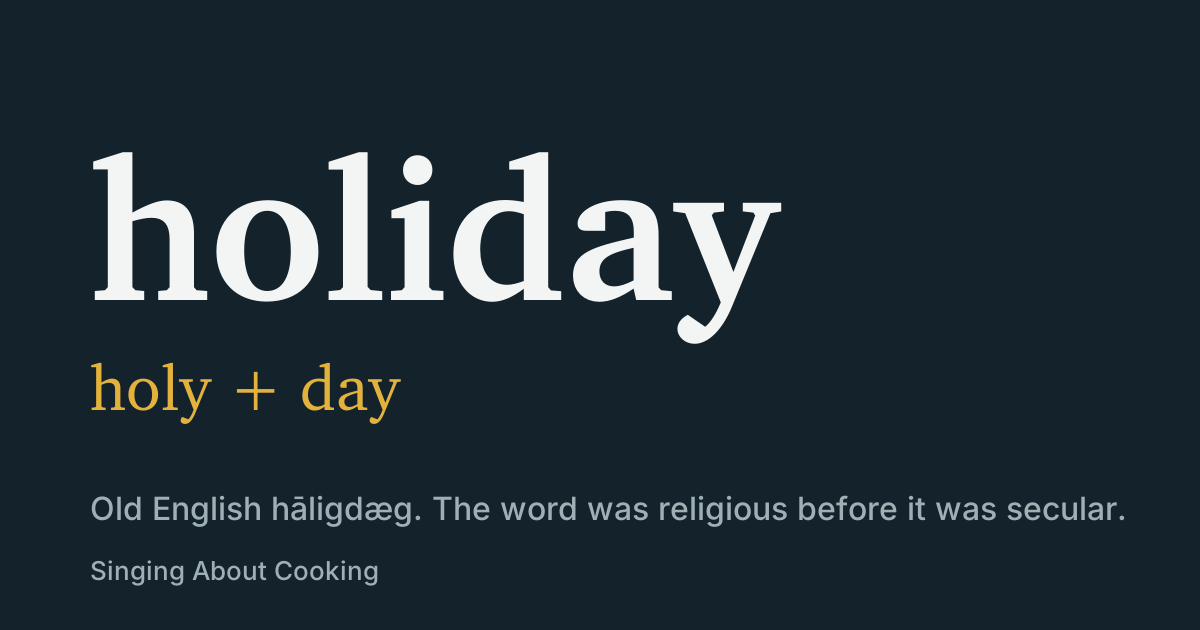
I am not going to soften this. United States Thanksgiving is a fucking fake holiday. It is a fake celebration built on a story invented in the nineteenth century, and it should be eliminated. Not reformed. Not reframed with a land acknowledgment before the turkey. Eliminated.
I am not calling it “American” Thanksgiving, either. The continent was already occupied, governed, and named by hundreds of nations. This is a United States holiday, and the United States is the party with the explaining to do.
The Story Is Invented
Set aside the menu. Set aside the intended gratefulness. The event itself is thinly documented. Only two primary sources describe the autumn 1621 harvest gathering at Plymouth, and both were written by English colonists. The main one is a letter from Edward Winslow dated December 11, 1621. It says Massasoit, whose actual name was Ousamequin, the sachem of the Pokanoket Wampanoag, arrived with about ninety men. Historians read that as a diplomatic meeting as much as a feast. The Wampanoag brought five deer.
Nobody called it “the first Thanksgiving” in 1621. That label comes from a footnote. In 1841, Alexander Young reprinted Winslow’s letter in Chronicles of the Pilgrim Fathers and added the phrase himself. A meal became an origin story more than two centuries after the fact.
The gathering happened. The holiday story did not.
The Massacre that Was Actually Declared a Day of Thanksgiving
On May 26, 1637, colonial forces attacked a Pequot village at Mystic, Connecticut. They set it on fire and shot the people who tried to escape. Estimates of the dead run from 400 to 700, most of them women and children. Survivors were sold into slavery.
Thanksgiving days were routine religious observances in the colonies, and one was declared in celebration of the victory over the Pequot.
That is the record. It is why Wampanoag activists and their allies stopped treating the day as a celebration.
Lincoln’s Holiday to Soften the Civil War
The national holiday came on October 3, 1863, when Abraham Lincoln proclaimed the last Thursday of November a day of thanksgiving in the middle of the Civil War. His proclamation mentioned neither the Pilgrims nor the Wampanoag. The Pilgrim narrative was attached afterward, to give a divided country a founding story.
So United States Thanksgiving is a Civil War morale measure wearing a 1621 costume.
The Date Is Fake Too
Harvest thanksgivings are real, and they are older than 1621. They are also not scheduled for the last Thursday of November.
Harvest festivals fall when the harvest falls. China’s Mid-Autumn Festival and Korea’s Chuseok both land in late September or October. Native nations on this continent held thanksgivings for what was happening on the land: a Strawberry Thanksgiving, a Green Corn Thanksgiving, the return of a fish to spawn. The Wampanoag give thanks several times a year, and the timing follows the crop or the animal, not a calendar date.
The 1621 gathering at Plymouth fit that pattern. The sources place it sometime between September 21 and November 9, and one account puts it in September or early October. If it happened when the evidence suggests, it fell closer to the second Monday of October than to the fourth Thursday of November.
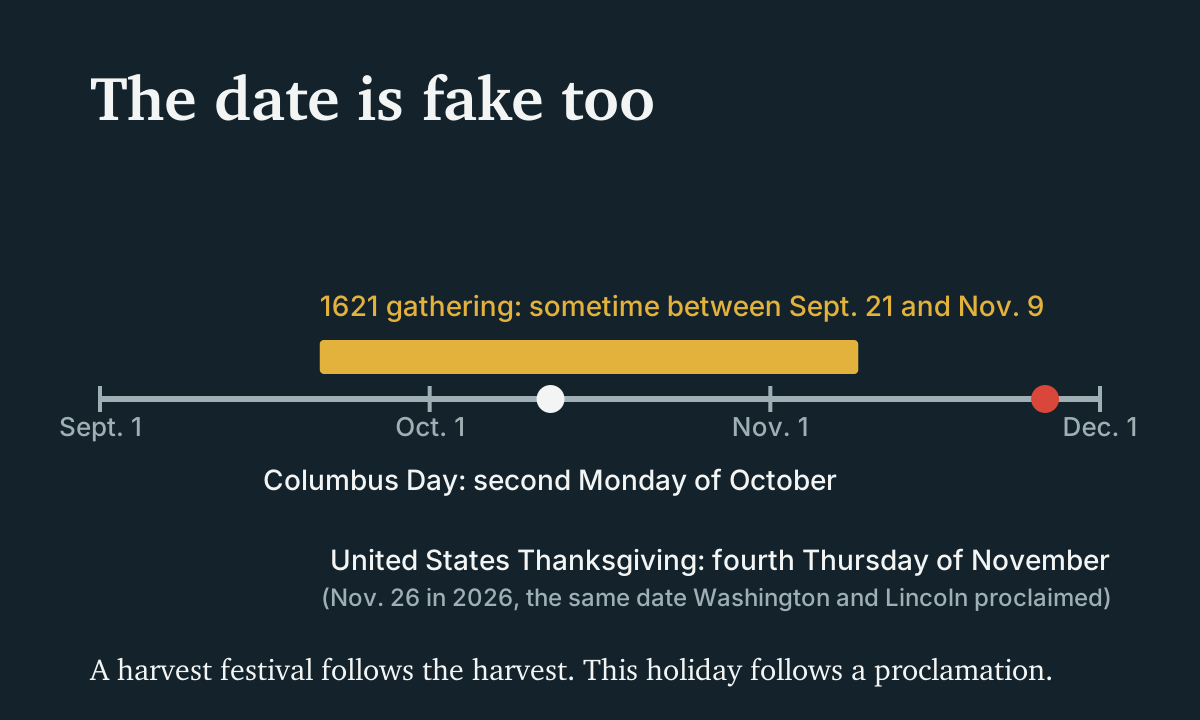
The late November date came from white colonist presidents of Western European origin. George Washington proclaimed a national day of thanksgiving on November 26, 1789, and Sarah Josepha Hale later chose the last Thursday of November because of it. Lincoln made it an annual date in 1863. Franklin Roosevelt tried to move it in 1939, thirty-two states went along, sixteen did not, and the holiday landed on two different days until Congress fixed the date in 1941.
A harvest festival follows the harvest. United States Thanksgiving follows a proclamation.
Whitewashing: What the Holiday Asks You to Look Away From
The holiday asks every household to feel grateful and look away. That is whitewashing: keep the part of the story that flatters the country and bury the rest. The United States does it with holidays, and it does it with statues.
Consider the documented example of J. Marion Sims. He is called the father of modern gynecology. Between 1845 and 1849 he performed experimental surgeries on enslaved women in Alabama, including more than thirty operations on a woman named Anarcha, and most accounts say he did it without anesthesia. The women could not consent, because their owners consented for them. A statue honored him in Central Park until April 17, 2018, and the Sims speculum is still a standard medical instrument.
He was honored for the result, and the cost was left off the plaque. United States Thanksgiving does the same thing to Native nations. This is what the looking away covers.
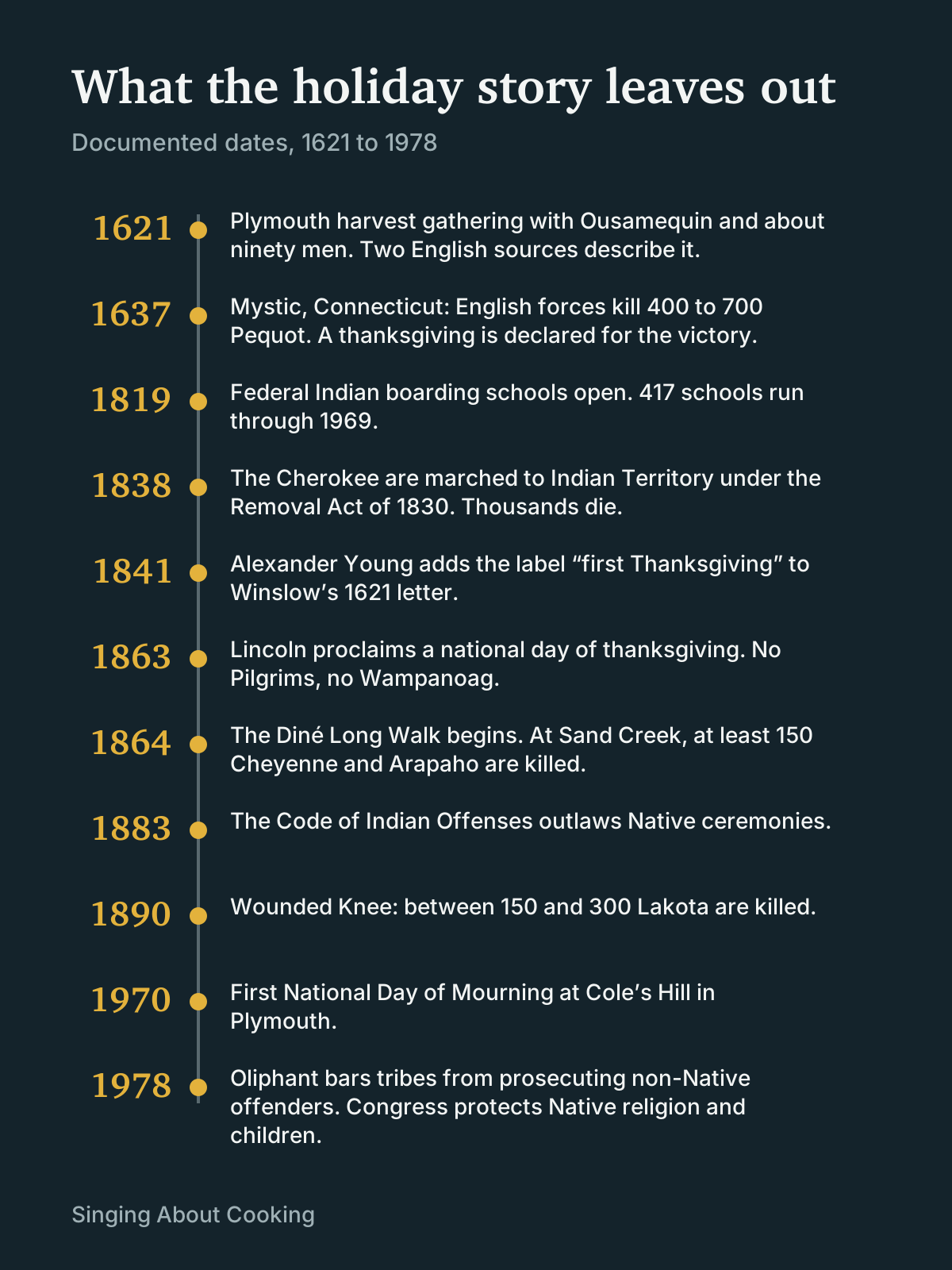
- 1830: The Indian Removal Act. In 1838, federal soldiers and Georgia volunteers rounded up the Cherokee and drove them to Indian Territory. Thousands died on what became the Trail of Tears.
- 1864: The Long Walk. Under Colonel James Carleton, Kit Carson burned Diné crops and orchards and killed livestock until the Diné starved into surrender. From 1864 to 1866, more than fifty groups of Diné men, women, and children were marched over three hundred miles from Dinétah to Bosque Redondo, an internment camp at Fort Sumner, New Mexico. Estimates of the dead run from 2,500 to 3,500. The survivors were allowed home in 1868 under the Treaty of Bosque Redondo.
- November 29, 1864: Sand Creek, Colorado. Colonel John Chivington led about 675 volunteers against a village of roughly 750 Cheyenne and Arapaho under Black Kettle, who had registered with the military as non-hostile and flew an American flag over his camp. At least 150 people were killed, by some counts over 200, and most were women and children. Captain Soule and Lieutenant Cramer refused to fire. Chivington was never punished in court. The site did not become a National Historic Site until 2007.
- 1871: Congress declared that no Indian nation or tribe would be recognized as an independent power the United States could make treaties with. The treaties were broken by statute.
- 1883: The Code of Indian Offenses. The federal government outlawed the Sun Dance and other ceremonies and enforced the ban by withholding rations and imprisonment. The code was formally ended in 1934. Arrests of religious practitioners continued in places into the 1970s. The American Indian Religious Freedom Act passed in 1978.
- December 29, 1890: Wounded Knee, South Dakota. The 7th Cavalry surrounded Chief Spotted Elk’s band of Miniconjou Lakota, who were walking to Pine Ridge to seek refuge. Spotted Elk was sick with pneumonia. Four Hotchkiss guns sat on the hill above the camp. Between 150 and 300 Lakota were killed, most of them women and children. The Army gave twenty Medals of Honor to the soldiers. They have not been revoked.
- 1819 to 1969: The federal Indian boarding school system. The Interior Department counted 417 schools across 37 states or territories. Children were taken, given English names, had their hair cut, and were drilled like soldiers. The government paid religious organizations per child to run some of them. At least 973 children are documented as having died there, and the department expects the true number to be far higher.
- Before 1978: Native children were removed from their families into foster and adoptive homes at rates in some states nearly twenty times those of white children. Congress passed the Indian Child Welfare Act in 1978 to stop it.
- 1973 to 1976: The Government Accountability Office found that four of the twelve Indian Health Service regions sterilized 3,406 Native women, and that the consent requirements were not met.
This is not ancient history. Many of these policies were still running within living memory, and some of the people they were done to are still alive.
It Is Still Happening: Missing and Murdered Indigenous Women
A 2016 National Institute of Justice study found that 84.3 percent of American Indian and Alaska Native women have experienced violence in their lifetimes, and 56.1 percent have experienced sexual violence. In some tribal communities, murder rates for Native women are more than ten times the national average. Only about one in three suspects in homicides with Native victims is Native. Most of these women are killed by someone from outside their communities.
The law built that gap. In 1978, in Oliphant v. Suquamish Indian Tribe, the Supreme Court ruled that tribes could not prosecute non-Native people for crimes on tribal land. The case started when a white man got into a drunken fight at the 1973 Suquamish celebration and fought tribal police. Congress did not begin to restore that authority until the Violence Against Women Act of 2013, and expanded it in 2022 to cover sexual violence, stalking, and trafficking.
The data is a failure of its own. In 2020 there were 5,293 reports of missing Native women and girls and only 690 in the federal missing persons database. The Government Accountability Office reported that the full scale of the problem is unknown.
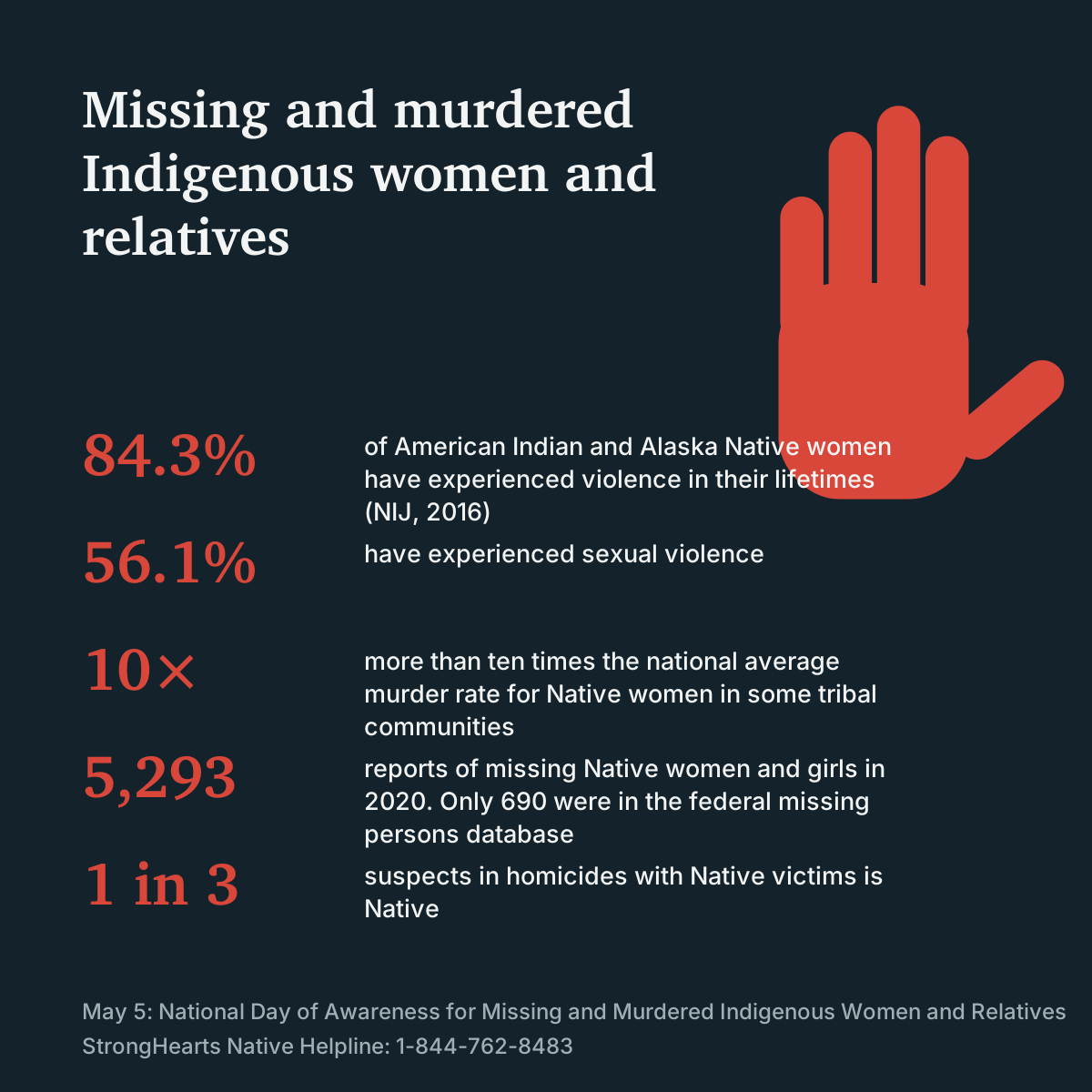
The red handprint across the mouth is the symbol of the movement. Rosalie Fish, a Cowlitz runner, popularized it in 2019. It stands for the voices that have been silenced, including by the media and by law enforcement. May 5 is the National Day of Awareness for Missing and Murdered Indigenous Women and Relatives. It honors Hanna Harris, a 21-year-old Northern Cheyenne woman who was murdered in 2013.
Alaska is at the center of it. A 2018 Urban Indian Health Institute report ranked Alaska fourth in the nation for missing and murdered Indigenous women and girls and Anchorage third among cities.
Columbus Did Not Discover Anything
The same country still puts Columbus’s name on a federal holiday. Franklin Roosevelt proclaimed Columbus Day in 1937 after heavy lobbying by the Knights of Columbus. It became a federal holiday observed on the second Monday of October in 1971.
Columbus discovered nothing. People were already here. On Hispaniola, his administration required every Taíno over fourteen to deliver gold dust every three months. In 1495 he led an expedition that captured over fifteen hundred Taíno to be shipped to Spain and sold. The Taíno population collapsed by as much as ninety percent within decades. Disease was part of it, and historians agree that forced labor, violence, and starvation made it worse. In 1500, a royal investigator arrested Columbus and sent him back to Spain in chains. His critics’ motives have been disputed, but the tribute system and the enslavement are documented in more than that one report.
President Biden became the first president to proclaim Indigenous Peoples’ Day, on October 8, 2021, and on the same day he proclaimed Columbus Day. Indigenous Peoples’ Day is not a federal holiday. The Columbus holiday is.
Why Eliminate It
A reform asks the Wampanoag, the Pequot, the Diné, the Cheyenne, the Arapaho, the Lakota, and the Cherokee to sit at a table decorated with a lie and help improve it. The 1621 meal was a diplomatic meeting that colonists later turned into a mascot for the country. The 1637 thanksgiving was a celebration of a massacre. The 1863 holiday was a wartime invention. None of the three is worth keeping.
It is also not enough to hold gratitude quietly in your heart and tell yourself you are not celebrating the bad parts. The holiday does the burying whether you intend it or not, and sitting at the table without saying anything lets it. Silence is not enough. Silence is not correction. Silence is not honest.
What exists already is the National Day of Mourning. Since 1970, United American Indians of New England have gathered at noon on Cole’s Hill in Plymouth every Thanksgiving. It began when Wamsutta Frank James, an Aquinnah Wampanoag, was invited to speak at the 350th anniversary of the Pilgrim landing and then dis-invited when organizers saw his speech.
That is the observance with a record behind it. I am not going to celebrate the other one.
If this post has you looking for something to do, learn which nations were removed from the land under your feet, and call them by their own names. If someone in your life is missing, or you need help, the StrongHearts Native Helpline is 1-844-762-8483.


