Posted in Being Healthy, coeliac friendly, Cooking, corn free, dairy free, diabetes, diabetic friendly, gluten free, low carb, nut free

Middle Eastern Chicken and Potato Dupe

While doom scrolling one night, I came across this recipe video for Middle Eastern Chicken and Potato one pot bake. Mmmm, mm – now that’s my kind of dinner inspiration.
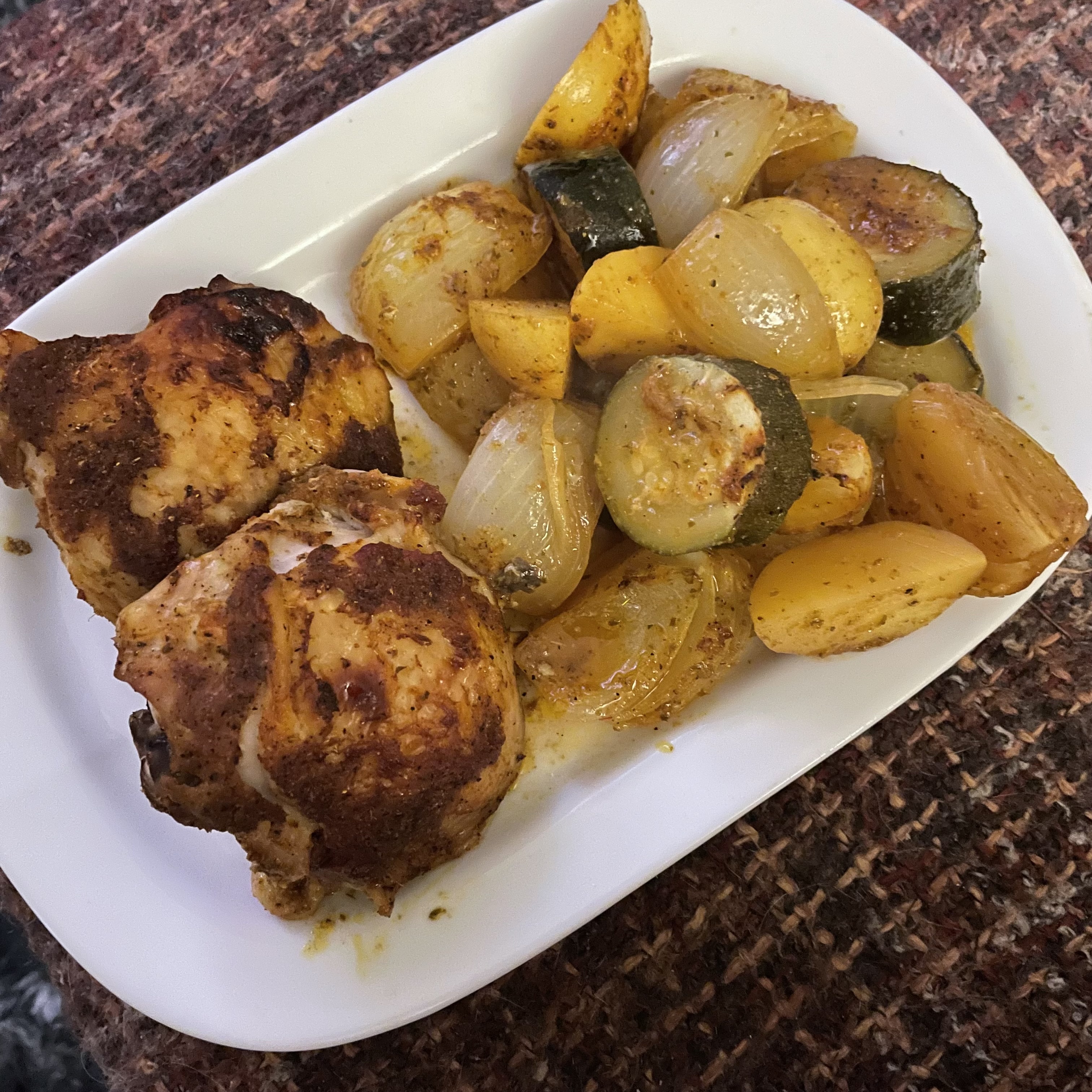
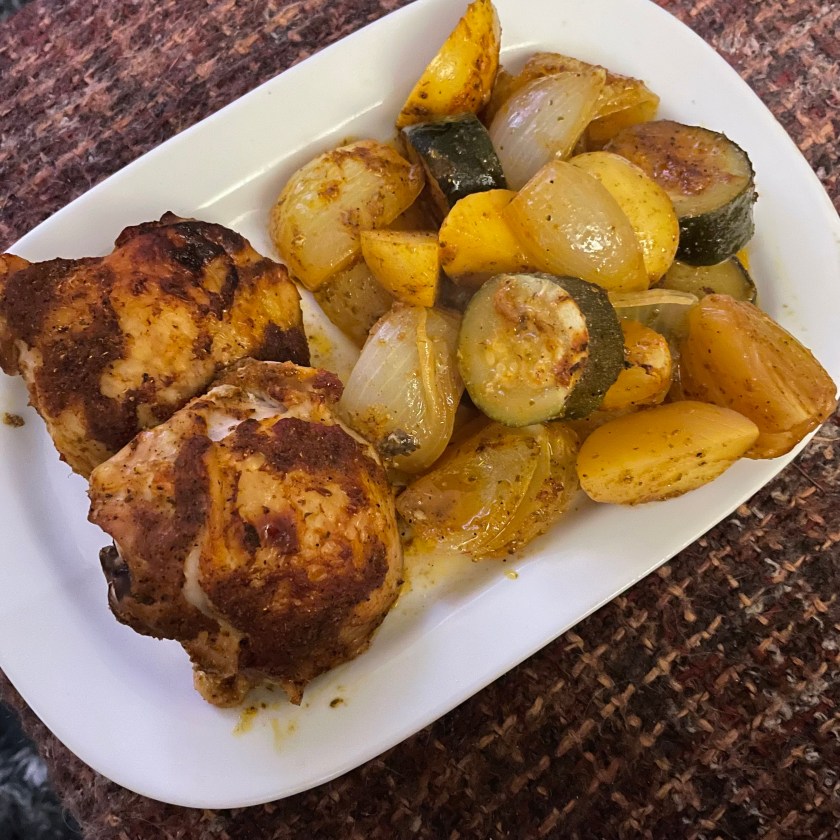
plated vision

The Things I Like and Will Use

One pot – while the video shows using a pot that is commonly used when starting a meal on the stove and then finishing in the oven, there’s no reason you can’t or shouldn’t use a sheet pan or standard baking dish.

Chicken thighs – bone in with the skin – this is my favorite piece of chicken to cook with. The little extra fat keeps it juicy while cooking and adds that little bit of extra flavor you just can’t get from a chicken breast.

Covered and uncovered cooking. When cooking meat with the bone in, it can be hard to confidently cook it through, so cooking covered – foil or lid – is an excellent way to achieve this. And then the shorter uncovered time is for crisping up the skin so if you are eating that (and you don’t have to), it’s a delightfully crispy crunch.

The Things I’ll Take Inspiration From and Why

Now, I love the idea and all of the individual and collective flavors of this dish, but I find myself on a tighter food budget these days. So here’s how I’m making this work with what’s in my pantry.

Lemon – rather than rely on fresh lemons and their rising cost from tariffs, I keep a bottle of lemon juice in the fridge. It’s controversial with professional chefs, but it’s far more versatile and I don’t have to worry about it going bad or drying out.

And as it happens, I also just bought a ton of Greek lemon infused olive oil, so I’ll also be prepping the baking dish with this lemon oil to contribute to the dish as well.

Tomato paste – I don’t cook anything that uses tomato paste – not even marinara. So I never have this ingredient in the house. What do I have? Ketchup. So tonight, the “sauce” base is ketchup.

Aleppo pepper – that’s a pretty specific spice that’s not part of my pantry, but in the spirit of peppers with and without heat, I have lots of others. For this, I added a squeeze of Sriracha for just a hint of heat and smoked paprika for the smokiness from dried pepper.

Cumin – so I definitely have cumin, but I was feeling more curry, so I switched. That simple – followed what my palate was more interest in.

Carbs – so this dish as shown in the video is pretty high carb and not at all diabetic friendly, so I made some simple additions and one subtraction to balance this out:

  • removed rice – because rice is my least favorite carb
  • added quartered onions
  • added chunks of zucchini

Both the onion and zucchini are highly traditional additions to meals from countries and cultures east of the Mediterranean to the Indian Ocean and to the Pacific.

Side Note on the Term “Middle Eastern”

I’m nearing my 50th birthday as I make this dinner, and I recall a video excerpt I found earlier this week that challenged the terms “middle East” and “far East” as colonial, and therefore, oppressive terms. Yes, I agree, and I wanted to bring your attention to this. You see, the words “middle” and “east” only have meaning when we know the origin point – middle compared to what? east compared to what fixed point. In this case – it’s London – the center of the British colonial empire.

In that paradigm, then, “East” refers to everything east of the Mediterranean to the Pacific ocean, the middle of which is the Arabic and Indian countries and cultures and the “far” of which is the aggregate of the Asian cultures.

I offer these as generalized geographic assignments for the colonial “Middle East”:

  • Western Asia
  • Southwest Asia
  • West Asia and North Africa (WANA)

I offer these as generalized geographic assignments for the colonial “Far East”:

  • East Asia
  • Pacific Asia
  • Northeast Asia – Korea, Japan, northern China
  • Southeast Asia – Vietnam, Thailand, Indonesia

I offer these as generalized geographic assignments for the colonial “Indian subcontinent”:

  • South Asia
  • The subcontinent

I offer these as generalized geographic assignments for Arabic-speaking regions

  • Arab world or Arab states
  • North Africa and Arabian Peninsula

These alternatives focus on the geography relative to the region itself rather that in comparison with a conquering or colonial empire center.

One of the obvious challenges to Westerners is that our sense of world geography is likely to confound most in correcting our terminology. Beyond that, these terms have been assigned cultural meaning as well that may not align with the geographic/continental mapping, where a term like “Middle Eastern” is generalize to Arabic speaking countries regardless of their geographic location, and likewise “Far East” to a reductive understanding of Asian to refer to those of Chinese, Japanese, Thai, Vietnamese, Korea, and Indonesian descent.

This discussion deserves far more exploration, so thank you for not skimming just to get to more details about the recipe.

The Ingredients

In the recommended order of preparing (to make it easy to assemble):

  • 8 tiny golden creamer potatoes, quartered (or 4 medium or 2 large)
  • 3-4 small yellow or white onions, peeled and quartered
  • 2 medium zucchinis, cut into 1-inch thick “slices” or round chunks
  • 1/2 cup ketchup (or the tomato and pepper paste combo from the original recipe)
  • 1/2 lemon juice (bottle or fresh squeezed)
  • 1T Sriracha (or 1T Aleppo pepper from the original recipe)
  • 1T curry (or cumin from the original recipe)
  • 1T garlic powder (or 4-5 fresh cloves minced)
  • 1T oregano
  • 2t salt
  • 1t pepper
  • 4-6 chicken thighs, bone in with skin (or breasts or leg quarters)

The Assembly Process

Here’s how to layer it all into your baking dish.

Step 1: wash and chop your potatoes, onion, and zucchini. Drop them all into a greased baking dish, ideally into a single layer. They’ll be squished together, which is good.

potatoes, onions, and zucchini - large cut and mixed in the bottom of the baking dish

Step 2: in a measuring cup or other vessel with a pour spout, add your wet and spice ingredients and then mix well with a whisk or fork.
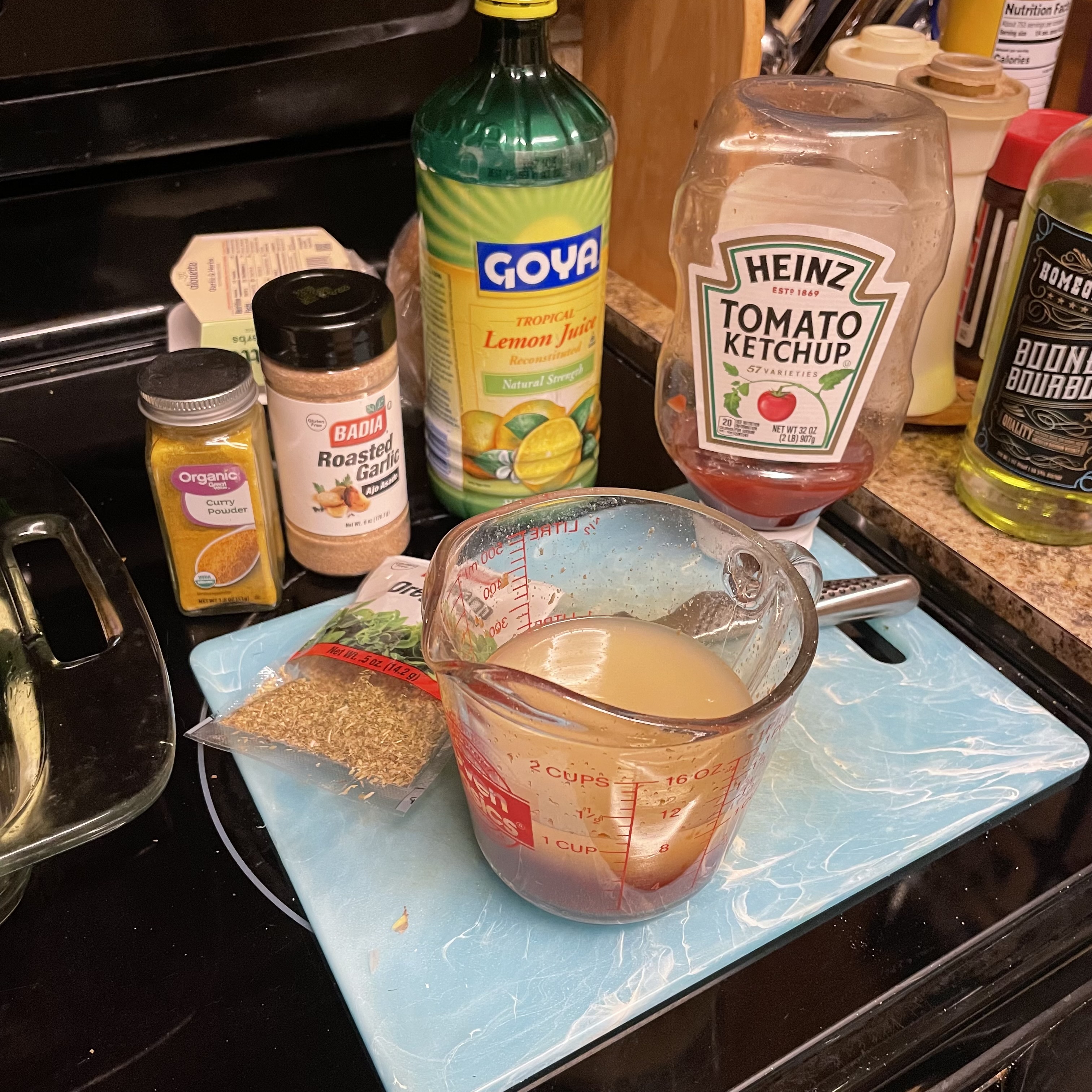
sauce ingredients collected and started in the measuring cup with pour spout

Step 3: pour about half of the sauce over the veggies. Use a spoon or tongs to toss the veggies in the sauce to coat all sides.

Step 4: place your chicken on top.

Step 5: pour most of the remaining sauce and use your hand(s) to quickly coat the entire chicken thigh – not just the top. Pour any remaining sauce on top of the chicken.
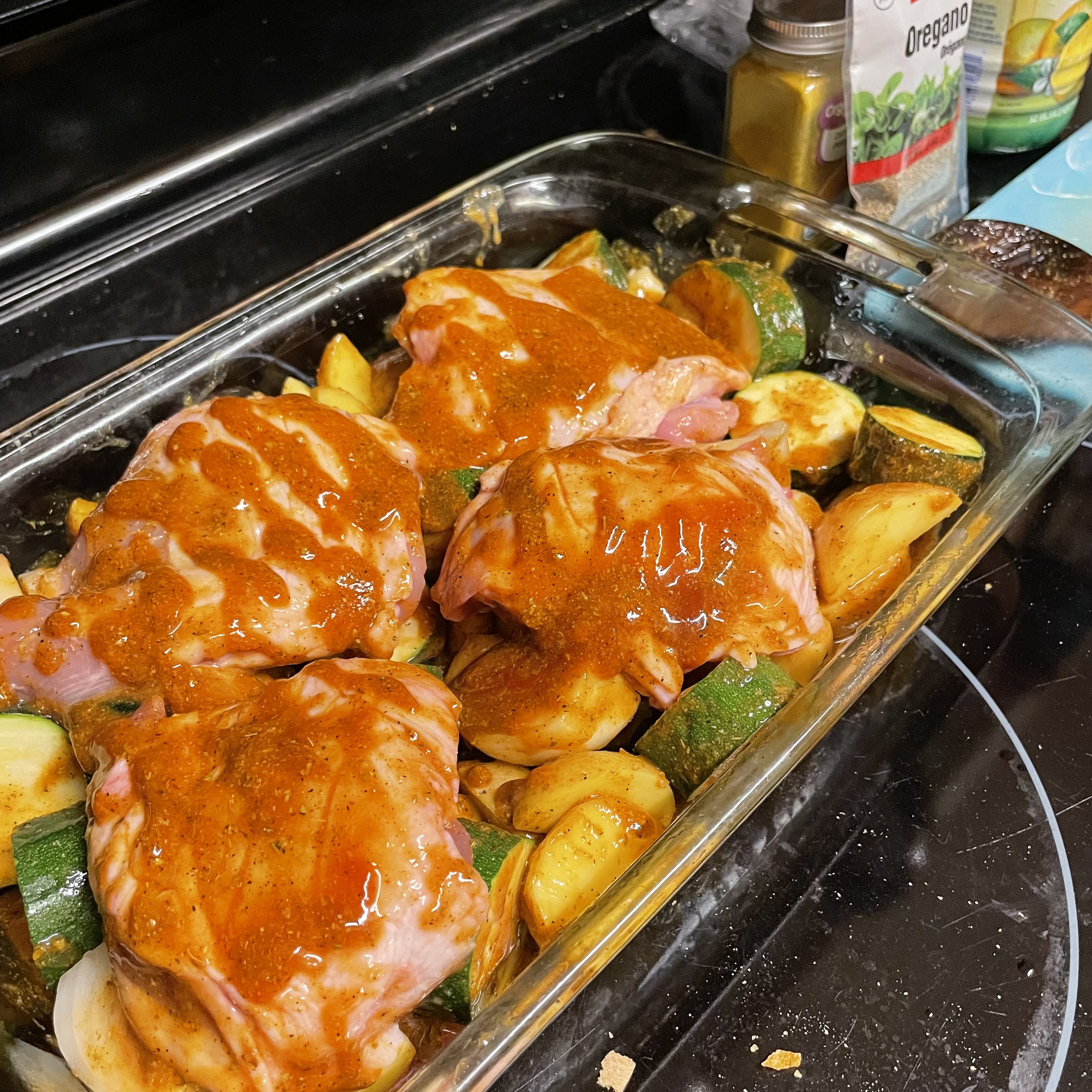
use all of the sauce - half on the veggies first and the remaining amount on the chicken placed on top of the veggies in the backing dish

The Cooking Process

Step 1: preheat the oven to 400 degrees Farenheit. NOTE: I do not wait for the oven to fully preheat to put in the dish; my oven rarely takes more than 7-8 minutes total to preheat, so the difference is negligible for such a long-baking dish.

Step 2: cover the baking dish with foil, wrapping the edges snuggly around the end handles.
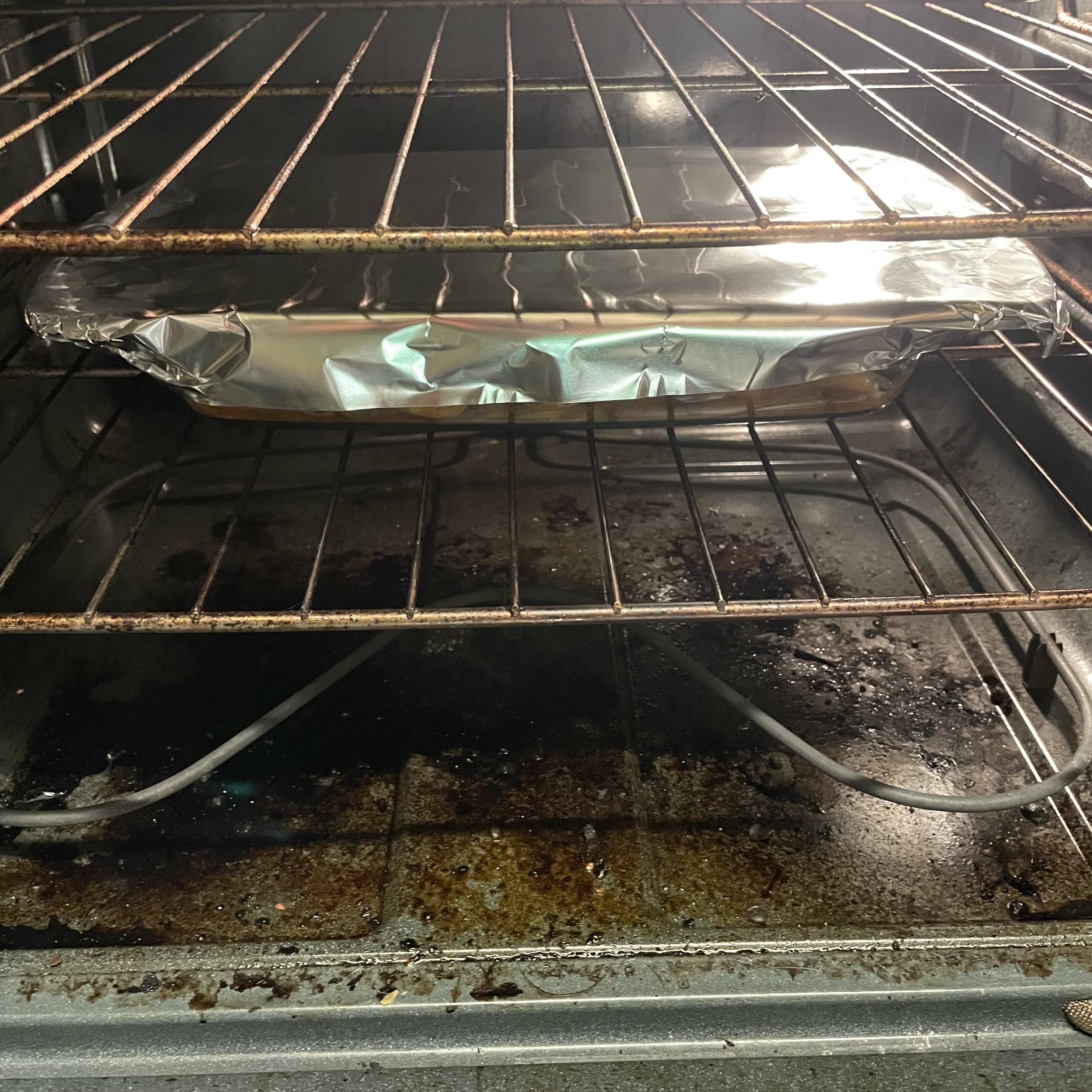
foil sealed baking dish placed on the lowest oven rack (closest to the baking heating element)

Step 3: bake for 45 minutes with the foil on and on the lowest rack, closest to the baking element (usually at the bottom of the oven).

Step 4: slide out the oven rack and remove the foil lid.
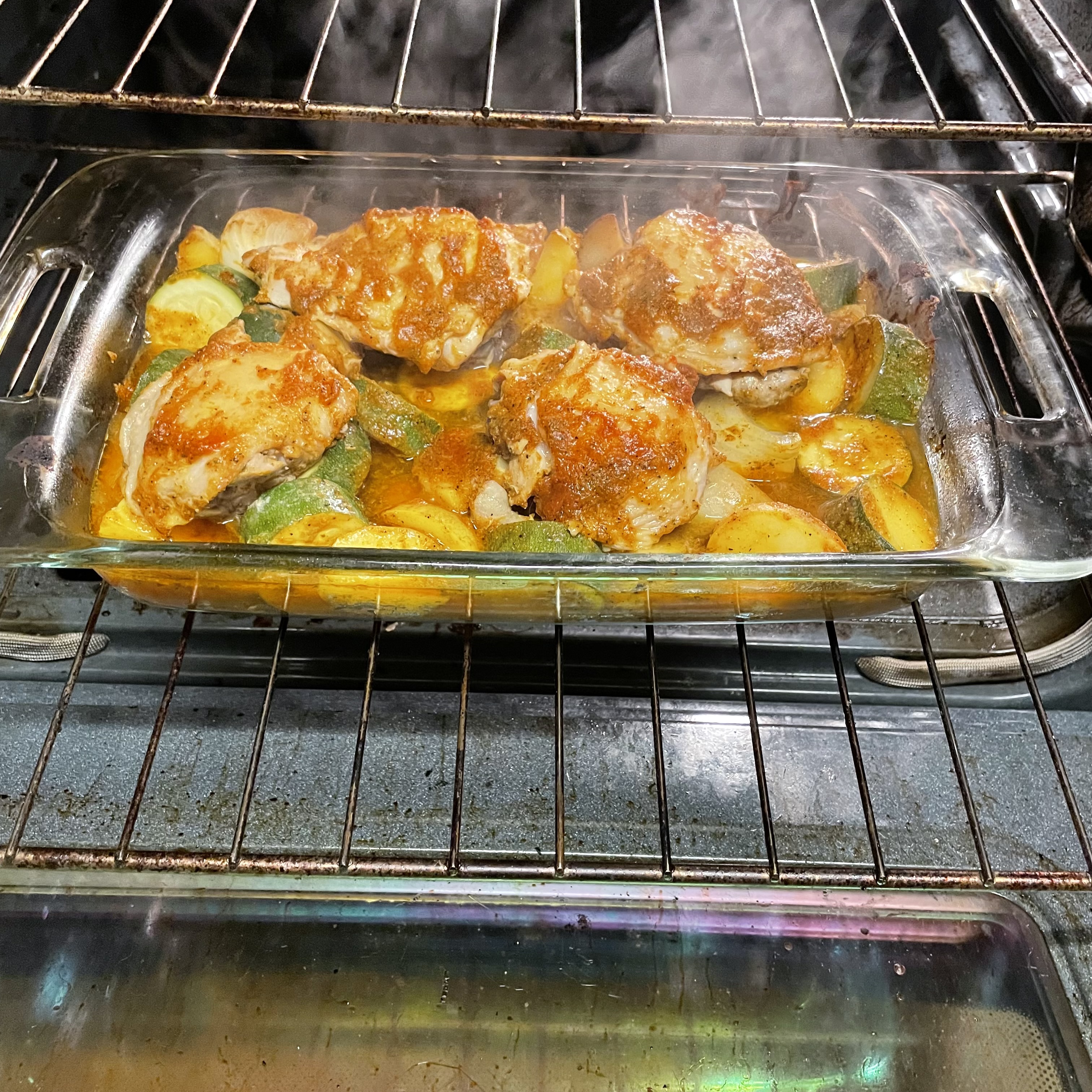
uncovered for the final 15-20 minutes

Step 5: push the oven rack back in and set the timer for another 15 minutes. This is an essential step for cooking the skin to be pleasant to eat and ensure the meat is fully cooked.

Step 6: take out of the oven and let rest for 10-15 minutes to cool enough to eat without burning fingers and tongues.

when it’s all done – let cool and serve

Enjoy!

Posted in Being Healthy, coeliac friendly, Cooking, dairy free, diabetes, diabetic friendly, gluten free, low carb, vegan

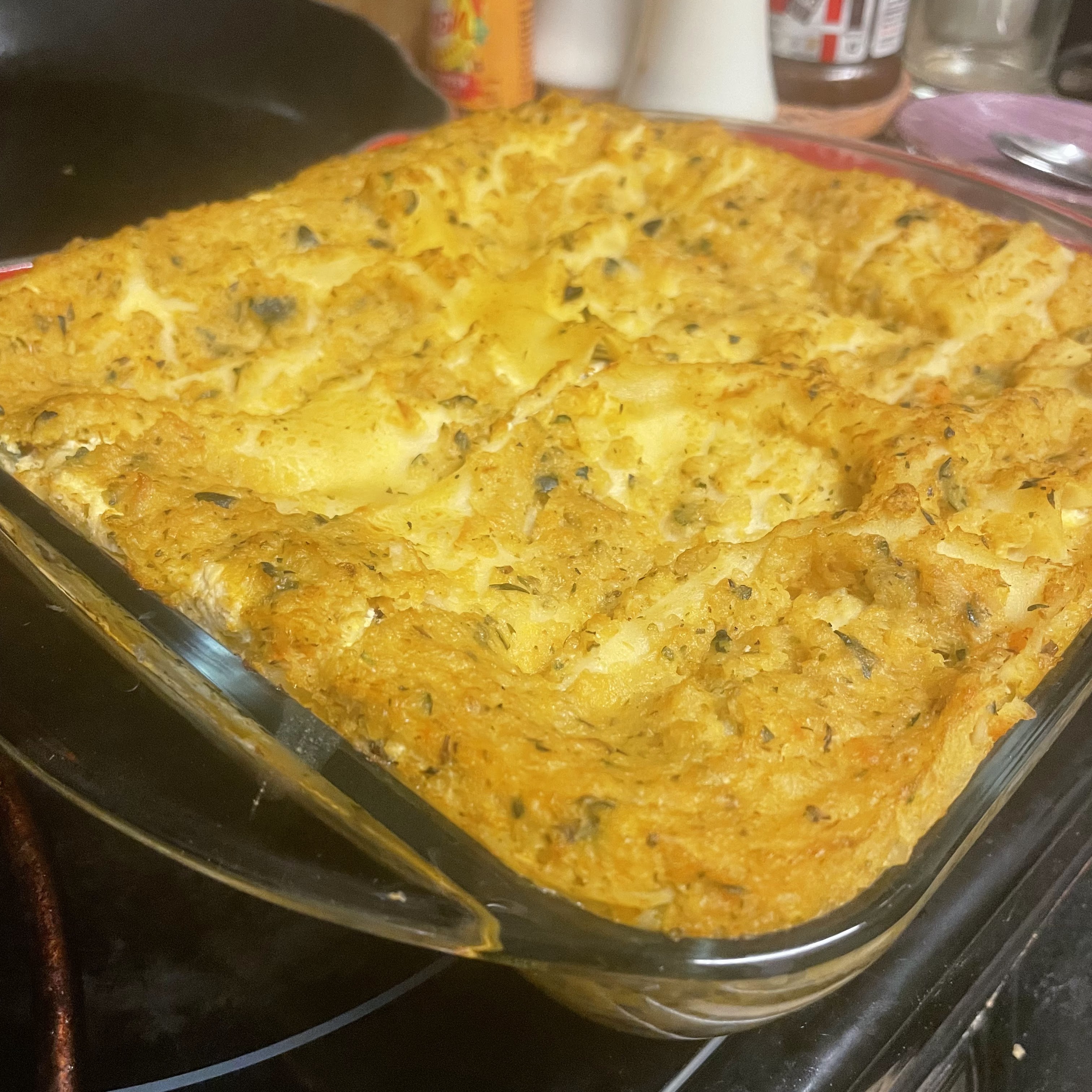
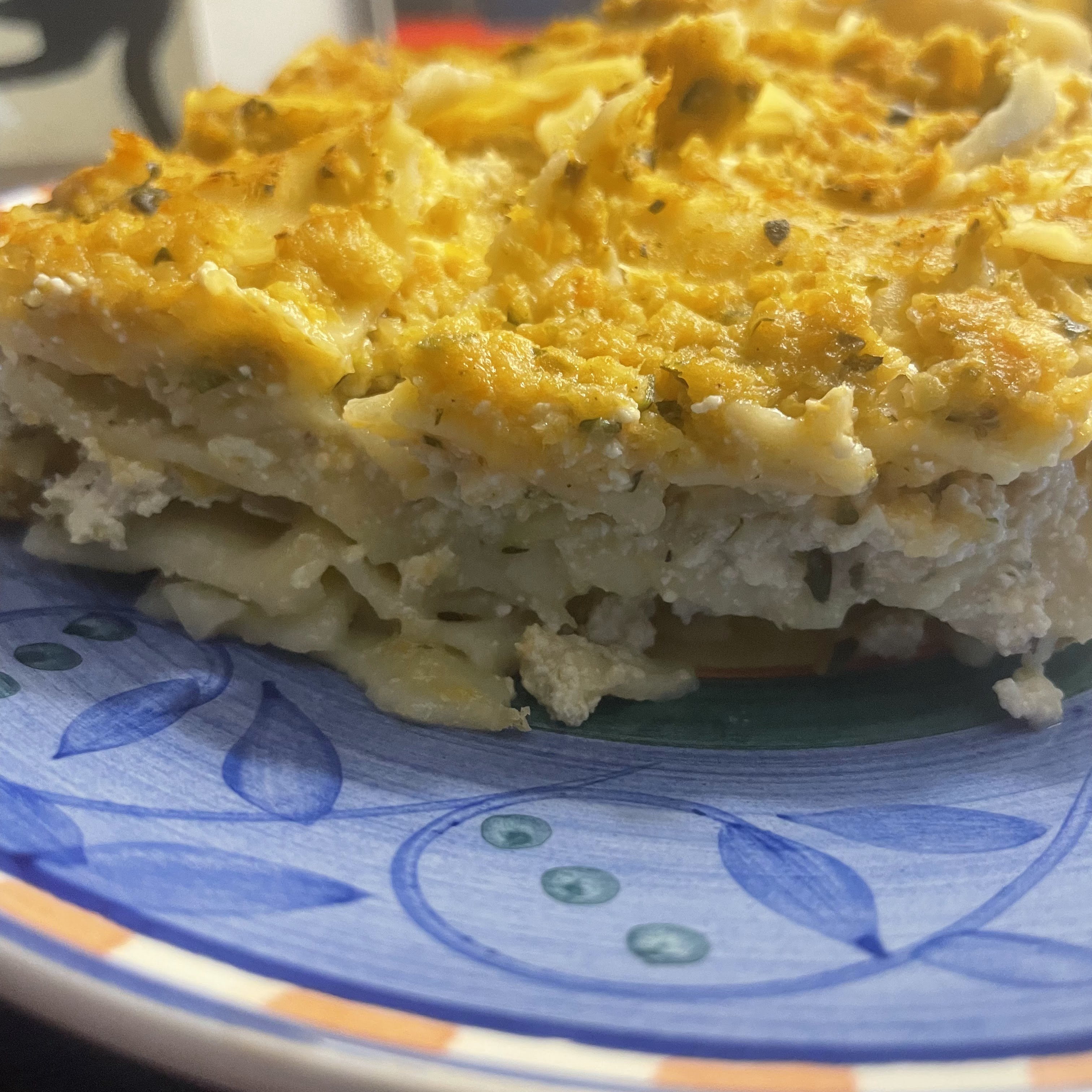
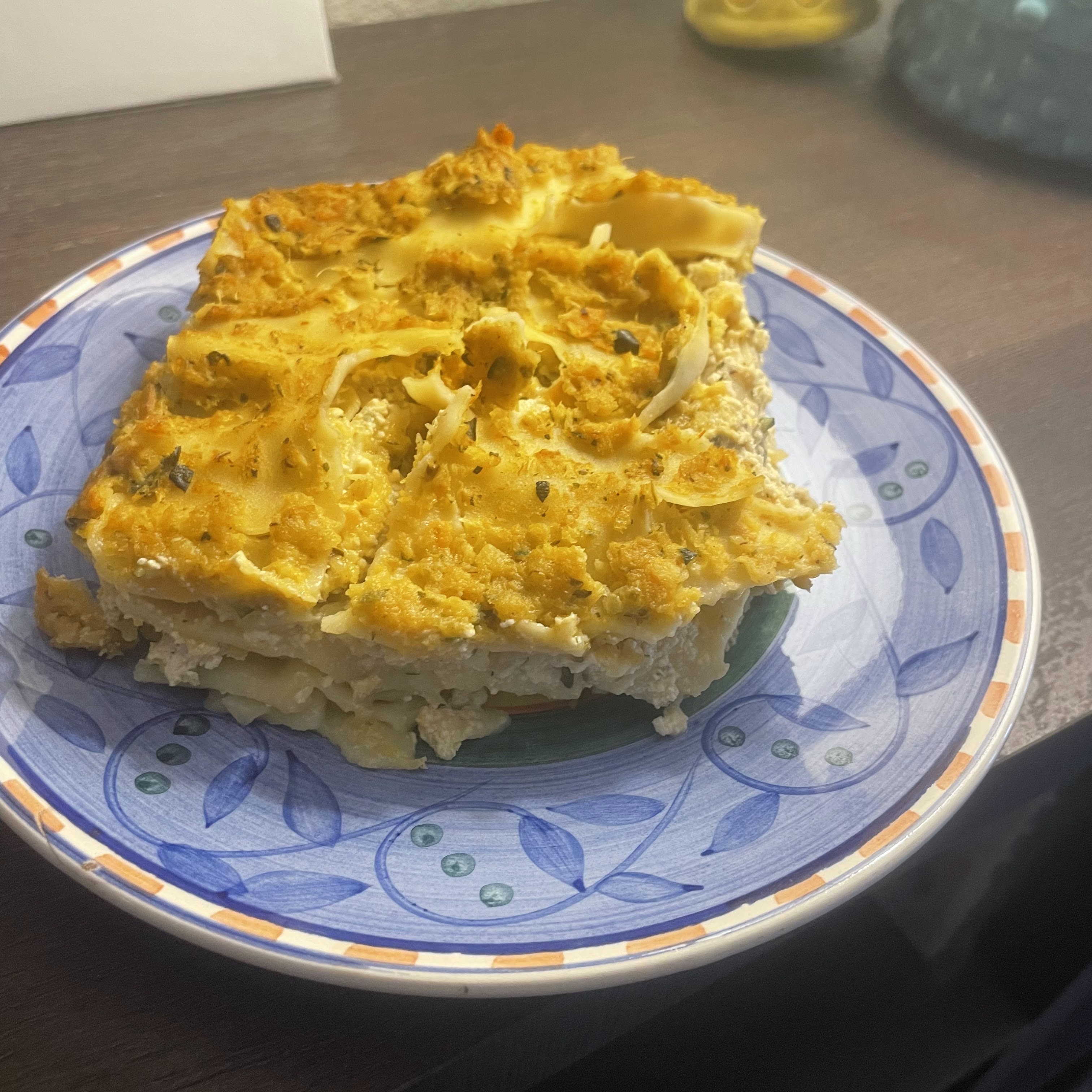
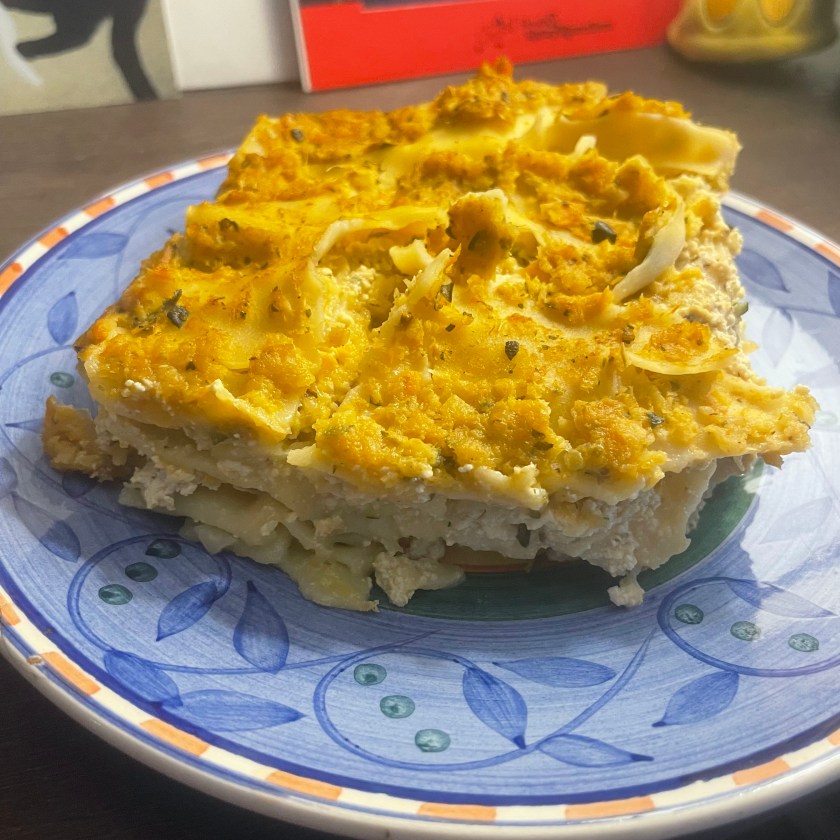
Lasagna – Gluten Free, Dairy Free, Nightshade Free, Accidentally Vegan

I’ve been craving lasagna, but anything Italian is really hard when your food allergies/intolerances hit all three major Italian points: pasta, cheese, and tomatoes. I mean, c’mon, it’s their flag, for crying out loud.

Gluten-free Lasagna Noodles

Gluten free pasta is easy as long as you have some kind of access to the Italian made stuff – and thank Amazon, I do! These gluten free, egg free, no cook lasagna noodles are perfect. In fact, one box makes two 9×9 lasagnas for the single person (or maybe 2-person family). Highly recommend, but you do you.

Buy on Amazon at https://www.amazon.com/gp/product/B00HRJNNSS/ref=ox_sc_act_title_3?smid=A3MXLTRINUPWUY&psc=1

Tomato-free Sauce

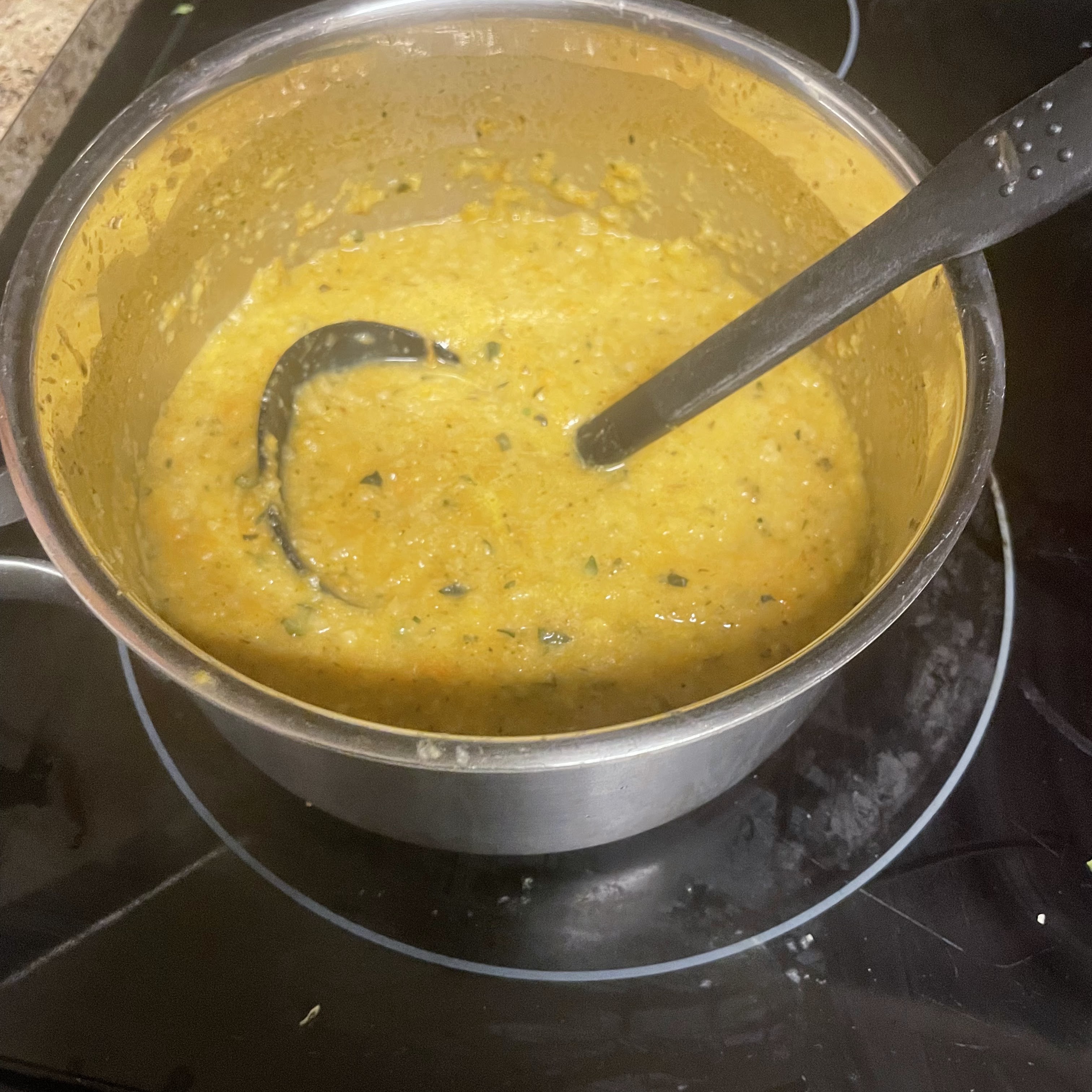
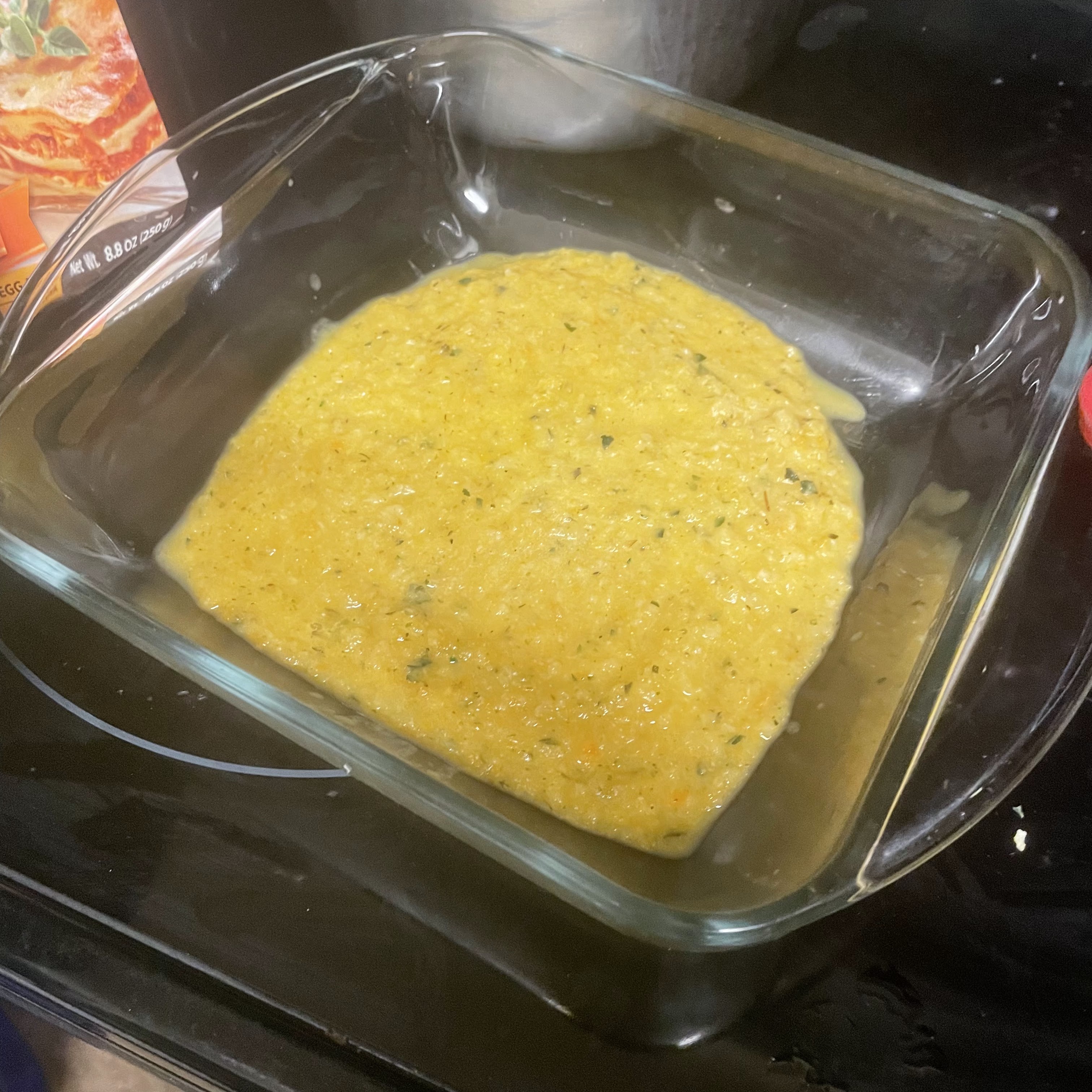
This piece of the puzzle has taken me the longest to figure out because all of the “red” vegetables are nightshades, and that’s specifically what I need to avoid – no tomatoes, no peppers. And it finally hit me – ratatouille sauce: roast down what’s currently in season and then blend into a sauce.

What I made today is

  • 1 zucchini
  • 2 carrots
  • 1 whole pod of garlic
  • 1 package of frozen riced cauliflower
  • 2 cups homemade vegetable stock
  • 2T Badia Italian Seasoning
  • 1t salt
  • 1t pepper (I like a little kick)
  • 2T cooking oil of your choice (I like grapeseed oil)

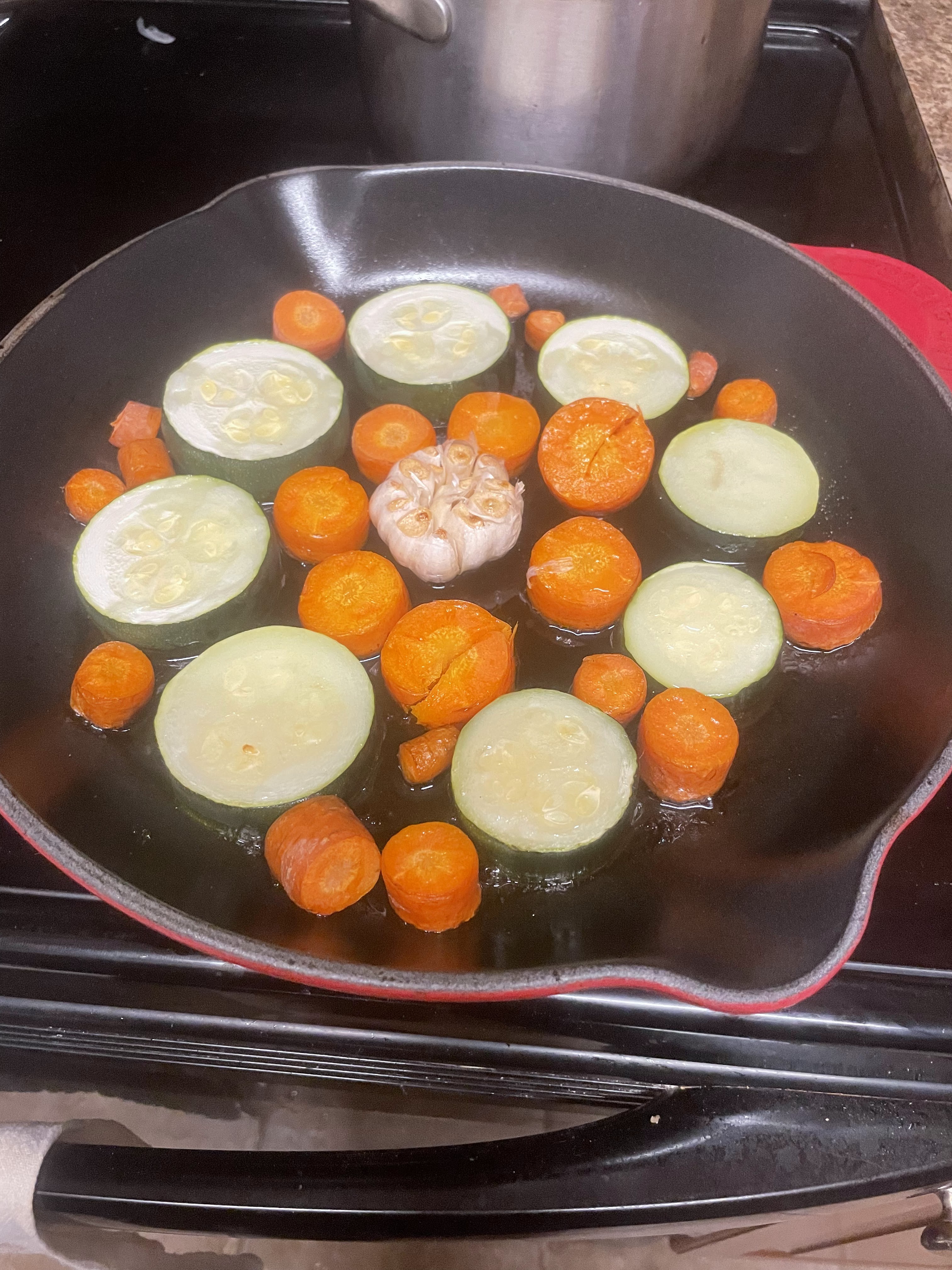
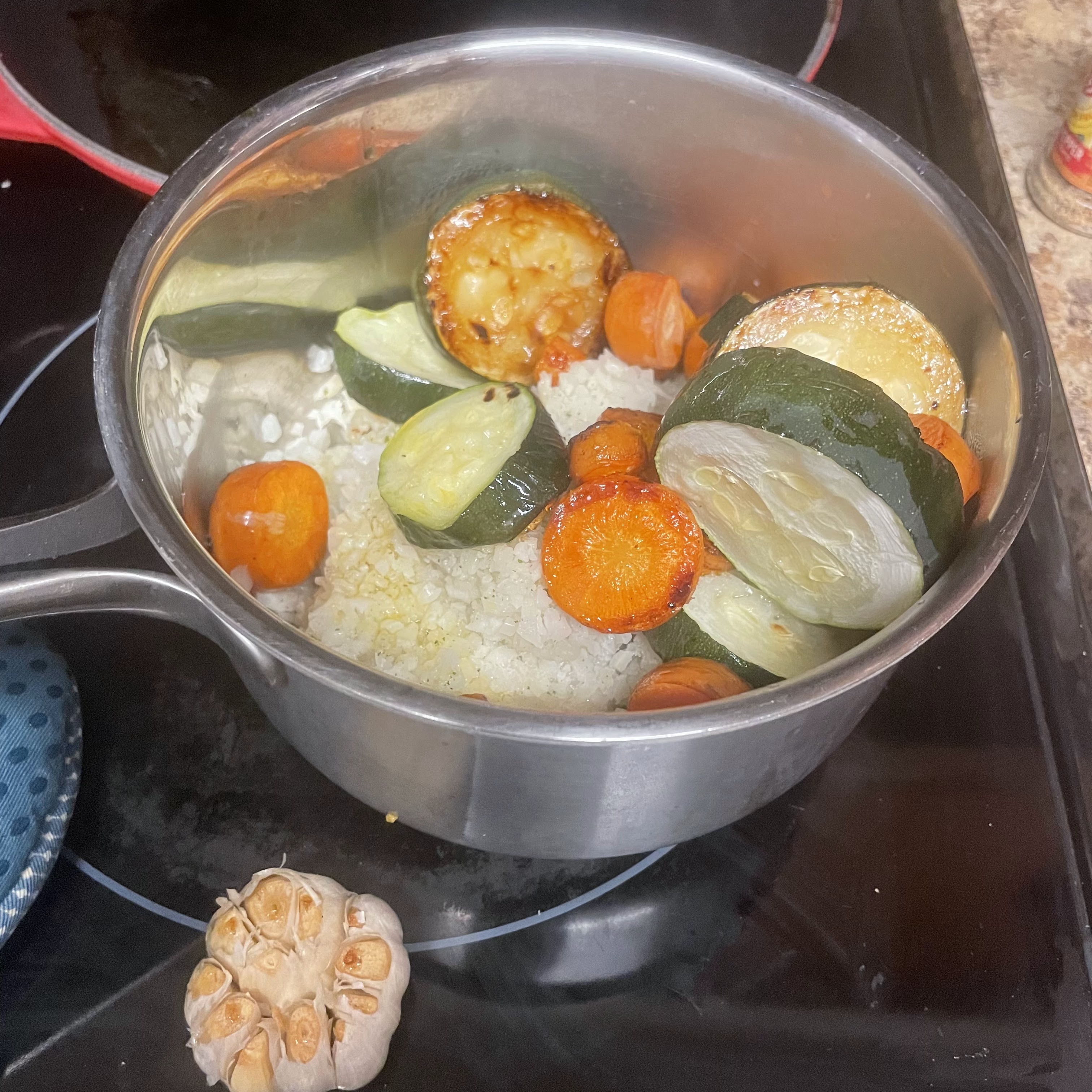
Roast the zucchini, carrots, and garlic at 350 for 45 minutes. While those are roasting, dump the frozen riced cauliflower in a sauce pan with 1 cup of the veggie stock and heat on low, mainly to thaw the cauliflower; you don’t need to “cook” anything.

When the roasting veggies are done, add them to the sauce pan and blend with an immersion blender. Add more veggie stock as needed to get to your desired thick or thinness.

Set aside until ready to assemble.

Dairy-free Ricotta Filling

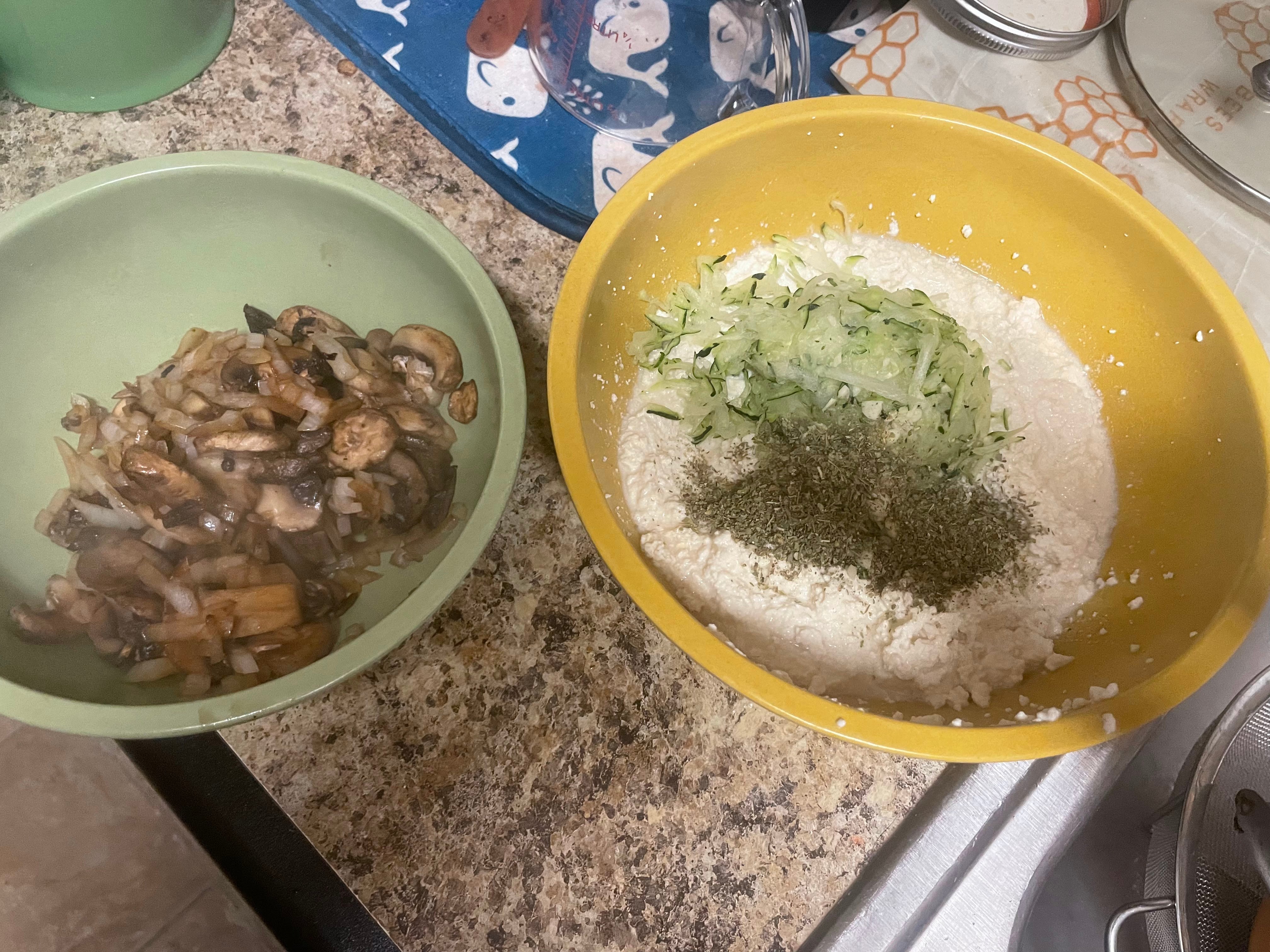
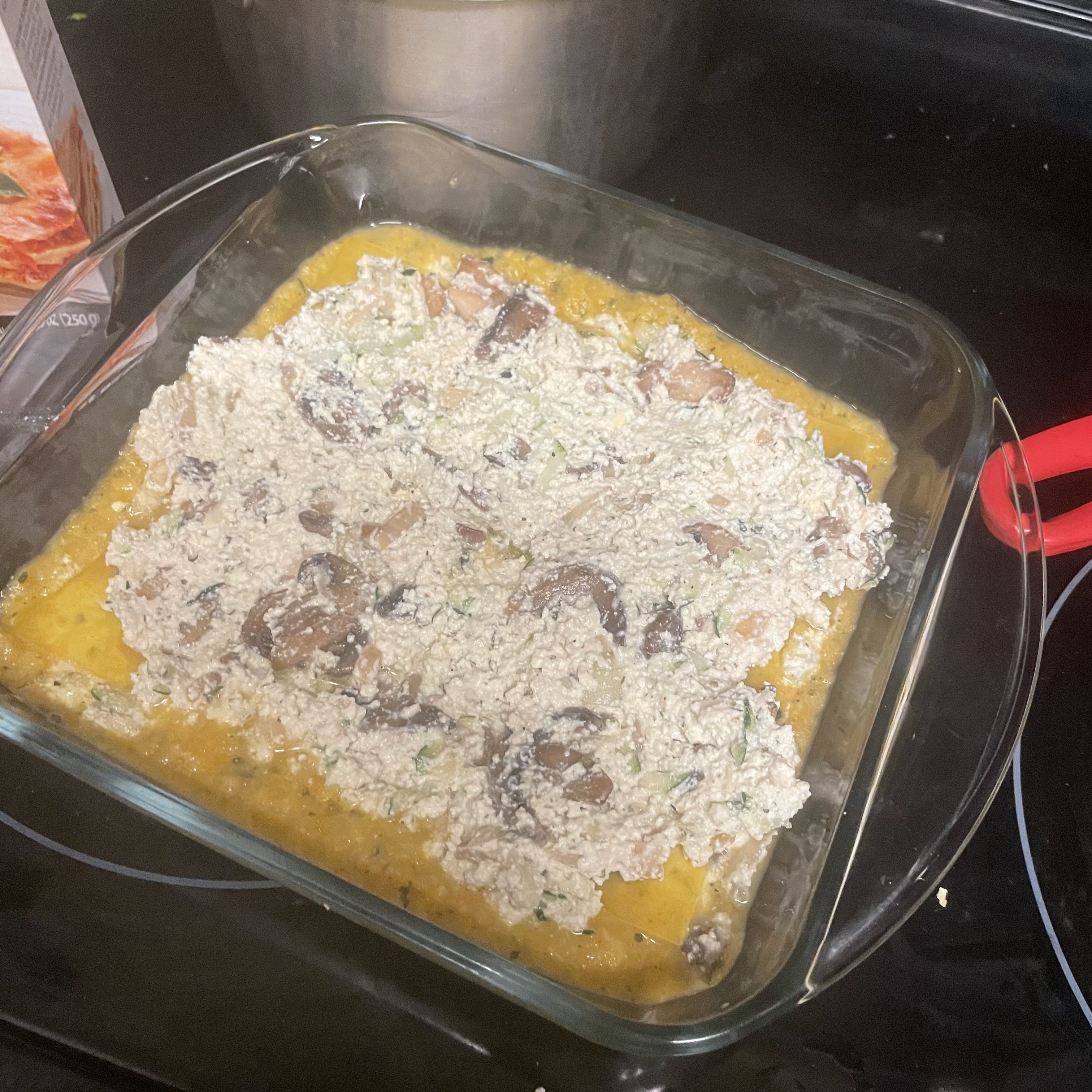
In the absence of any options for dairy-free ricotta in any market (brick-and-mortar or online), I turn to tofu, which is my go-to for replacing “creamy” ingredients. Normally for this I use silken tofu as it’s already in a soft, silky, creamy state. But I only had extra firm tofu today to make this recipe, so here’s how I turned it into even better faux ricotta than when I use silken: crumble it up well with your fingers, add about 1 cup of liquid (I used my homemade veggie stock), and blend with an immersion blender (secret weapon of this recipe, IMO). Then I add my “regular” mixins:

  • 1 cup shredded zucchini
  • 1 package of sliced mushrooms – sauteed until golden brown
  • 1/2 medium white onion, finely diced (about 2/3 cup) – sauteed with the mushroom until translucent
  • 3 cloves garlic, finely minced
  • 1T Badia Italian Seasoning blend – you do you
  • 1/2t salt
  • 1/4t pepper

Cook the mushrooms by themselves in the same pan you roasted the ratatouille veggies in – no extra oil is needed. Once the mushrooms have browned and the water they released evaporated, move them all to the outer edge of the pan and drop in the onions. Sautee maybe 2-3 minutes more until the onions are less white and moving towards clear-ish. Scoop it all into a bowl to cool for just a minute before mixing into the tofu ricotta.

Mix well in a bowl and set aside until ready to layer.

One of my favorite things about tofu as opposed to soy is that tofu is high protein with almost no carbs; soy is just the opposite – mostly carb with a modest amount of protein much lower than the carb load.

Let’s Assemble

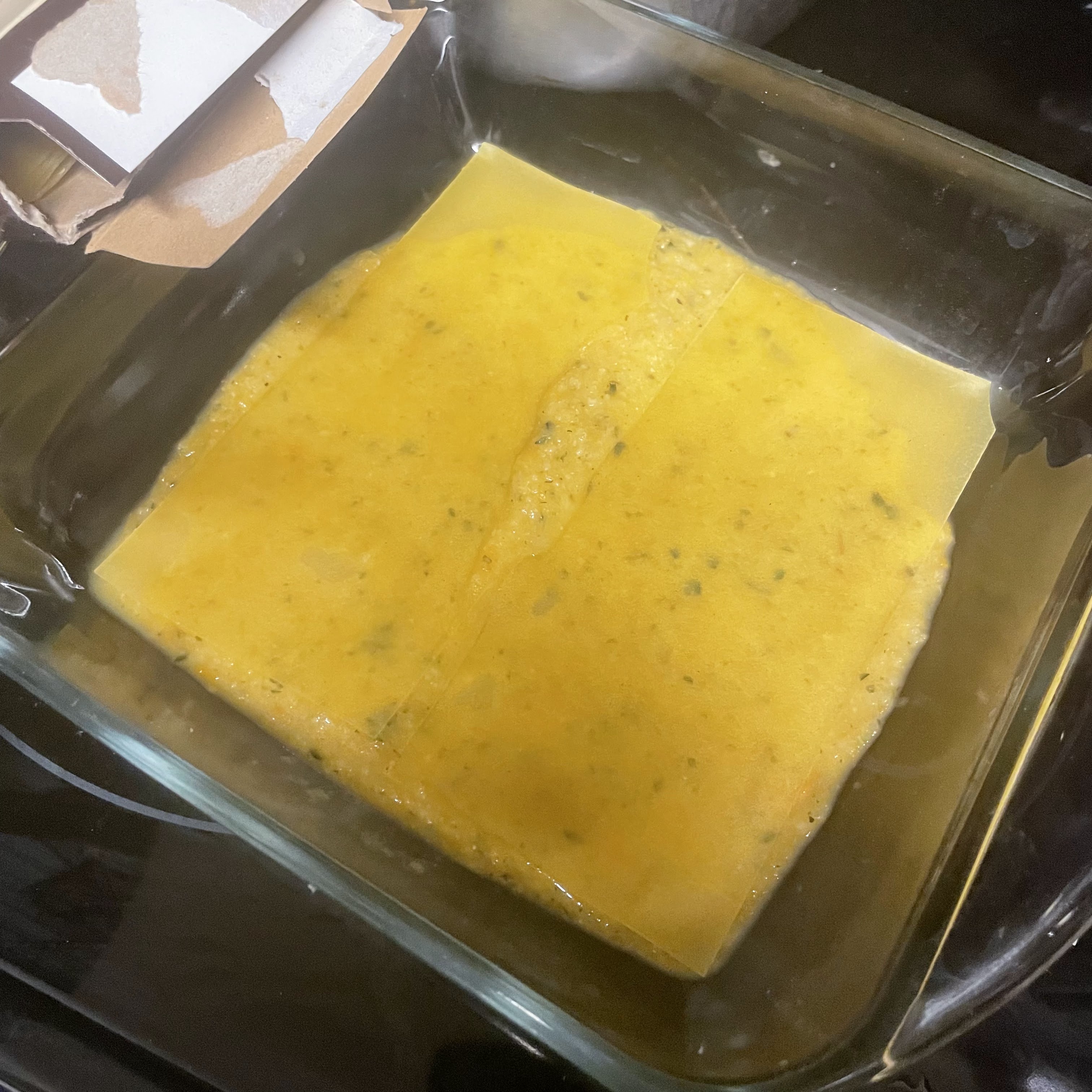
There’s no wrong way to layer lasagna, but I have a few things I like to do to ensure the no-cook noodles are given the best shot at success:

  • Start with sauce on the bottom of the pan before you put in noodle sheets
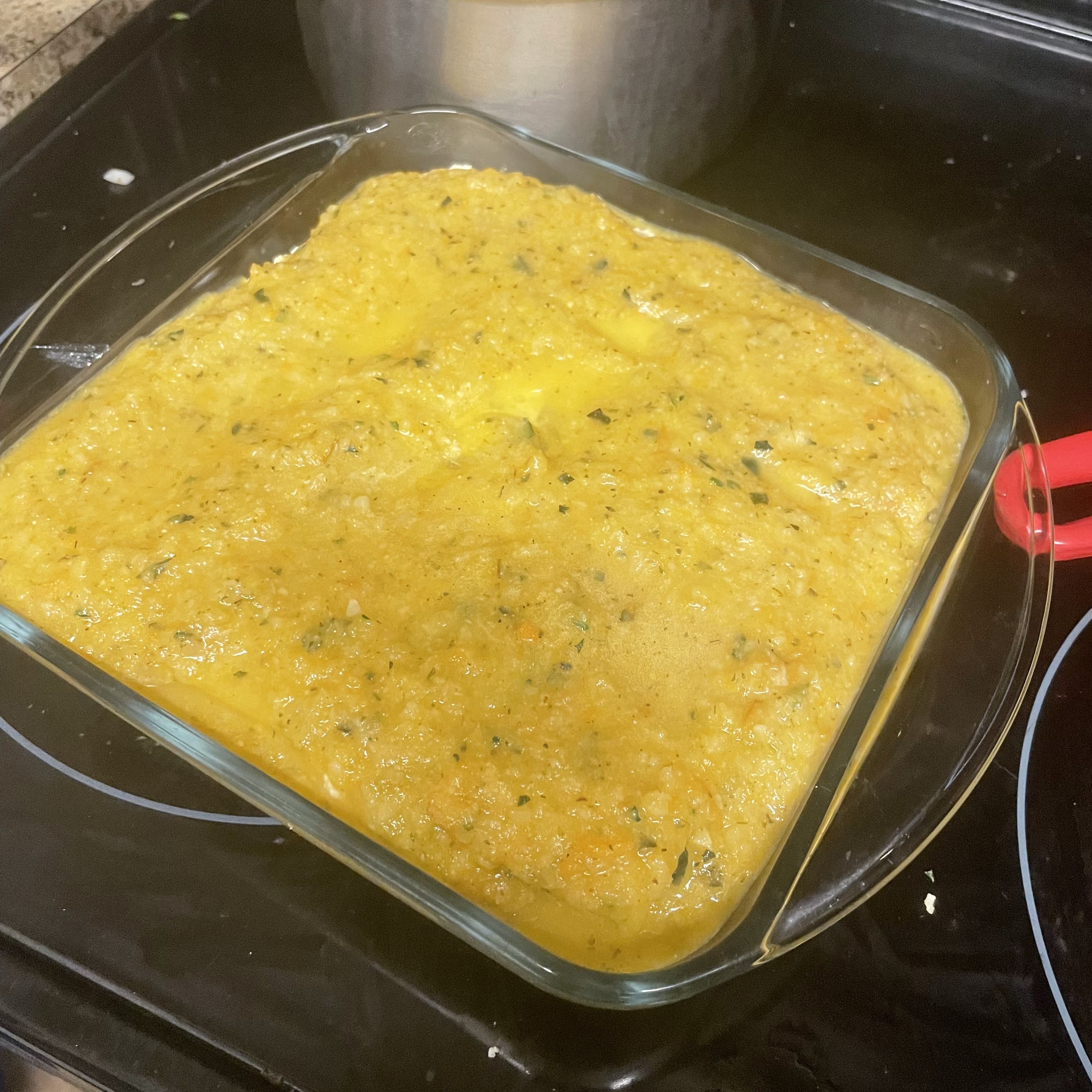
  • Top each layer with sauce so the noodles are always being set into sauce

When you do this, you ensure that there is always liquid surrounding the noodles during cooking so that they come out lovely and fully cooked like pasta should be.

Otherwise, the tip is to be patient, and to press the thicker layer instead of “spreading” them.

Final Bake

Once you’ve got all your layers done, bake at 350 for 35 minutes. If you are using any cheese on top of yours – regular or dairy free – I recommend adding at the 30-minute mark and baking for about 10 more minutes (longer if you like your cheese browned and crunchy).

Posted in Being Healthy, Cooking, corn free, gluten free, nut free, soy free

Prep-ahead Clean Lunch for $3.72: Ginger Chicken, Brussels Sprouts, Asparagus, Roasted Potatoes

You know those prep-ahead clean eating lunch videos – often from Tasty? Well, I decided to give one a whirl.

Here’s the basic concept: pick 1 protein for 3-oz servings, 2 vegetables, and 1 gluten free carbohydrate (rice, potatoes, quinoa).

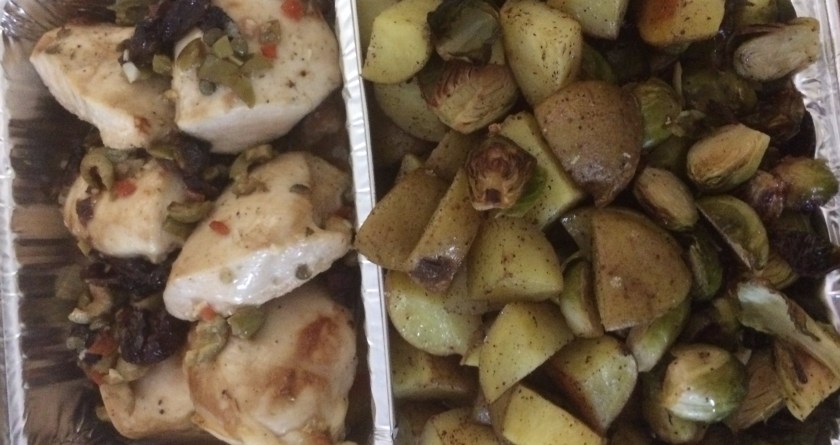
IMG_2144Mine: chicken breast with ginger aioli, brussels sprouts, asparagus and mushrooms, and creamer potatoes.

I took some help from my local Harris Teeter produce: cut and salt/pepper/garlicked brussels sprouts and asparagus pack ($3.99 each) and a ready-to-bake-in-pan package of creamer potatoes (also $3.99). The potatoes came with a seasoning packet, which I chose to use because the sodium was really, really low.

The only thing I made was garlic aioli. How? Peel some garlic – about 2 inches worth – and pour 1/4 cup of your good oil (olive, grapeseed, coconut) and a pinch of salt into your bullet blender and let it go. Then I brushed it directly onto my chicken breasts. I drizzled the little bit left over onto the brussels sprouts, just because.

Into a 450°F fully preheated oven for 30 minutes. That’s all it takes.

IMG_2148Let it cool and divvy it up into four microwave safe food storage containers. Voila. Lunch for the week – for me, at least, since I have only four days with a fixed lunch hour.
Cost Analysis

  • $2.90 – Chicken Breast – one giant one from a 6-pack, cut into 4 pieces
  • $3.99 – pre-cut asparagus with sliced mushrooms and minced garlic
  • $3.99 – pre-cut brussels sprouts seasoned with salt and pepper
  • $3.99 – creamer potatoes already in a baking pan and including seasonings

Total = $14.87

Cost per lunch = $3.72

Posted in Being Healthy, Cooking, corn free, gluten free, nut free, soy free

1-pan Dinner: Chicken Marbella with Roasted Potatoes and Brussels Sprouts

IMG_1859For a family of 2-4, this meal can be made using 1 cutting board, 1 chef’s or chopping knife, 1 mixing bowl, and 1 large baking sheet. You can make clean up even easier by lining your baking sheet with foil.

For this dinner, you’ll need

  • 4 boneless, skinless chicken breasts (or comparable chicken strips or chicken thighs)
  • 4 medium potatoes, scrubbed and diced (Yukon gold, red, russet – whatever kind you like)
  • 1 lb brussels sprouts, cleaned and halved
  • 1 Vidalia or sweet onion, large diced (optional)
  • 2-4 T good oil (olive, grapeseed, coconut)

For the Marbella marinade, you’ll need

  • 4 prunes, chopped roughly
  • 6-8 green Spanish olives stuffed with pimentos, chopped roughly
  • 1 T capers, chopped roughly
  • 1 large clove of garlic, minced
  • 1/4 cup good oil (olive, grapeseed, coconut)
  • 1/4 apple cider vinegar
  • 1/4 t salt
  • 1/4 t pepper

The night before you’ll be cooking this dinner, combine all of the Marbella marinade ingredients and whisk to mix well. Pour over the raw chicken (yep, it can even be frozen still); make sure the chicken is one layer when you put it in the fridge. It is super important that you marinate the chicken overnight.

For baking, prehead the oven to 375°F, line your baking sheet with foil and spray it down well with cooking spray.

Toss your diced potatoes and halved Brussels sprouts in good oil and salt and pepper. You can certainly add any other spices you like at this time; for pairing with the Marbella flavors, I recommend lemon pepper or dijon, something with a strong, tart flavor to contrast with the salty and sweet of the Marbella.

Lay out the chicken in a row across one end of the pan, layer the potatoes in the middle in one layer, and layer the Brussels sprouts and onions on the other end of the pan. Pour any remaining Marbella marinate over the chicken.

Place the pan on the upper rack in the center of the oven, and set the timer for 30 minutes.

Posted in Cooking, corn free, gluten free, nut free, soy free

Make Your Own Apple Cider Vinegar

Yeah, I don’t care if you believe it melts fat or flushes toxins from your body, ACV is yummy. And for folks with a corn allergy, it’s the safest vinegar to have in the kitchen.

What? You didn’t know that white vinegar, acetic acid, and even citric acid are made with corn? So, yeah, sorry to bust your bubble. But, hey, what I’m about to show you will reduce your wasted dollars AND be safe for you to use.

You know those apple peels and cores your kids won’t eat? You’re about to stop throwing those away! I happened to be making stewed spiced apples today and knew I’d have about 10 apple cores – YAY!

It’s best to start your ACV adventures with a quart. That way you’ll be able to experiment with types of apple, amounts of sugar/honey, and overall strength of flavor. I like mine very strongly tart, so I use very little honey.

IMG_1712For a strong, dark-colored ACV in a quart jar,

  • apple peels and cores to fill the jar to the top – stuff it full!
  • 2-4 T honey or sugar
  • water to cover the apple

For a lighter-colored, fruitier ACV in a quart jar,

  • IMG_17143-4 medium apples, diced, with cores
  • 1-2 T honey or sugar (you can wait to see how sweet it will be to add this)
  • water to cover the apple

Now here’s the actual “recipe” – it’s in the timing!

  1. Cover the jar with paper towel or cheesecloth and secure with a rubber IMG_1715band. Store in a dark place (mine goes on the bottom shelf of my pantry) and add a note to your calendar to check it in 21 days.
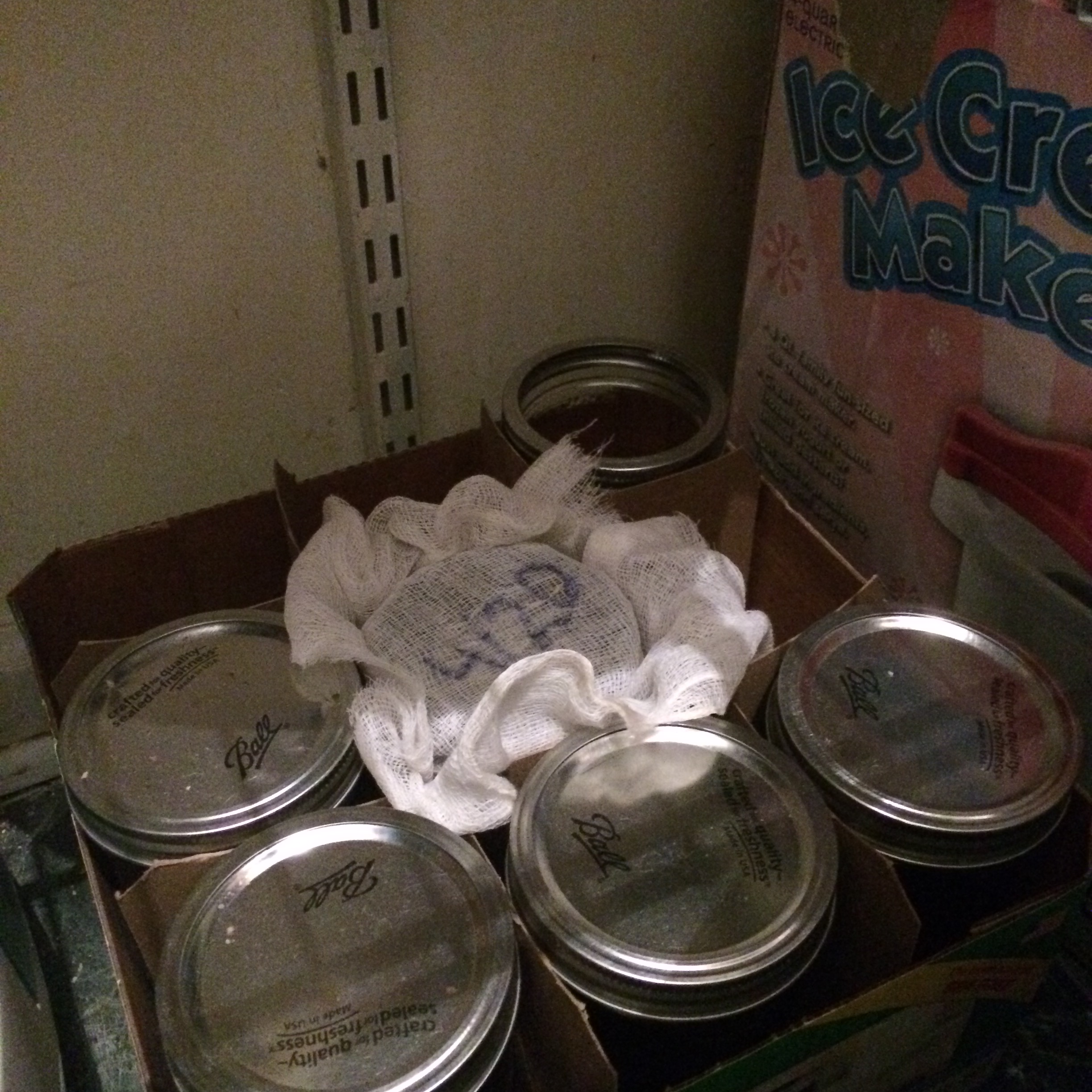
  2. Strain out the apples and return the ACV to the jar; it won’t fill to the top this time, perhaps a little past halfway. Taste and add honey to sweeten or water to weaken if it’s too strong for you already. Recover with paper towel or cheesecloth and rubber band. Add a note to your calendar to check it in 4 weeks.
  3. IMG_1716At 4 weeks, taste. If you like it, start using it and switch to a sealed jar top or bottle with a cap/lid. If it’s not there yet, re-cover and add a note to your calendar to check again in a week. Continue this process until the ACV reaches your desired taste.
I’m at the point now where I deliberately ferment to different flavor levels and acidity for use in a variety of dressings, sauces, poaching, etc.

  • Dark and Strong for sauces like my soy-free, corn-free, gluten-free soy sauce
  • Sweet and fruity for dressings and vinaigrettes
  • Light-colored short ferment for poaching – to use instead of wine (which often has corn and sulfites) or store-bought broths (which also often have corn)

Tip: if you just want the dark ACV with the peels and cores, you can dice and freeze the apple meat for use in pies, cakes, and applesauce later.

Tip: when it’s not apple season, you can save and freeze the apple peels and cores until you’ve got enough to fill the jar.


Posted in Being Healthy, Cooking

Soy and Teriyaki Sauce Alternative – soy free, corn free, gluten free

I’ve got a growing group of friends who have straight up food allergies to corn, gluten, soy – and, Lord help me, all three! And that makes safe store-bought sauces that most think of as a single ingredient not nearly impossible but actually impossible.

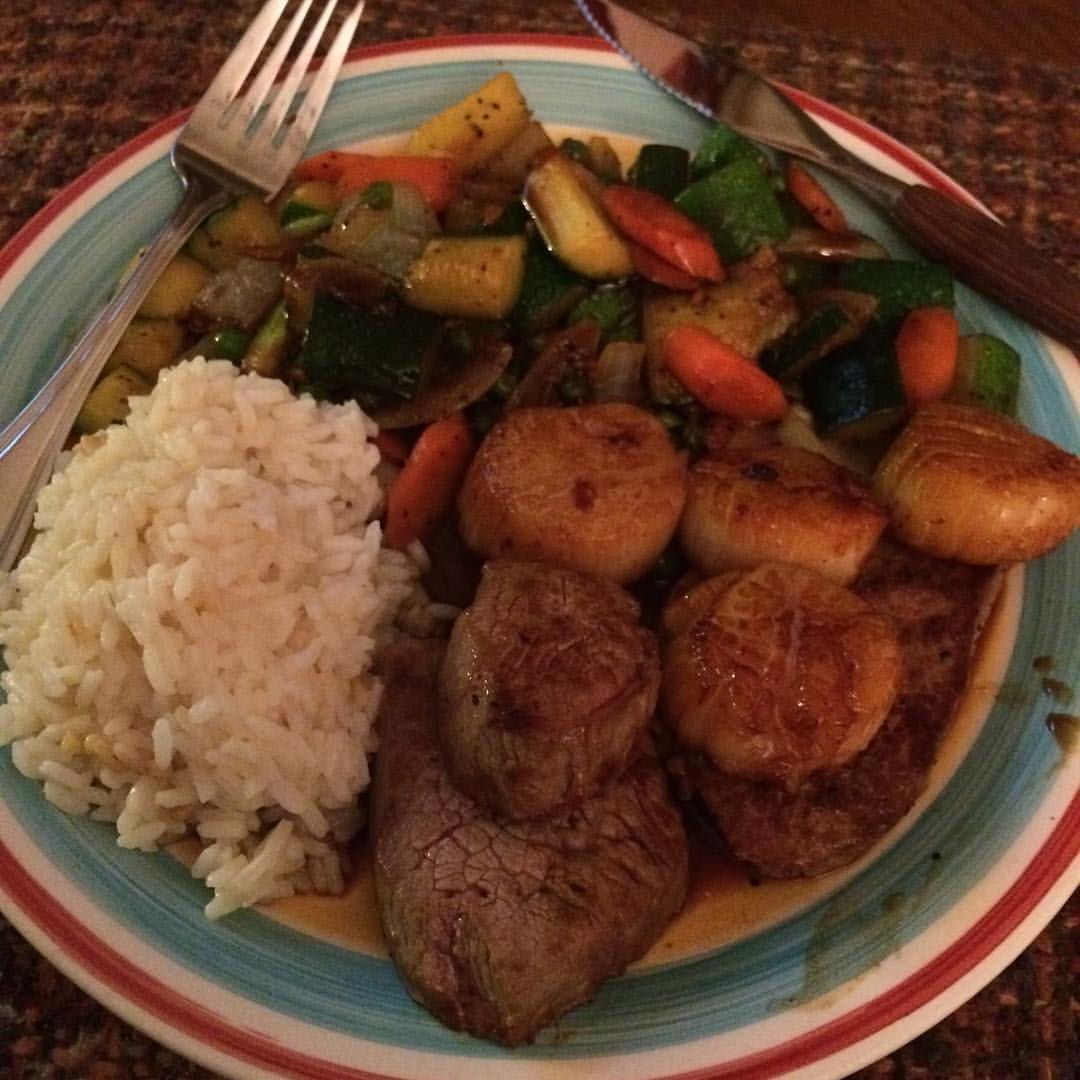
Hibachi-at-home: steak, scallops, veggies (zucchini, carrot, onion, peas), rice.
Hibachi-at-home: steak, scallops, veggies (zucchini, carrot, onion, peas), rice – using this homemade soy sauce turned into teriyaki sauce.

Here’s my alternative to soy sauce when cooking for them – and now myself since I can control the sodium level so much more!

  • 1/4 cup strong beef or mushroom broth (use homemade or Pacific brand)
  • 1/4 cup organic apple cider vinegar (make your own with this recipe)
  • 1.5 cups water
  • 2 T molasses – be sure to get organic and check the label for corn syrup or corn-derived additives – I get mine raw from a local farm
  • 2 cloves finely minced garlic – I recommend using a garlic press
  • 1/2-inch of fresh, finely minced ginger – I recommend using a cheese grater
  • 1/4 t finely ground pepper
  • kosher or sea salt – add in 1/4 t amounts until you achieve the soy sauce saltiness you like

Combine all ingredients in a sauce pan and bring to a boil. Simmer for 20 minutes. Cool and store in the refrigerator for up to 6 months.

Did you know that Teriyaki Sauce is nothing more than a sweeter soy sauce? Add 1/2 to 3/4 cups of this soy-free soy sauce to a sauce pan with 1/2 cup corn-free brown sugar, combine well and simmer for 20 minutes.

Posted in Being Healthy, Cooking, corn free, gluten free, nut free, soy free

Butternut Squash Bliss

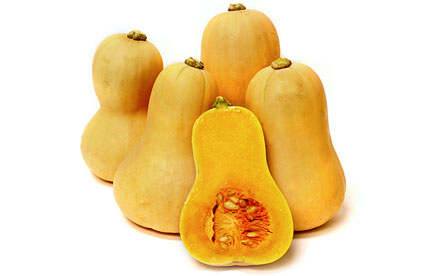
This weekend, my friend Sarah offered me her entire crop of butternut squash…because she didn’t know what to do with them. Sarah, you don’t know what you’re missing! This delicious squash has a simple, light, nutty butter flavor of its own but also provides a wonderful base for sweet or savory additions.

As we are on the cusp of Fall and the morning and evening temperatures are cooling, I’m ready to start on soups, and butternut squash soup is hands-down my favorite! Luckily it’s also the one I can’t seem to screw up despite the fact that I don’t measure…ever!

Here’s what you’ll need for my savory version of the soup:

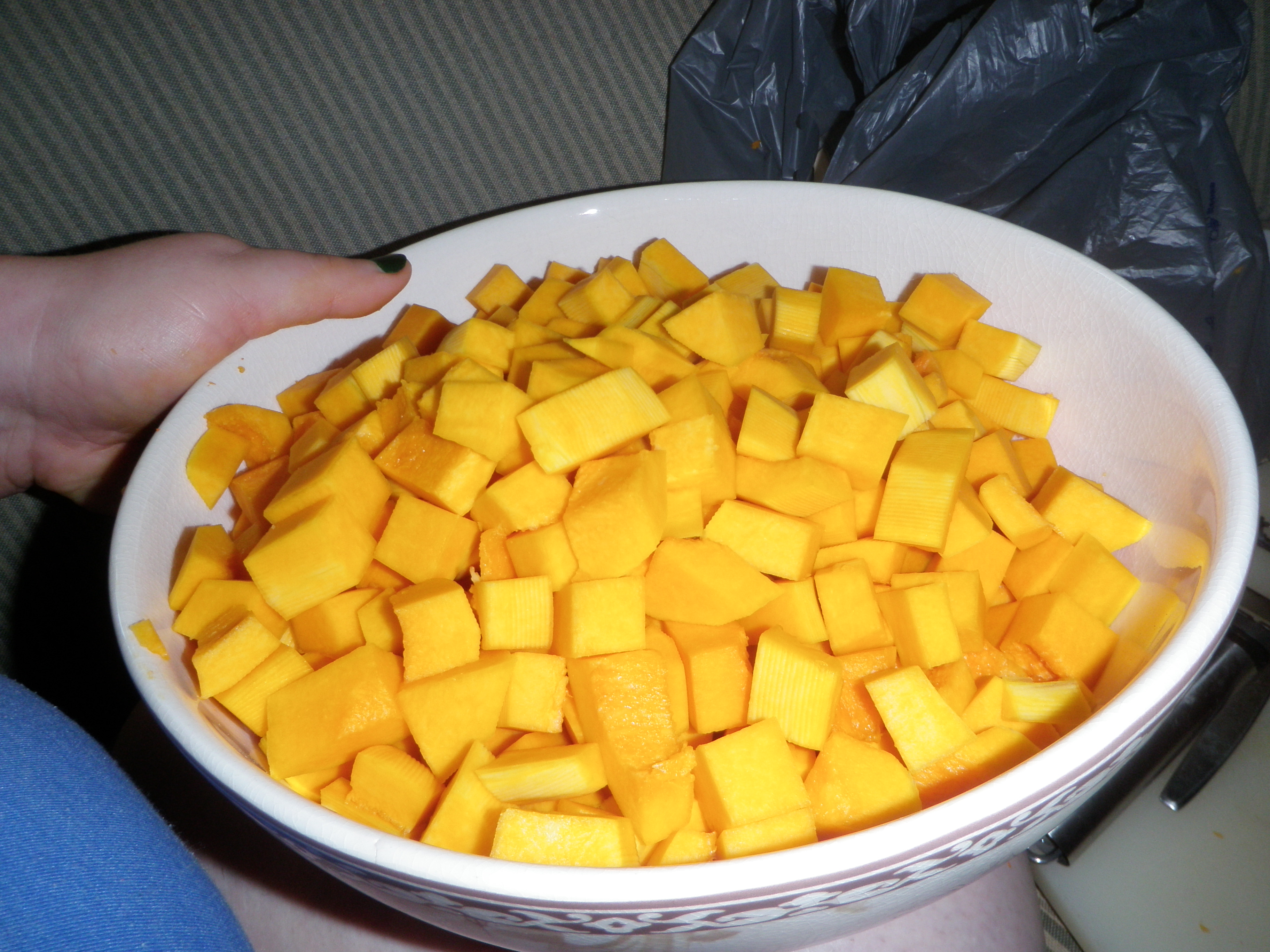
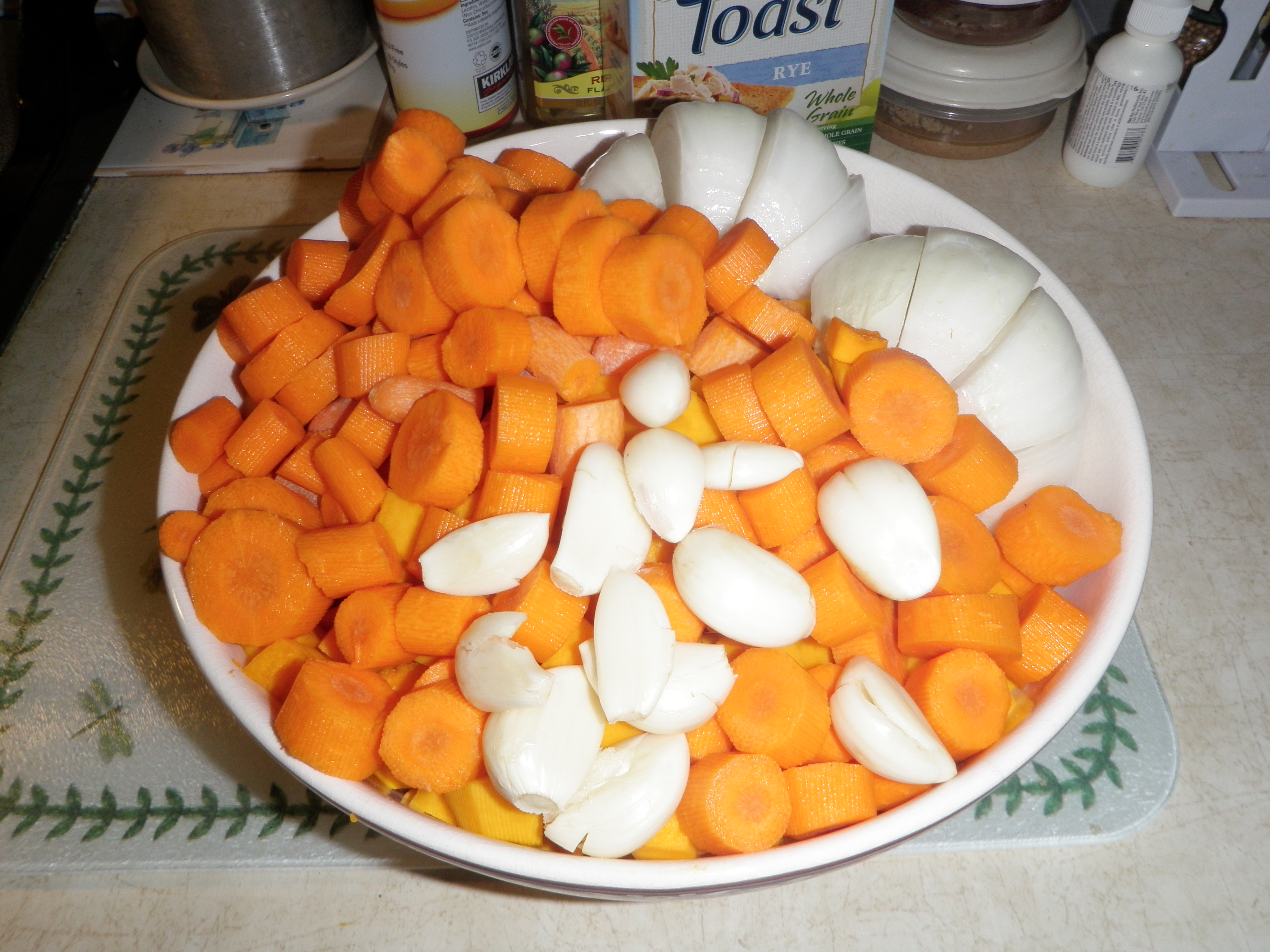
  • Butternut squash: peeled, seeded, and diced
  • Sweet onion: peeled and quartered
  • Carrots: cleaned and chopped
  • Garlic: one whole pod peeled (not one clove, but the whole pod of 10-12 cloves)
  • Stock or Cream: up to 8 cups, depending on your preference
  • Spices: Salt, Black Pepper, Ginger, Cumin, Coriander Seeds

Get all the veggies cleaned and cut. I usually do this while watching a movie, a method I “developed” from my days living in a tiny Brooklyn flat with no kitchen counters. If you’re using fresh ginger, peel, dice, and add that to the roasting mix.

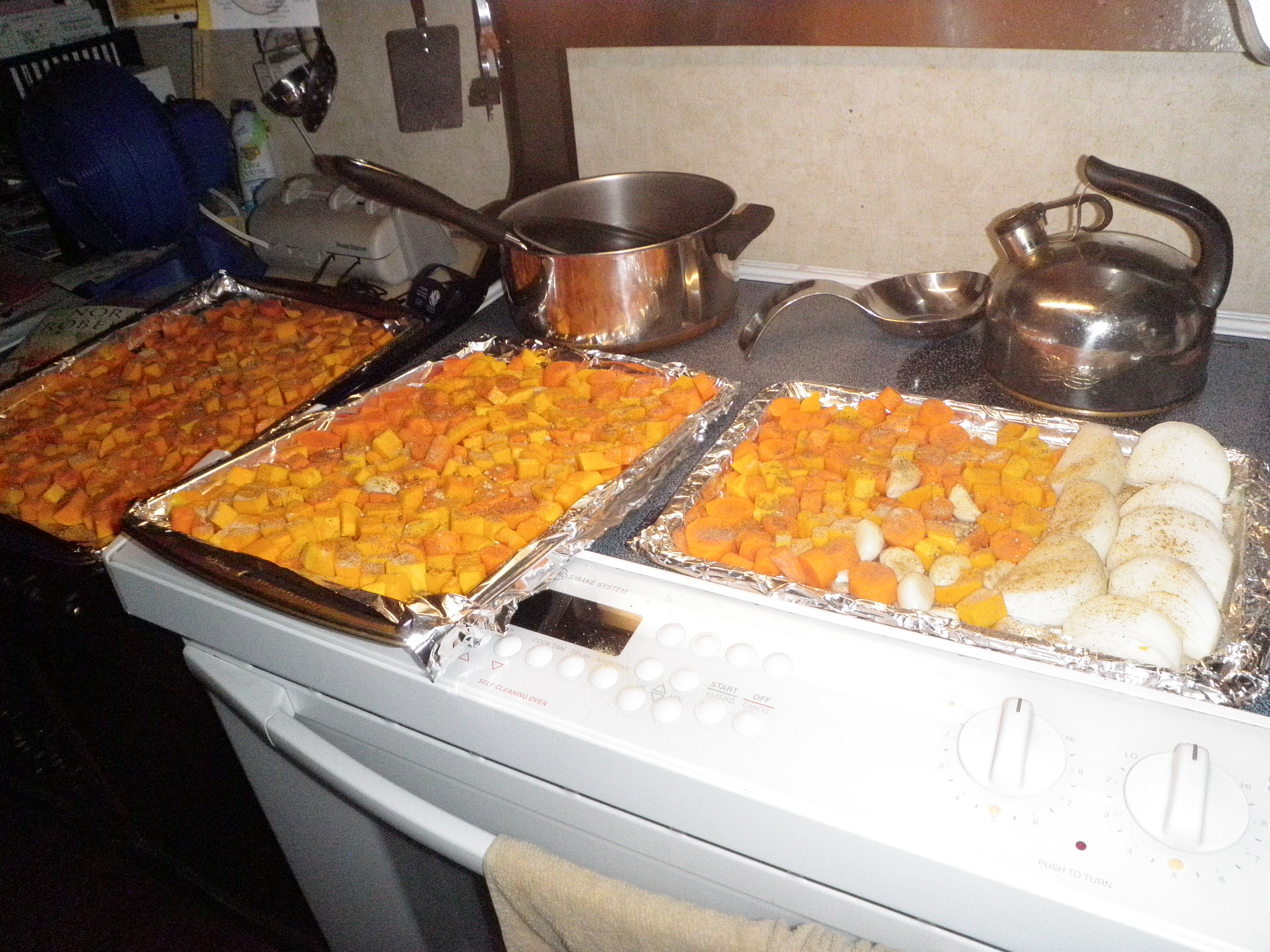
Spread them all out on cookie sheets, making sure everything is in just one layer. Dust with salt, pepper, and spices; use as much or as little as you like. Roast at 400°F for 45 minutes. Turn off the oven and let them sit for another 15 minutes.

Dump all the veggies carefully into a large stock pot. Here’s where I’ve got to talk you through some options.

Option 1: Stock or Cream

The difference between a soup or a bisque is the use of stock or cream as your thinning or thickening agent. There are a few other options besides cream for a bisque, but that’s the traditional one. Vegans can choose vegetable stock or soy or rice milk. For the least flavor interference, use homemade vegetable or chicken stock. For a richer, velvety flavor, use beef stock. For the sweeter version of this soup, use ham or veal stock. And you can always use just plain water, especially if you are looking for a thicker consistency and not worried about having to use too much.

Option 2: Blending Method

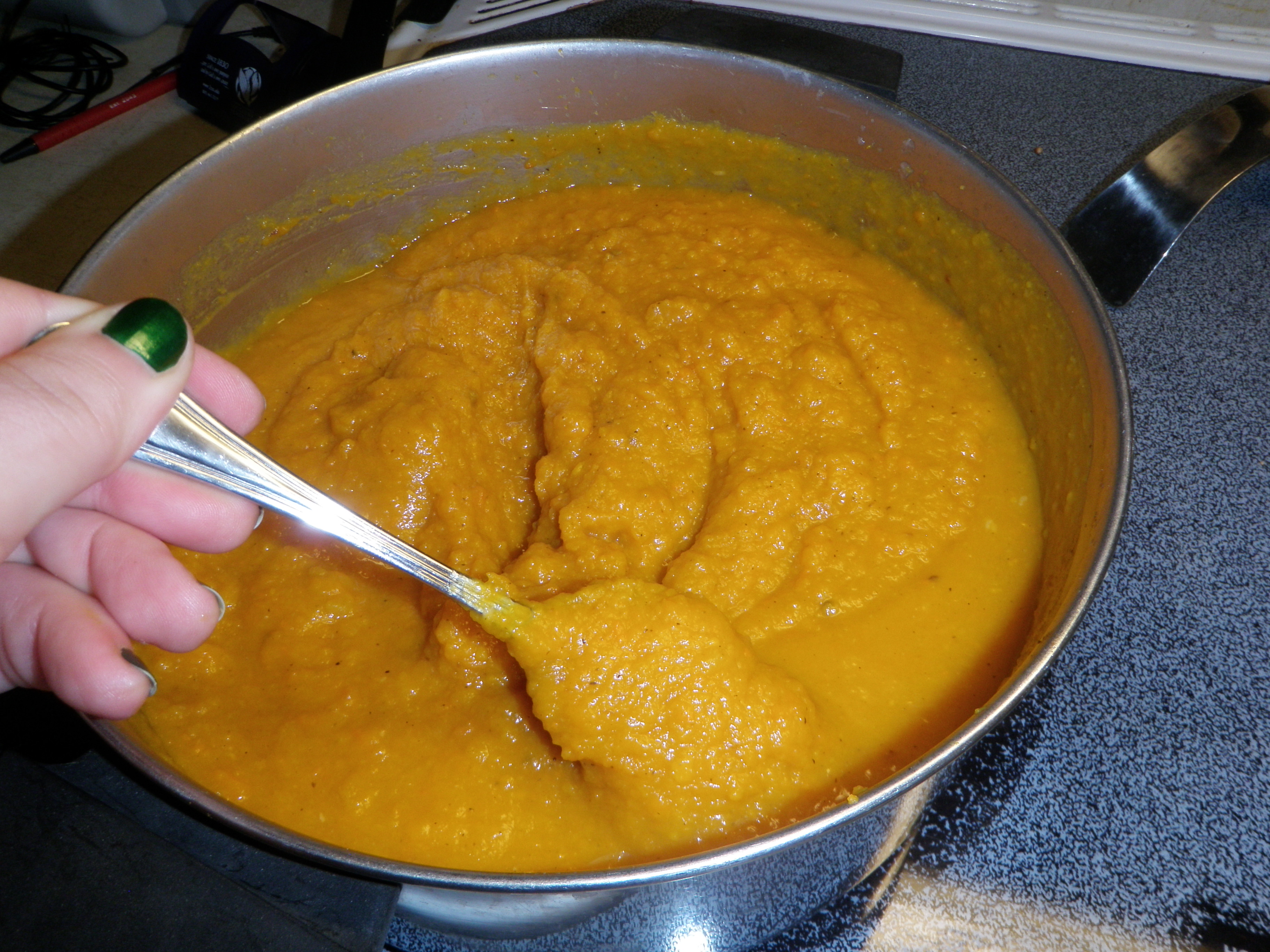
If you’ve watched chefs on cooking shows make soup, you’ve seen the two methods: blender or immersion wand. Both can achieve the same level of smoothness, but the traditional blender will get you there faster; just make sure the veggies have cooled to room temperature before using the traditional blender. Me, I like the convenience of the immersion wand because I can pretty much put all of the veggies in at one time and both see and feel the consistency as I’m blending; it offers a level of control that you don’t get with the traditional blender.

I like my soups with a strong “mouth feel,” which usually translates into thick or stew-like. I know it makes the blended soups look like baby food and/or baby poo, which, by the way, reminds me to tell you that this is exactly how to make your own baby food; studies show that children who eat the same food and same seasonings in their baby food as their parents have on their plates aren’t as picky during their formative years, making meal time much easier to deal with.

When my Mom insists on the sweeter version of this soup, it goes something like this:

  • Butternut squash
  • Carrots
  • Onion
  • Cream
  • Ginger, Nutmeg, Cinnamon, Brown Sugar (during blending)

This version comes out similar to sweet potato soufflé (aka sweet potato casserole) with Thanksgiving spices and sweetness. I just don’t happen to like that very much.

Note for Sarah: other ways I use butternut squash:

  • Oven or deep fried fries…similar to sweet potato fries
  • Winter Veggie Salad with b. squash, zucchini, carrots, onions (or mix with orzo or rice or risotto)
  • Mashed butternut squash
  • Ravioli or Lasagna filling