Posted in Being Healthy, coeliac friendly, Cooking, corn free, dairy free, diabetes, diabetic friendly, gluten free, low carb, nut free

Middle Eastern Chicken and Potato Dupe

While doom scrolling one night, I came across this recipe video for Middle Eastern Chicken and Potato one pot bake. Mmmm, mm – now that’s my kind of dinner inspiration.
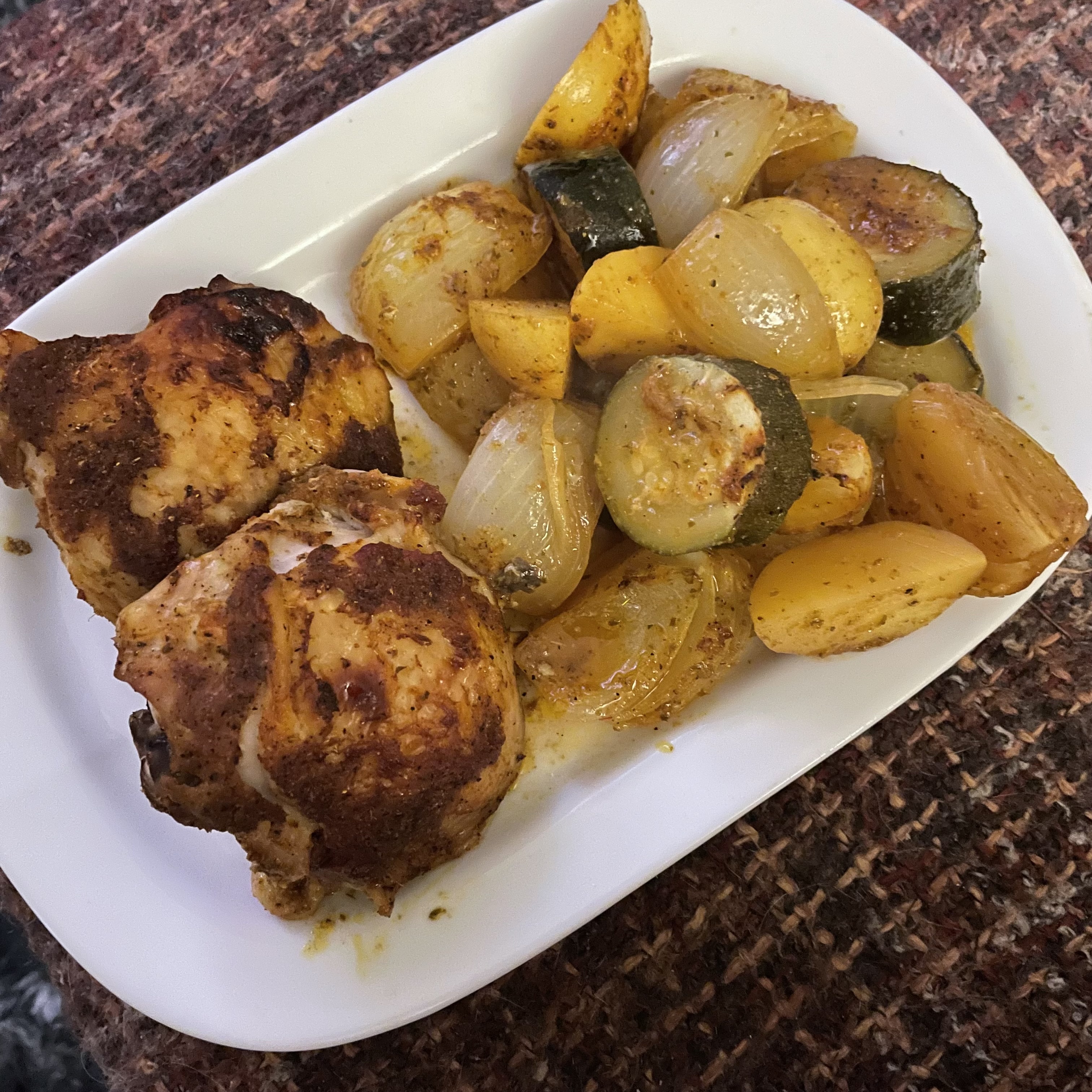
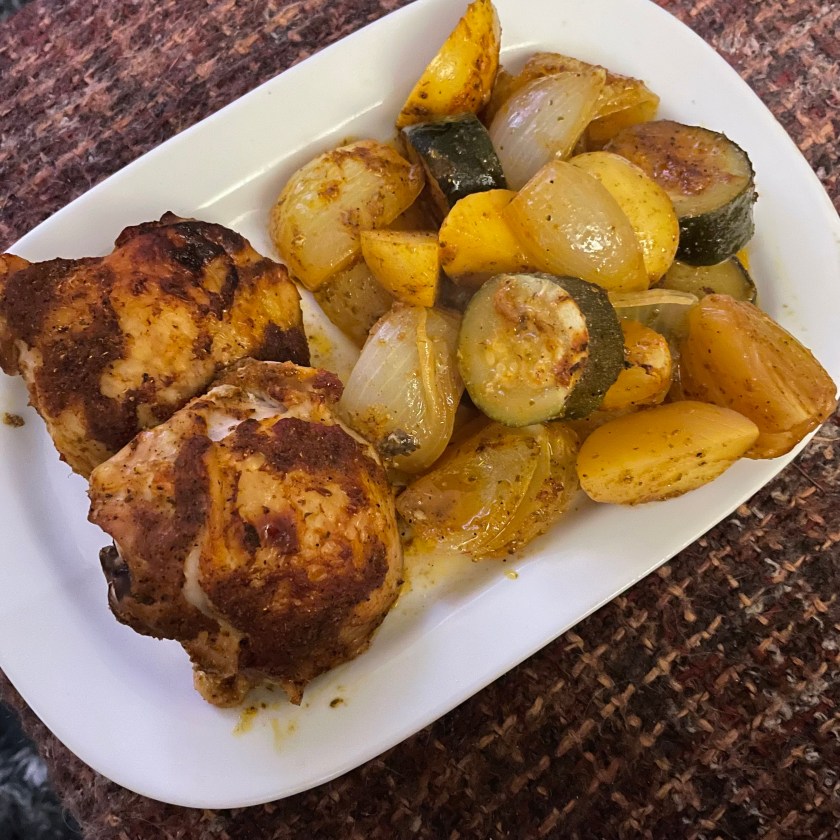
plated vision

The Things I Like and Will Use

One pot – while the video shows using a pot that is commonly used when starting a meal on the stove and then finishing in the oven, there’s no reason you can’t or shouldn’t use a sheet pan or standard baking dish.

Chicken thighs – bone in with the skin – this is my favorite piece of chicken to cook with. The little extra fat keeps it juicy while cooking and adds that little bit of extra flavor you just can’t get from a chicken breast.

Covered and uncovered cooking. When cooking meat with the bone in, it can be hard to confidently cook it through, so cooking covered – foil or lid – is an excellent way to achieve this. And then the shorter uncovered time is for crisping up the skin so if you are eating that (and you don’t have to), it’s a delightfully crispy crunch.

The Things I’ll Take Inspiration From and Why

Now, I love the idea and all of the individual and collective flavors of this dish, but I find myself on a tighter food budget these days. So here’s how I’m making this work with what’s in my pantry.

Lemon – rather than rely on fresh lemons and their rising cost from tariffs, I keep a bottle of lemon juice in the fridge. It’s controversial with professional chefs, but it’s far more versatile and I don’t have to worry about it going bad or drying out.

And as it happens, I also just bought a ton of Greek lemon infused olive oil, so I’ll also be prepping the baking dish with this lemon oil to contribute to the dish as well.

Tomato paste – I don’t cook anything that uses tomato paste – not even marinara. So I never have this ingredient in the house. What do I have? Ketchup. So tonight, the “sauce” base is ketchup.

Aleppo pepper – that’s a pretty specific spice that’s not part of my pantry, but in the spirit of peppers with and without heat, I have lots of others. For this, I added a squeeze of Sriracha for just a hint of heat and smoked paprika for the smokiness from dried pepper.

Cumin – so I definitely have cumin, but I was feeling more curry, so I switched. That simple – followed what my palate was more interest in.

Carbs – so this dish as shown in the video is pretty high carb and not at all diabetic friendly, so I made some simple additions and one subtraction to balance this out:

  • removed rice – because rice is my least favorite carb
  • added quartered onions
  • added chunks of zucchini

Both the onion and zucchini are highly traditional additions to meals from countries and cultures east of the Mediterranean to the Indian Ocean and to the Pacific.

Side Note on the Term “Middle Eastern”

I’m nearing my 50th birthday as I make this dinner, and I recall a video excerpt I found earlier this week that challenged the terms “middle East” and “far East” as colonial, and therefore, oppressive terms. Yes, I agree, and I wanted to bring your attention to this. You see, the words “middle” and “east” only have meaning when we know the origin point – middle compared to what? east compared to what fixed point. In this case – it’s London – the center of the British colonial empire.

In that paradigm, then, “East” refers to everything east of the Mediterranean to the Pacific ocean, the middle of which is the Arabic and Indian countries and cultures and the “far” of which is the aggregate of the Asian cultures.

I offer these as generalized geographic assignments for the colonial “Middle East”:

  • Western Asia
  • Southwest Asia
  • West Asia and North Africa (WANA)

I offer these as generalized geographic assignments for the colonial “Far East”:

  • East Asia
  • Pacific Asia
  • Northeast Asia – Korea, Japan, northern China
  • Southeast Asia – Vietnam, Thailand, Indonesia

I offer these as generalized geographic assignments for the colonial “Indian subcontinent”:

  • South Asia
  • The subcontinent

I offer these as generalized geographic assignments for Arabic-speaking regions

  • Arab world or Arab states
  • North Africa and Arabian Peninsula

These alternatives focus on the geography relative to the region itself rather that in comparison with a conquering or colonial empire center.

One of the obvious challenges to Westerners is that our sense of world geography is likely to confound most in correcting our terminology. Beyond that, these terms have been assigned cultural meaning as well that may not align with the geographic/continental mapping, where a term like “Middle Eastern” is generalize to Arabic speaking countries regardless of their geographic location, and likewise “Far East” to a reductive understanding of Asian to refer to those of Chinese, Japanese, Thai, Vietnamese, Korea, and Indonesian descent.

This discussion deserves far more exploration, so thank you for not skimming just to get to more details about the recipe.

The Ingredients

In the recommended order of preparing (to make it easy to assemble):

  • 8 tiny golden creamer potatoes, quartered (or 4 medium or 2 large)
  • 3-4 small yellow or white onions, peeled and quartered
  • 2 medium zucchinis, cut into 1-inch thick “slices” or round chunks
  • 1/2 cup ketchup (or the tomato and pepper paste combo from the original recipe)
  • 1/2 lemon juice (bottle or fresh squeezed)
  • 1T Sriracha (or 1T Aleppo pepper from the original recipe)
  • 1T curry (or cumin from the original recipe)
  • 1T garlic powder (or 4-5 fresh cloves minced)
  • 1T oregano
  • 2t salt
  • 1t pepper
  • 4-6 chicken thighs, bone in with skin (or breasts or leg quarters)

The Assembly Process

Here’s how to layer it all into your baking dish.

Step 1: wash and chop your potatoes, onion, and zucchini. Drop them all into a greased baking dish, ideally into a single layer. They’ll be squished together, which is good.

potatoes, onions, and zucchini - large cut and mixed in the bottom of the baking dish

Step 2: in a measuring cup or other vessel with a pour spout, add your wet and spice ingredients and then mix well with a whisk or fork.
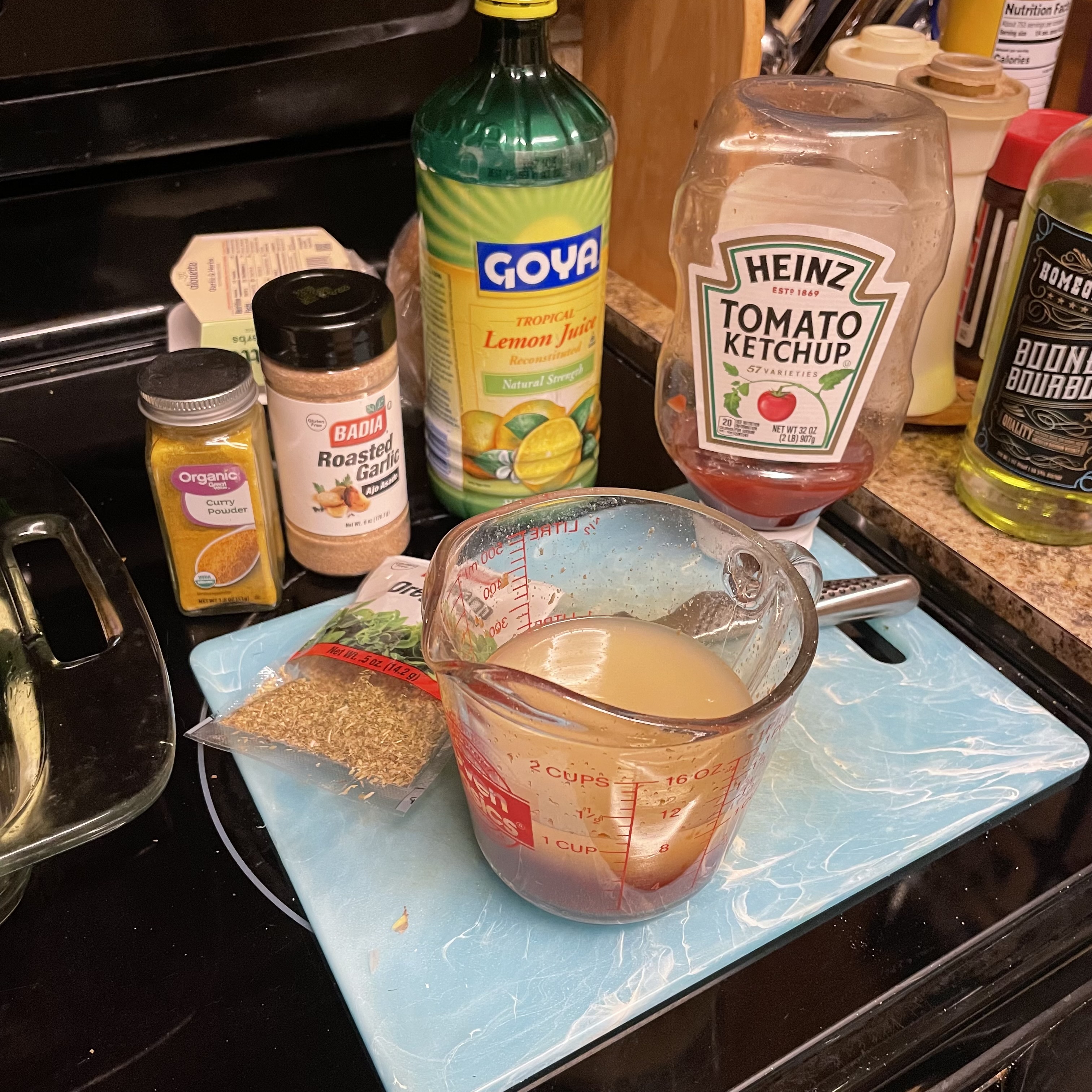
sauce ingredients collected and started in the measuring cup with pour spout

Step 3: pour about half of the sauce over the veggies. Use a spoon or tongs to toss the veggies in the sauce to coat all sides.

Step 4: place your chicken on top.

Step 5: pour most of the remaining sauce and use your hand(s) to quickly coat the entire chicken thigh – not just the top. Pour any remaining sauce on top of the chicken.
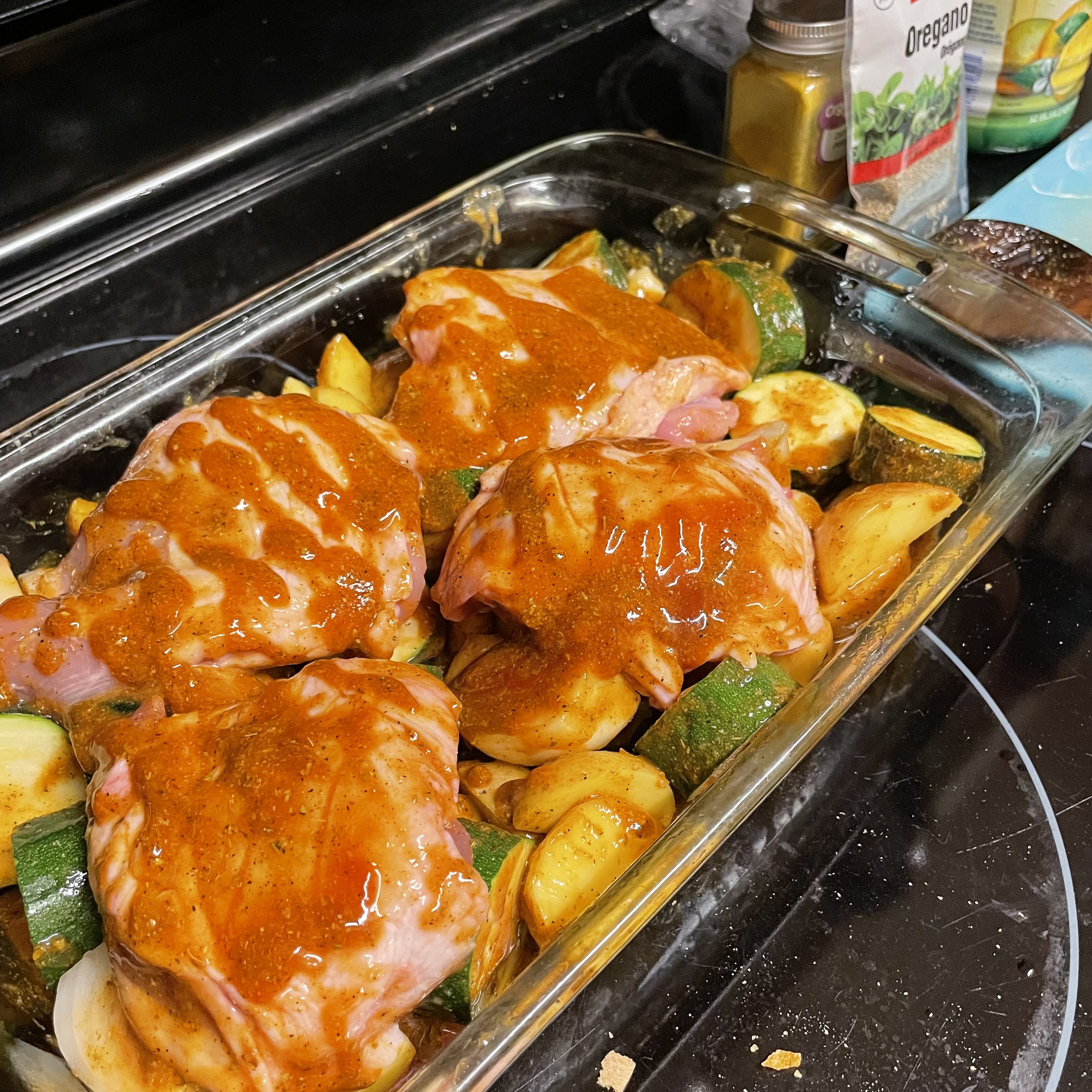
use all of the sauce - half on the veggies first and the remaining amount on the chicken placed on top of the veggies in the backing dish

The Cooking Process

Step 1: preheat the oven to 400 degrees Farenheit. NOTE: I do not wait for the oven to fully preheat to put in the dish; my oven rarely takes more than 7-8 minutes total to preheat, so the difference is negligible for such a long-baking dish.

Step 2: cover the baking dish with foil, wrapping the edges snuggly around the end handles.
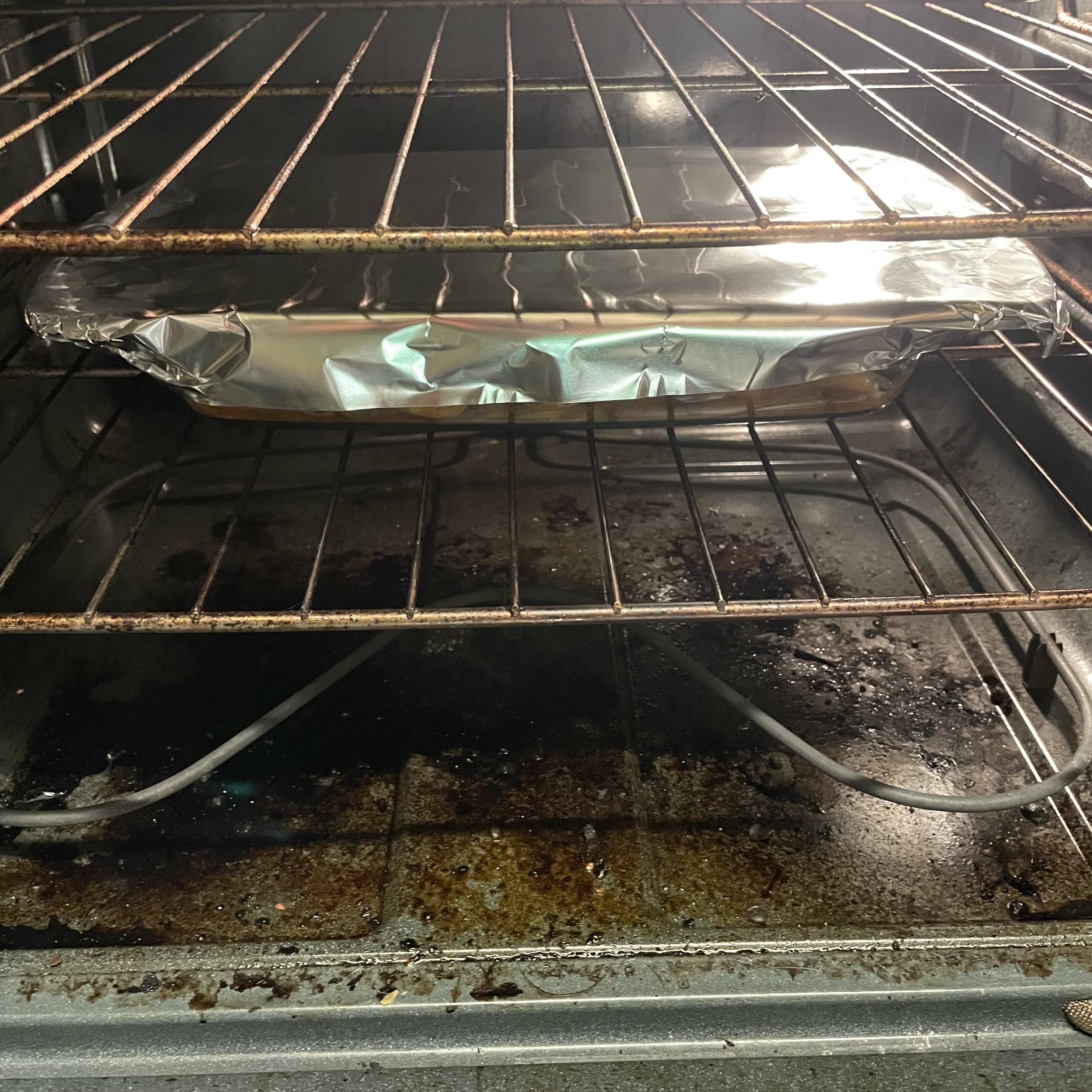
foil sealed baking dish placed on the lowest oven rack (closest to the baking heating element)

Step 3: bake for 45 minutes with the foil on and on the lowest rack, closest to the baking element (usually at the bottom of the oven).

Step 4: slide out the oven rack and remove the foil lid.
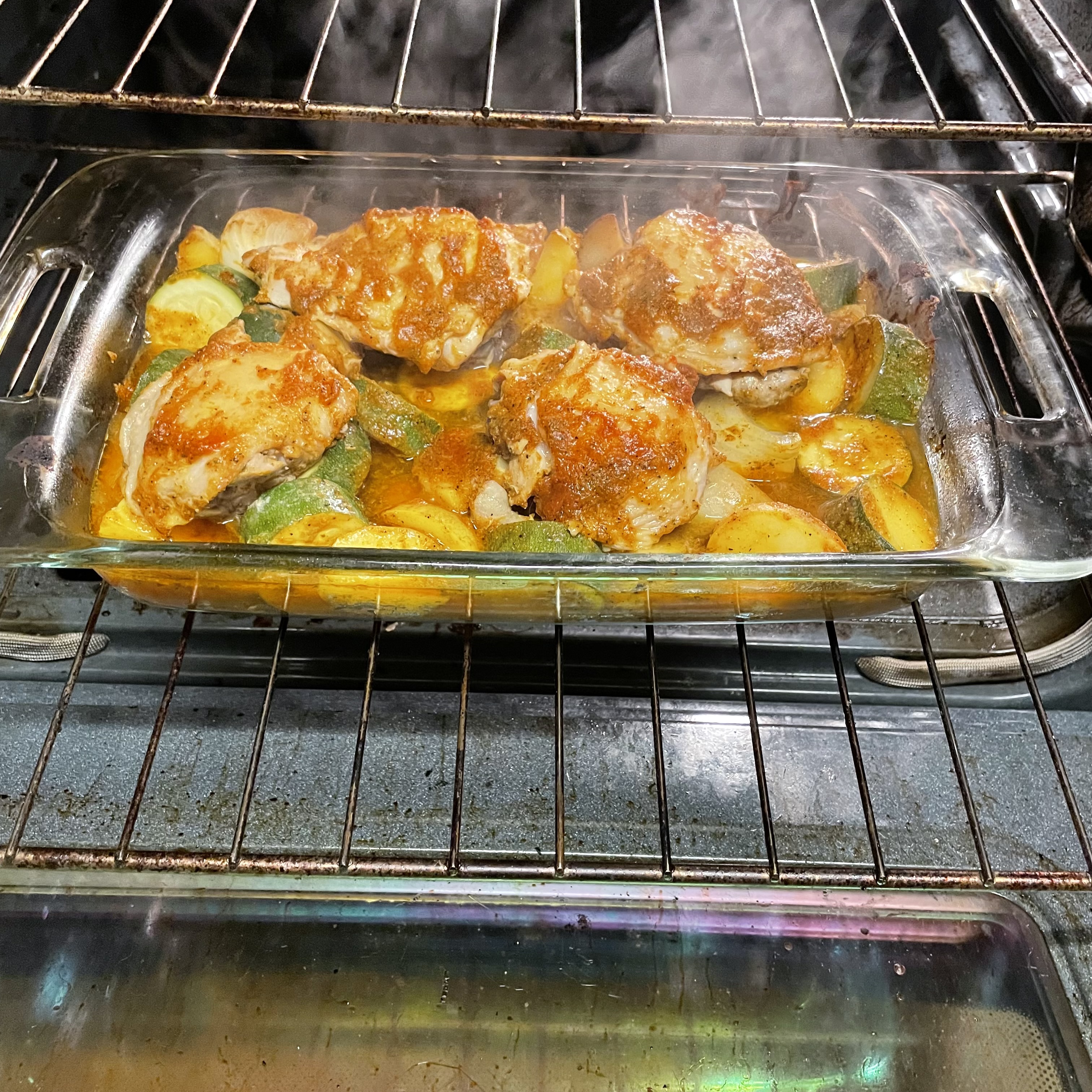
uncovered for the final 15-20 minutes

Step 5: push the oven rack back in and set the timer for another 15 minutes. This is an essential step for cooking the skin to be pleasant to eat and ensure the meat is fully cooked.

Step 6: take out of the oven and let rest for 10-15 minutes to cool enough to eat without burning fingers and tongues.

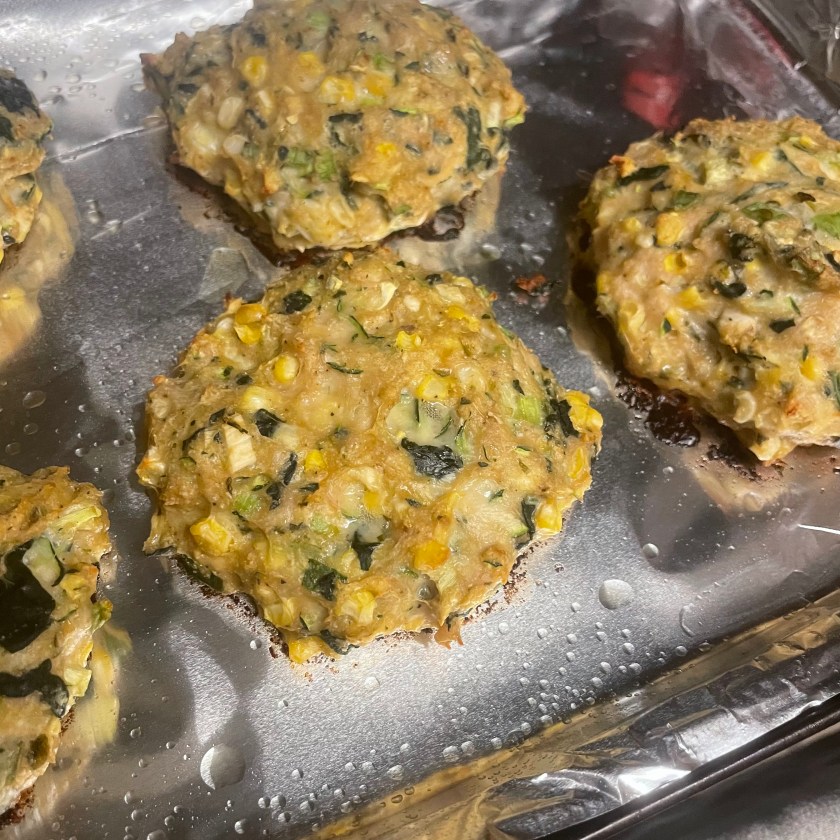
when it’s all done – let cool and serve

Enjoy!

Posted in Being Healthy, coeliac friendly, Cooking, dairy free, diabetes, diabetic friendly, gluten free, low carb, nut free, soy free

Chicken, Zucchini, and Corn Burgers

I’ve been craving zucchini fritters and corn fritters and have been on a ground chicken kick, so when I came across this recipe for Chicken, Zucchini, and Corn Burgers from The Cafe Sucre Farine, the ingredients when on the shopping list!

And if you’ve followed me for any length of time, you know I had to make a couple of modifications due to food allergies – though thankfully not huge changes:

  • red peppers (nightshades) are replaced by chopped frozen spinach
  • panko (gluten) is replaced by chickpea flour

Check out how this recipe when for me.

Mise en Place

I’ve been taking an online cooking course in gluten-free and dairy-free cooking, and the first lesson isn’t in cooking itself but in the philosophy of mise en place – preparing all of your raw ingredients so that once you begin with assembly, you won’t have to stop or worry about missing something as you move efficiently through the cooking process. So that’s how I started here since it’s all raw ingredients, mixing and shaping, and then cooking.

  • 1 lb ground chicken
  • 1 cob of corn, kernels sliced off
  • 1 cup shredded and drained zucchini
  • 1/2 cup frozen chopped spinach
  • 4 green onions, sliced
  • 3 cloves garlic, minced
  • 1 egg, beaten
  • 4-6T chickpea flour
  • 2T cilantro
  • 1T cuminn
  • 1T salt
  • 1/2T pepper

Mix with Your Hands

Both sides of my family – the country cooks and the city cooks – have a hands-on approach to cooking. Pretty much any time ground meat is mixed, we use our hands. And this is no exception, especially since I choose to form the burgers and place them on a cookie sheet to bake rather than cook in a skillet.

With replacing the panko with chickpea flour instead of gluten free break crumbs or panko, the mixture remains a bit more wet since there’s not as much carbohydrate to soak up the moisture from the egg, vegetables, and chicken.

I chose to go with the chickpea flour because I wanted more nutritional value than any bread crumb or panko – regular or gluten free – provides while achieving similar results. I also like keeping the moisture available during the cooking process so that the resulting burgers are still juicy.

Meal Prep

And that’s how meal prep is done for this week. These protein- and vitamin-packed burgers will accompany my gluten-free, dairy-free, nightshade-free lasagna for lunch at work.

Posted in Cooking, corn free, gluten free, nut free, soy free

The Secrets to Perfect Every Time Homemade Caramel Sauce

When corn and all of its derivatives became persona non grata (food allergy) in my family, we had to go searching for the old homemade recipes from before WW1, when corn syrup made its debut into home pantries as an inexpensive alternative to sugar.

And – gratefully – I found among our family recipes “Bon’s Burnt Sugar Sauce.” Aunt Bon was my grandfather Joe Jones’s oldest sister Yvonne, whom the family nicknamed Bon. And she was my mom’s favorite candy-making expert. We also use her divinity and whipped fudge recipes at the holidays.

The good news: homemade caramel, whether you are making sauce or candy chews, is a really quick recipe – about 3 minutes to measure out the three ingredients to be ready, about 10 minutes from dry sugar to completed sauce, and another minute to pour it into a jar. And done.

The bad news: there’s about a 3 second line between caramelized and burnt so badly you can’t eat it. Melting and caramelizing the sugar is “the hard part” and a candy thermometer won’t help you.

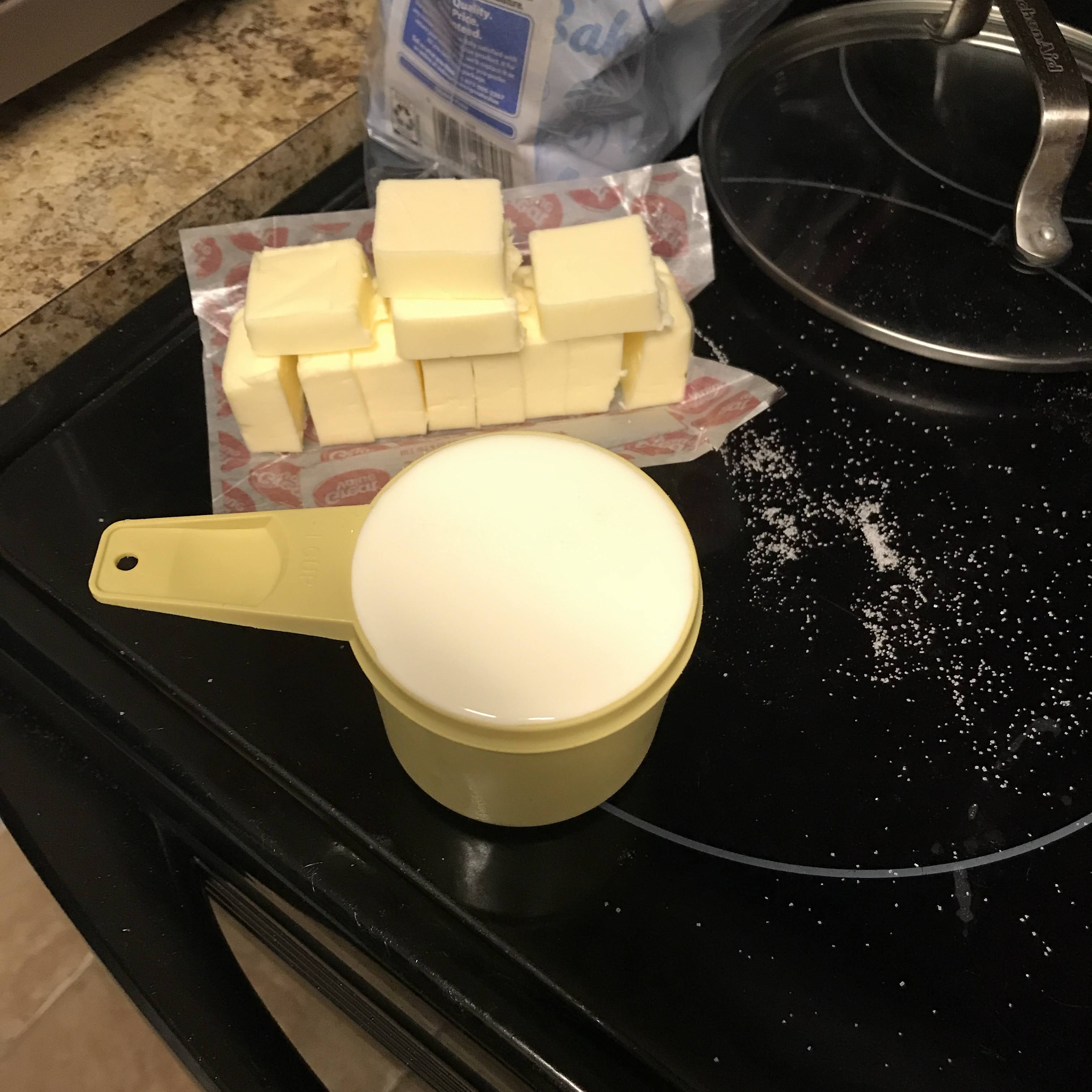
So let’s get ready. This is a recipe where you can’t be measuring ingredients as you go. It literally happens too fast for that.

Tools needed:

  • enamelled cast iron 6-8 quart pot
  • non-reactive stirring spoon – like firm silicone – or a metal/silicone whisk
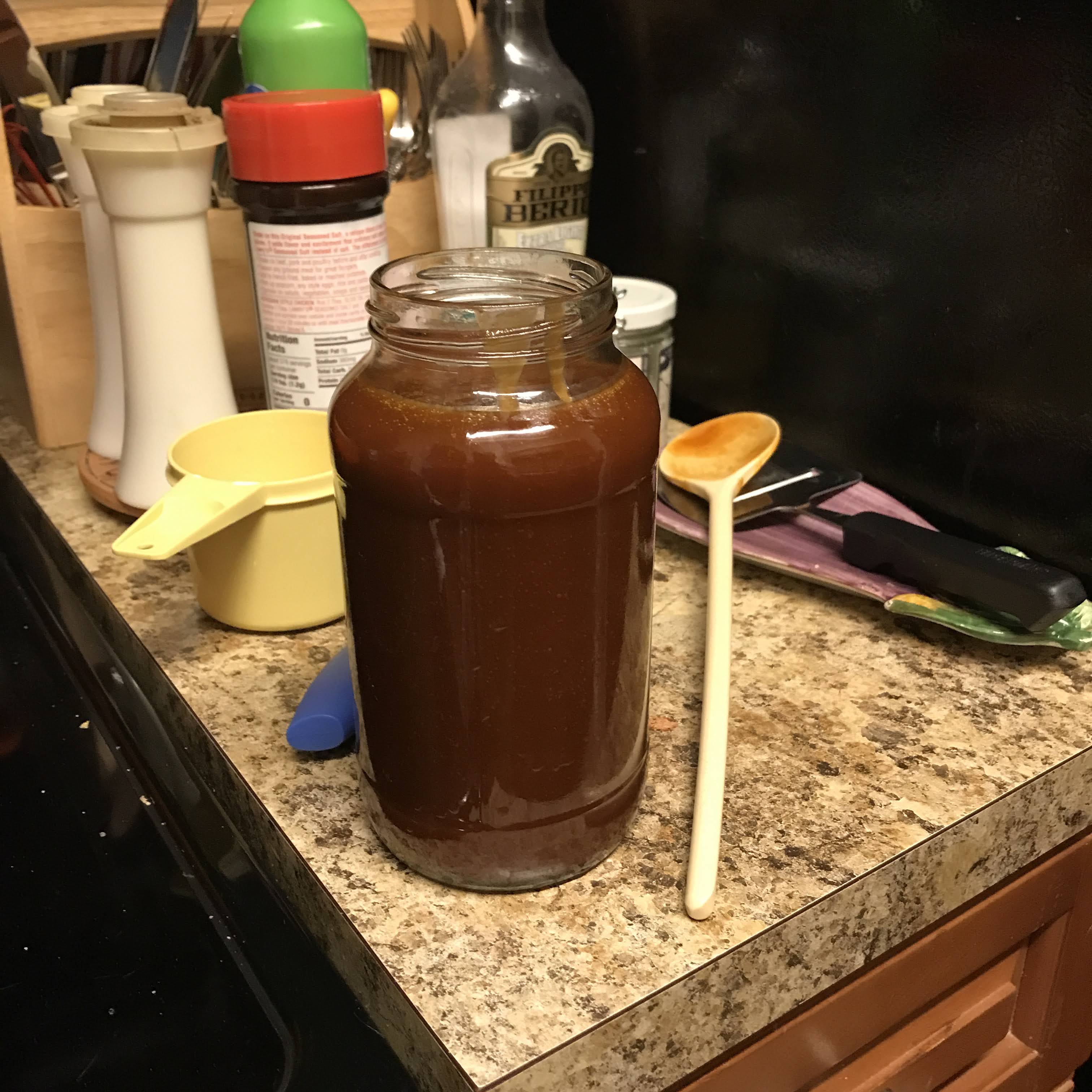
  • glass or ceramic container with a lid – if I don’t have any fancy mason or ball jars, I like to re-use spaghetti sauce jars as they are just the right size

Ingredients needed for roughly 24 oz (4 cups) of caramel sauce

  • 2 cups granulated sugar
  • 12 Tbsp salted butter, cut into 1 Tbsp slices
  • 1 cup heavy cream

Alright, you’re ready to get started.

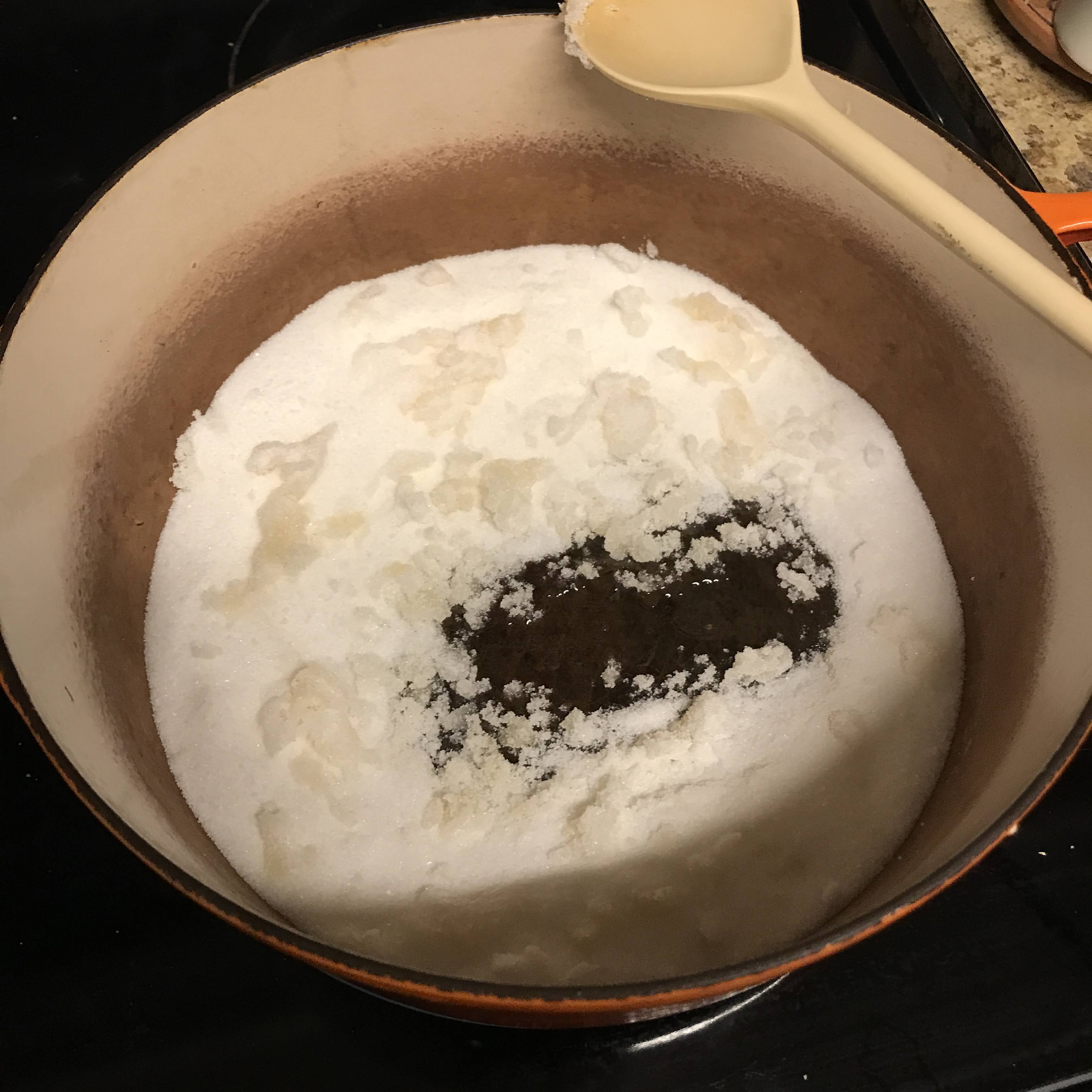
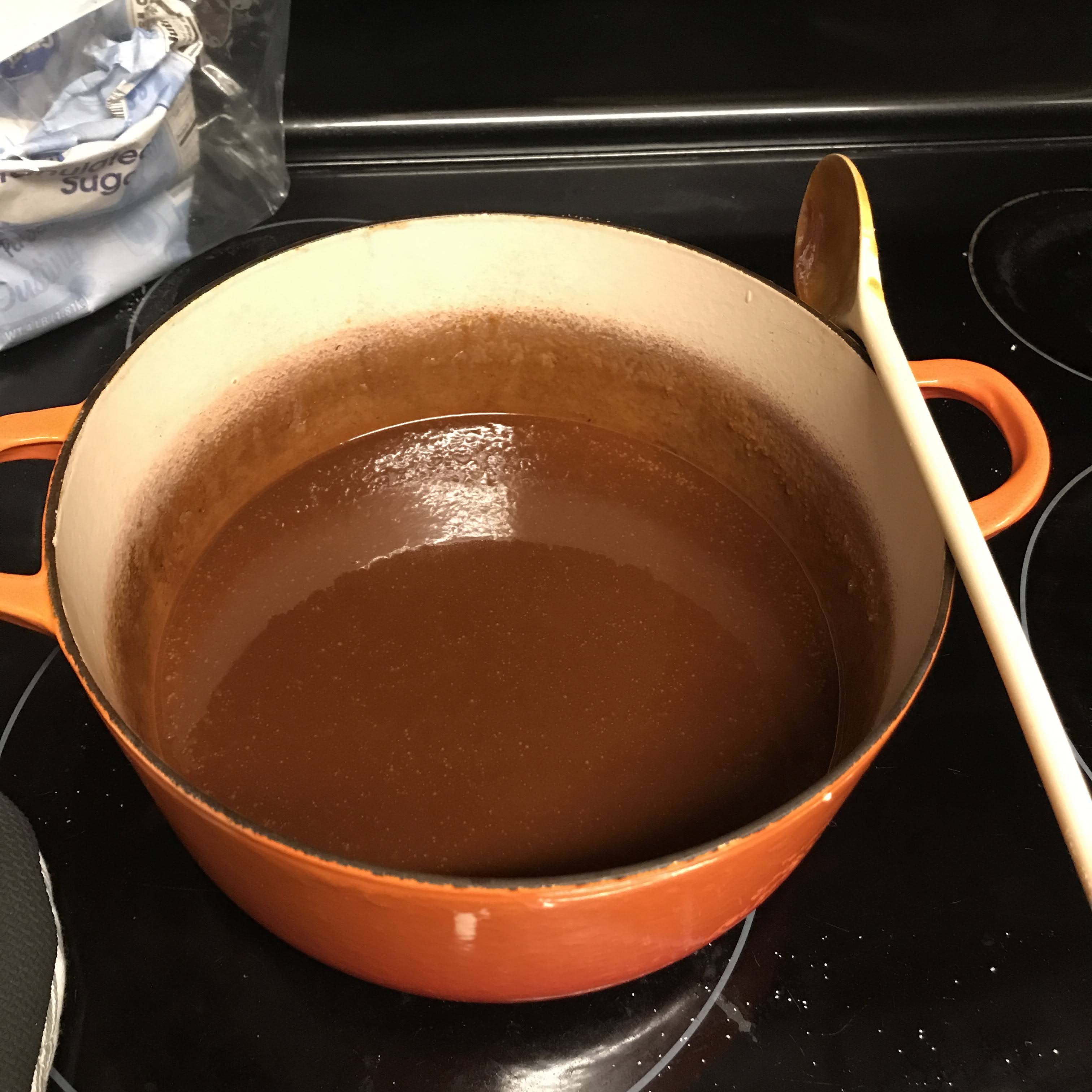
Step 1: pour the 2 cups of sugar into the bone dry enamelled cooking pot. Enamel is a non-reactive surface known to distribute heat most evenly across the large bottom of the pot so that no section of the sugar burns before the others; it’s also a non-reactive surface, so it won’t introduce metal elements or flavoring into your caramel like stainless steel, copper, and direct cast iron will. And you need it to be a pot rather than simply a large skillet because the later steps will result in the mixture bubbling and foaming up, and this will overspill a skillet.

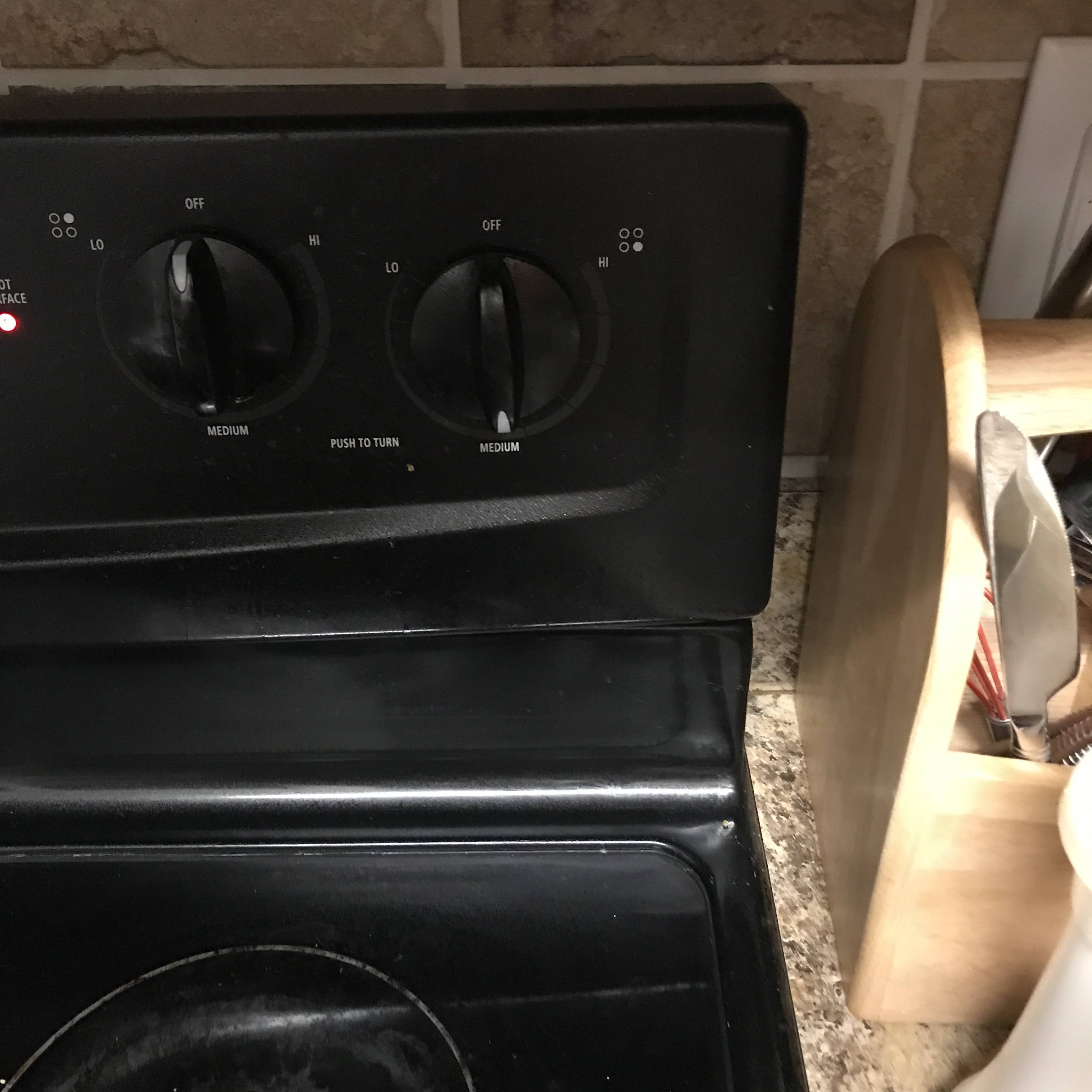
Step 2: place the pot with sugar on medium heat. WARNING: do not use higher than medium or your sugar will burn before it’s all melted, and you’ll have to dump the whole pot and start over. Now, every stove is different AND your local environment (heat and humidity) will affect the stove setting that achieves your desired level of burnt. On my electric, glass-topped stove in Winter Park, FL, exactly medium achieves my preferred dark caramel and one notch from medium towards low achieves my family’s preferred standard medium caramel.

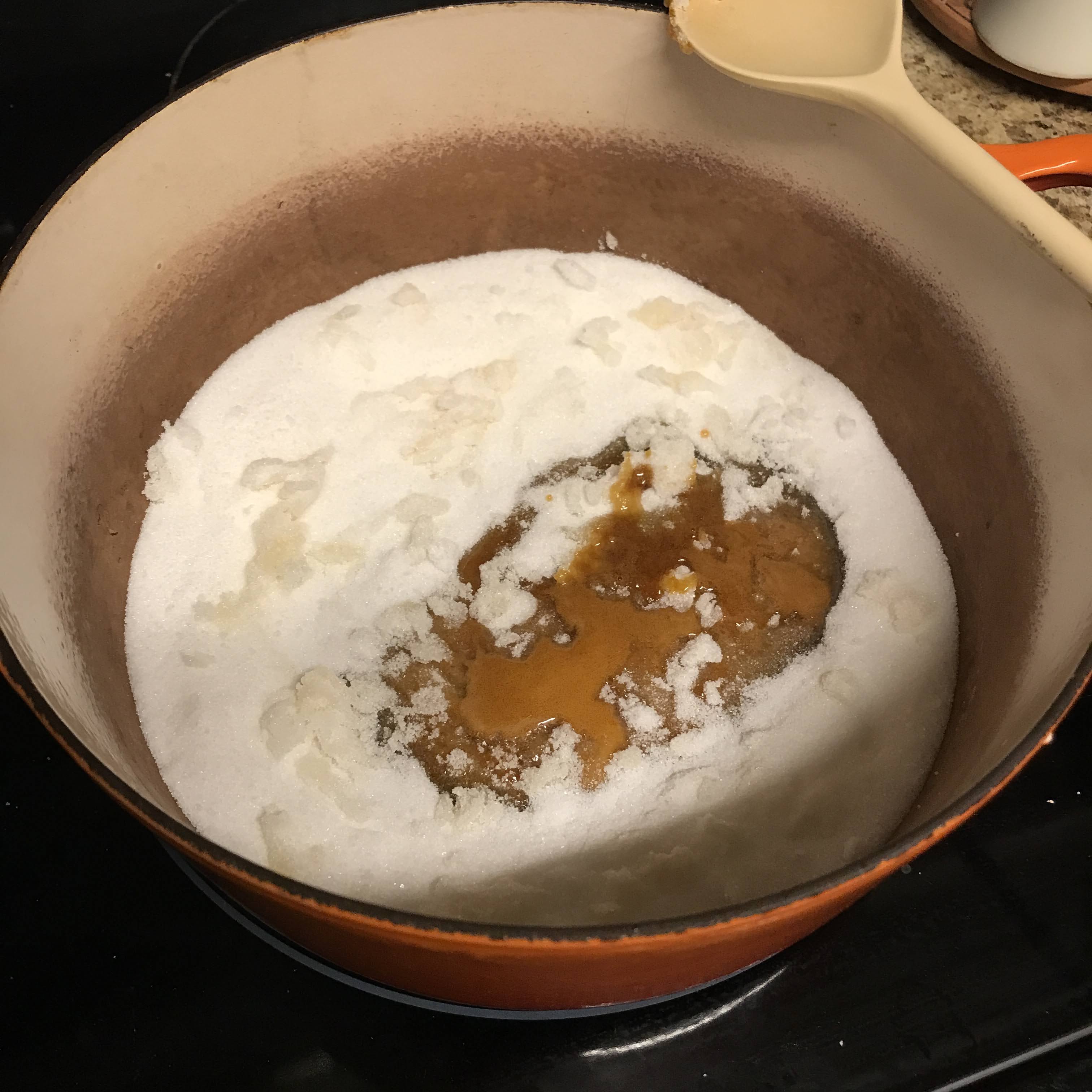
Step 3: to stir or not to stir while the sugar metls. This is a bit controversial because you’ll see the majority of online recipes insist that you not stir. In my experience, not stirring leads to a darker brown, slightly bitter caramel sauce; so if you like that, don’t stir. Most of my friends prefer the lighter to medium, milky sweet caramel sauce, and I find that minimal stirring makes this easier to achieve. And when I say minimal, I mean that once every 90-120 seconds, I use my spoon to “turn over” the sugar so that the melted layer is on top and the dry sugar that hasn’t gotten heat is on the bottom. That’s what I mean by stirring.

And as you can see, I prefer a spoon to a whisk. Like the pot, the spoon is an heirloom and is part of the history of making this sauce and others like it. Also, my experiences with whisks and a pot full of sugar have been meh, so I stick with the spoon that works.

When I see it color and bubble through the sugar layer, that’s when I scoop the sugar over to put the dry on the bottom to get melted.

Step 4: use your nose. Your nose is your best guage to the level of burnt you desire. If this is your first time trying homemade caramel, I encourage you to let it go to the too burnt to use state so that you can teach your nose “when it’s time” to stop burning the sugar.

Step 5: add the knobs of butter.Turn off the heat, but leave the pot on the burner. Drop in the knobs of butter and let them start bubbling and foaming up the sauce. Once it starts dropping back down, stir like crazy to really get the butter incorporated into the sugar sauce. This entire steps takes maybe 25-30 seconds.

Make sure you have these two ingredients cut and measured and ready to go at your fingertips.

Step 6: add the cream. Move the pot off of the burner and pour in the cold cream. Once again, the sauce will bubble and foam up. And once again, as it starts to drop back, stir until all of the cream is incorporated and the sauce turns a uniform color and is mostl shiny on top.

It’s one thing to say it will bubble and foam up, and another to see it before it happens to you for the first time.

Step 7: let the sauce sit for a few minutes just to cool off a bit. Since you’ll be using a glass jar or glass or ceramic bowl to store the sauce, you can pour it in hot, but it’s still a good idea to cool a bit, just in case there are any flaws in the container that might make it break. There’s nothing sadder than 4 cups of freshly made caramel sauce dripping down the front of your cabinets and pooling on the floor.

Step 8: run scalding hot water in your cooking pot immediately. This will melt any remaining sticky sugar and make cleaning your pot for the next batch of caramel sauce quick and easy. Do the same for your stirring spoon or whisk as well.

Ways to Use 4 Cups of Caramel Sauce:

  • Popcorn topping
  • Coffee add-in
  • Dessert topping
  • Oatmeal topping (in place of things like brown sugar, maple syrup)
  • Ham glaze
  • Pancake/Waffle topping
  • Fruit dip
  • Fondue – in place of chocolate
Posted in Being Healthy, Cooking, corn free, gluten free, nut free, soy free

Prep-ahead Clean Lunch for $3.72: Ginger Chicken, Brussels Sprouts, Asparagus, Roasted Potatoes

You know those prep-ahead clean eating lunch videos – often from Tasty? Well, I decided to give one a whirl.

Here’s the basic concept: pick 1 protein for 3-oz servings, 2 vegetables, and 1 gluten free carbohydrate (rice, potatoes, quinoa).

IMG_2144Mine: chicken breast with ginger aioli, brussels sprouts, asparagus and mushrooms, and creamer potatoes.

I took some help from my local Harris Teeter produce: cut and salt/pepper/garlicked brussels sprouts and asparagus pack ($3.99 each) and a ready-to-bake-in-pan package of creamer potatoes (also $3.99). The potatoes came with a seasoning packet, which I chose to use because the sodium was really, really low.

The only thing I made was garlic aioli. How? Peel some garlic – about 2 inches worth – and pour 1/4 cup of your good oil (olive, grapeseed, coconut) and a pinch of salt into your bullet blender and let it go. Then I brushed it directly onto my chicken breasts. I drizzled the little bit left over onto the brussels sprouts, just because.

Into a 450°F fully preheated oven for 30 minutes. That’s all it takes.

IMG_2148Let it cool and divvy it up into four microwave safe food storage containers. Voila. Lunch for the week – for me, at least, since I have only four days with a fixed lunch hour.

Cost Analysis

  • $2.90 – Chicken Breast – one giant one from a 6-pack, cut into 4 pieces
  • $3.99 – pre-cut asparagus with sliced mushrooms and minced garlic
  • $3.99 – pre-cut brussels sprouts seasoned with salt and pepper
  • $3.99 – creamer potatoes already in a baking pan and including seasonings

Total = $14.87

Cost per lunch = $3.72

Posted in Being Healthy, corn free, gluten free, nut free, soy free

Day-of Homemade Baked Beans

IMG_2085
That splatter around the rim is a result of the sauce reduction process. Yum!

Earlier this year, I made from dry-bean-scratch baked beans for a group of out-of-towners, and well, I think it blew their minds. And I get it. Even my family’s “Aunt Von’s Baked Beans” come from the 1940s, a time when country cooks like Aunt Von would have made most bean meals from dry beans, but even her recipe starts with Campbell’s Baked Beans – already seasoned and sauced.

But c’mon, what’s it gonna cost you to experiment and really understand and control exactly how your baked beans taste instead of trusting what comes out of a can with ingredients made or refined in a lab? These are my day-of baked beans – the only difference is that I start with plain, unseasoned, unsalted canned beans because they are pre-soaked for me. Everything else is the same as my regular dry-bean recipe:

  • 2 cans of great northern beans, drained and rinsed
  • 1 green bell pepper, diced tiny
  • 1 small or 1/2 large sweet onion, diced tiny (try to get Vidalia or Wadmalaw)
  • 1 large or 2 small garlic cloves, minced
  • 1 can of tomato sauce (try to get no salt added)
  • 1/4 – 1/2 cup brown sugar – for my family, I use 1/2 c, for out-of-towners I use 1/4 c
  • 1/3 cup worchestershire sauce – I use a gluten free, corn free, soy free version
  • 1T apple cider vinegar (more if you like it more tart than sweet)
  • 1t salt
  • 1t pepper
  • 1t ginger (ground for sweet, fresh diced for spice)
  • 1/2t all-spice
  • 1 pinch red pepper flakes (literally 10-15 flakes)
  • 3-4 slices of bacon, cut into 1-inch pieces

IMG_2083Mix everything together in a bowl at least 2 hours before you need to start baking (at least 4 hours before serving). Taste to see how sweet, tangy, tart, spicy it is and add seasonings as desired. Keep in mind that at this stage, the tomato sauce is the main source of tangy and that will mellow into sweet during baking; be careful not to go overboard on sweet at this stage.

Ingredients that contribute to sweetness are tomato sauce, sugar, bell pepper, onion, garlic, and ground ginger.

Ingredients that contribute to tangy- or tartness are tomato sauce, apple cider vinegar, worchestershire sauce.

Ingredients that contribute to spiciness are garlic, fresh ginger and red pepper flakes.

Cover with plastic wrap or lid and let marinate on the counter for at least 2 hours. It’s important to NOT put it in the refrigerator because that will slow down the marinating – not ideal for day-of beans.

IMG_2084Pour into 8×8 or 9×9 casserole dish and top with bacon pieces. Put in 350F oven for 90-120 minutes. Test at 90 minutes by lightly jiggling the dish. If it moves like liquid, makes a ripple, it’s not done yet. You’re looking for the liquid to reduce to a thick glaze and fully cooked bacon on top, not a thickened sauce and still-white fat on the bacon. And the bacon won’t really start to cook until the liquid stops touching it.

Another way to think of the ideal consistency of baked beans is that when you spoon then onto the plate 1) you don’t need to use a slotted spoon to drain them and 2) you don’t have to worry about the juice contaminating anything else on the plate.

Naturally, these are my ideals as a Southern cook in South Carolina who learned to cook from a Texas and Oklahoma ranch or cowboy style of cooking. Think about it: you can’t ride a horse around with a pot of juicy beans sloshing around.


Posted in Being Healthy, Cooking, corn free, gluten free, nut free, soy free

Greek Chicken and Rice

IMG_2004
Greek Chicken and Rice with Feta Cheese, accompanied with marinated cucumbers and onions (refrigerator pickle)

I’m not trying to present anything authentically Greek like your native or first-generation Yaya made, but rather to elevate the simple chicken and rice dish with the flavors most Americans associate with Greek or (generically) Mediterranean food. In fact, if you leave off the Greek-ish additions, you could just say this is Lemon Pepper Chicken and Rice and stop there :-).

To easily change up a wonderful dish when it’s getting a little stale in the dinner rotation, consider adding lemon juice to your chicken and rice bake and serve with a sprinkle of feta cheese and olives.

Ingredients for a 4-serving bake

  • 1 cup uncooked white or brown rice (jasmine, basmati, American long grain, whatever)
  • 2 cups water or chicken stock or combination
  • 1-2 lemons, juiced (1-2 T prepared lemon juice) – to taste
  • 4 4-6-oz pieces of boneless chicken – any combination of breasts and thighs
  • 1t salt (only if using water because even low sodium chicken stock already has salt)
  • 1t – 1T black pepper – to taste
  • 1 package of crumbled feta cheese
  • 1/2 cup roughly chopped kalamata olives (or black or green if you like those)

NOTE: you might think that dicing the chicken before putting it in the bake will make this easier, but the smaller pieces cook so much more quickly than the rice that they become dry and rubbery. Not pleasant, IMHO.

IMG_2001Preheat oven to 350°F.

Layer rice, water/stock, juice, chicken, salt, and pepper in a 9×9 baking dish in the order listed above for the least messy assembly.

Bake uncovered for 30 minutes. Stir – this is essential for all of the rice to get cooked.

Bake uncovered for 10 more minutes.

IMG_2002Use two forks to shred the chicken. Stir to mix thoroughly with the rice.

Serve with a sprinkle of feta cheese and chopped olives.

LEFTOVERS: if you have any leftovers, they make for a great cold rice salad with artichoke, cucumber, tomato, and sweet onion and a drizzle of olive oil or Greek salad dressing added to the feta and olives. Mmmmm, lunch!

Posted in Being Healthy, Cooking, corn free, gluten free, nut free

PaPa’s Fish Stew from my Grandfather’s Personal Recipe Book

IMG_1993My dad and brother go on a fishing trip every year in August, and brought back some shark that we’ve been wondering how we want to cook. And about a week ago, in a fit of nostalgia, I was flipping through my grandfather Joe Jones’s personal cookbook and came across his Fish Stew recipe, complete with variations for 21-, 15-, 10-, 5-, and 2-gallon batches. I rubbed my hands together and giggled with fanatical glee: PaPa would LOVE shark in his fish stew!

Bonus! This is such a pantry meal since every ingredient is a staple in our family pantry.

As I’m interested in batches for a standard 4-5 person family, I made just a few adjustments, mainly in the liquid ingredients:

  • 3 slices of bacon, chopped into strips or dices
  • 2 medium sweet Vidalia or yellow onions, chopped small
  • 1.5 lbs potatoes, diced (roughly 3 cups)
  • 2 14 oz cans of diced tomatoes (recommend fire roasted with garlic)
  • 2 cups V-8 juice (recommend original or low sodium)
  • 1 cup fish or chicken broth
  • 1/2 cup fish sauce or white wine (but not both)
  • 1/4 cup Worchestershire sauce or soy sauce (but not both)
  • 1/4 cup hot sauce (like Tabasco or Texas Pete)
  • 1 T Old Bay seasoning (or similar)
  • 2-3 lbs white fish (shark and gator work well also)
  • Optional ingredients: shrimp, crab, clams, lemon juice.

IMG_1989In a large stock pot over medium heat, drop in the bacon and onion and let sweat and sizzle for 3-4 minutes, just until the bacon starts to firm up and the onions start to get clear but NOT browned or caramelized.

Add the potatoes, diced tomatoes, V-8 juice, white wine/fish sauce, Worchestershire/soy sauce, hot sauce, and seasoning.

Bring to a boil and simmer for 15 minutes.
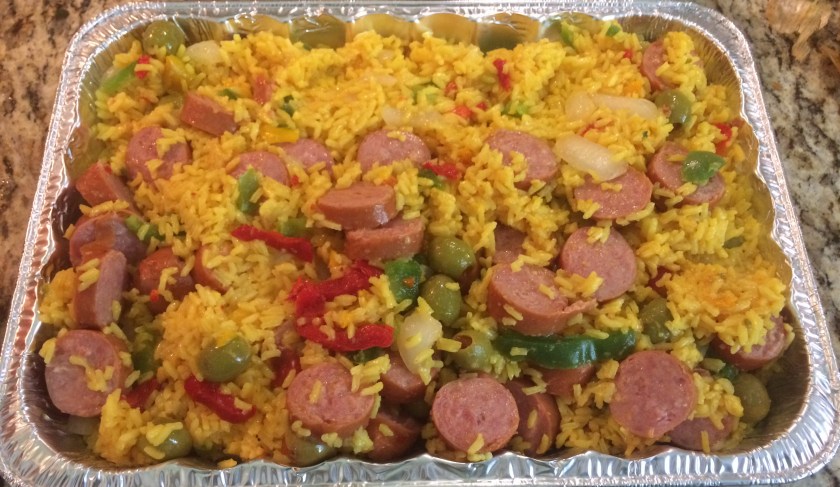
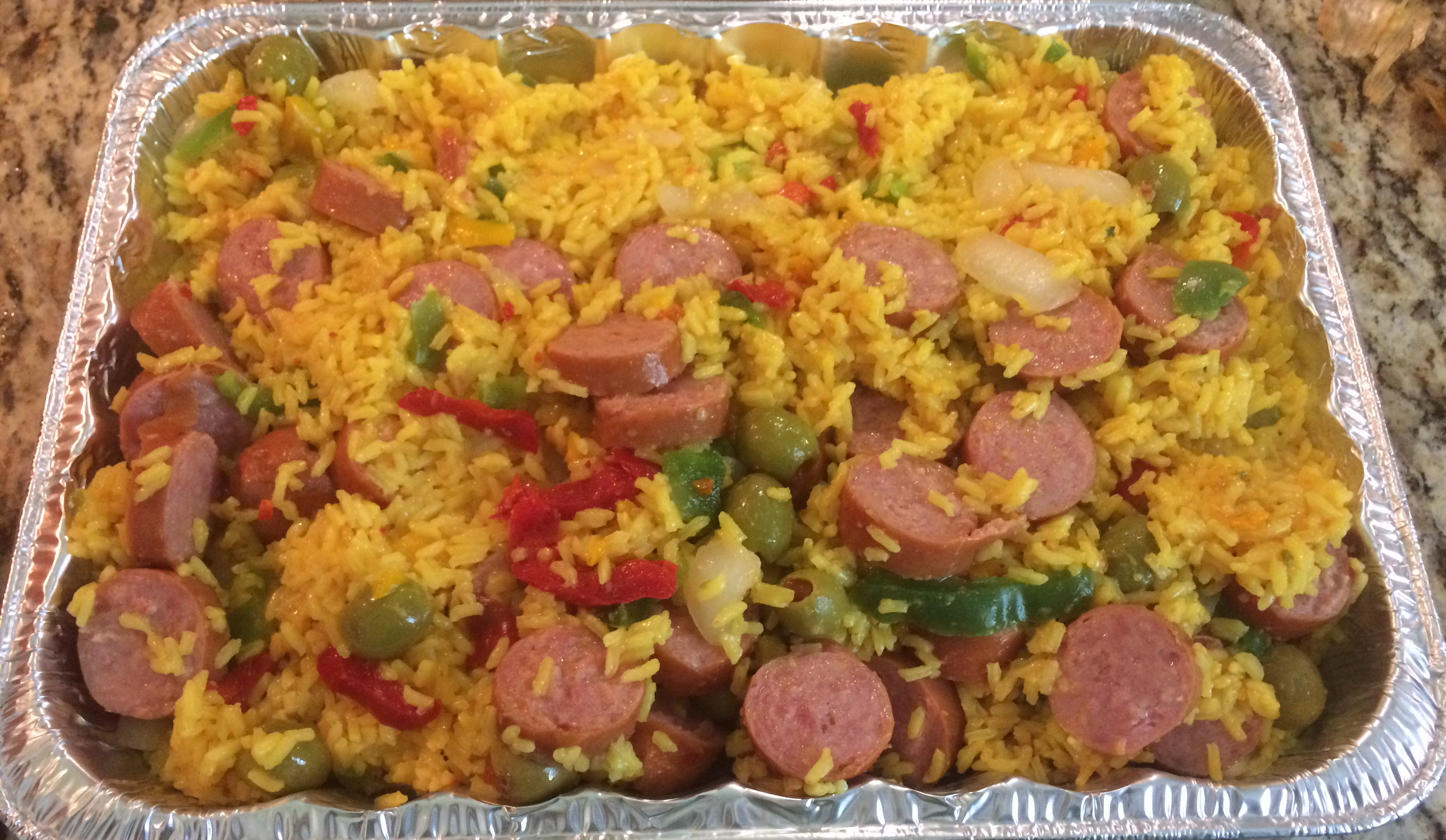
IMG_1992Add the fish. Bring to a boil and simmer for 15 minutes.

Use your stirring spoon to break up the fish into smaller pieces. Flakier fishes like catfish and flounder will “melt” into the stew. Sturdier fishes like mahi mahi, snapper, shark, or swordfish will hold up as chunks.

Serve with cornbread or breadsticks or any sturdy bread. Soft breads like croissants or yeast rolls will get gummy and chewy. For this night (photos), I heated some leftover Papa John’s parmesan breadsticks in the oven for 15 minutes on 350°F.

Confession: I HATE tomato juice and tomato soups, which extends to PaPa’s fish stew, but my family loves it. It’s often what we make with any leftover fish from a fry or a restaurant rather than reheating (stinky!) or choking down cold, dry fish.

Posted in Being Healthy, Cooking, corn free, gluten free, nut free, soy free

Easy Spanish-style Sausage and Rice

My best friend has her abuela’s pot for making Arroz con Pollo, but my family is much less discerning of that level of authenticity. Instead, we get close with this flavorful sausage and rice dish.

You’ll need

  • 1 family size package of Vigo Spanish Rice (with seasonings included in the package)
  • 2 lbs cooked link sausage, such as kielbasa, turkey sausage, venison sausage, etc.
  • 1-2 packages of frozen peppers and onions (roughly 1-2 cups of chopped frozen or cooked peppers and onions)
  • 1/2 – 1 cup whole green Spanish olives stuffed with pimentos
  • 1 poblano pepper, diced (optional)

Cook the rice according to package instructions.

While the rice cooks, slice cooked sausage into coins and brown in skillet.

Note: Vigo seasoned Spanish rice is not corn-free. Use unseasoned white or yellow rice and Sazon with Saffron seasoning.

Thaw/steam frozen peppers and onions (with poblano pepper if using) in the microwave. Or, if using fresh veggies, sautee in skillet after sausage is all browned.

Spanish_Sausage_and_Rice.jpgWhen rice is finished, mix in browned sausage, warmed peppers and onions, and olives. I leave my olives whole because all of my peeps like them; feel free to slice or chop yours up if you need to hide them ;-).
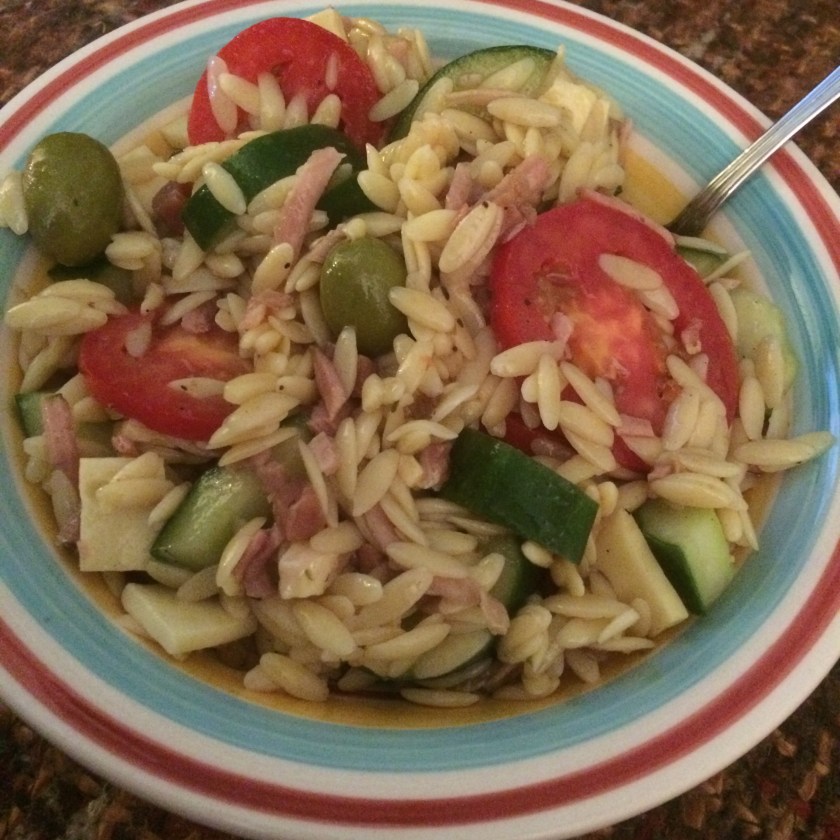
Serve directly from the rice pot, accompanied by fresh fruit salad or seasonal marinated vegetables.

Tip: maintain healthy overnight blood sugar by skipping the “bread on the side” with dinner when you already have rice, pasta, or potatoes. Even non-diabetics can experience unhealthy blood glucose levels when consuming extra complex carbohydrates.

Posted in Cooking, corn free, gluten free, nut free

Colombia Restaurant 1905-inspired Summer Pasta Salad

I’ve eaten at the Colombia Restaurant just once and was most impressed by the simplicity and the goodness of their signature salad with their 1905 salad dressing. But I can’t eat lettuce, so I looked for a way to make this a robust salad without it. Enter pasta…or quinoa or even rice for a Northern Italian-style dish.

Here’s what I used for the “salad”:

  • 1 box of orzo pasta, prepared according to package instructions (GF: use any small piece gluten free pasta; GF & CF: use quinoa)
  • 3 standard cucumbers, seeds removed, quartered lengthwise, chopped
  • 6 roma tomatoes, sliced in rings
  • 1 cup green Spanish olives stuffed with pimentos, whole or sliced (I like whole)
  • 8 slices of swiss cheese, cut into 1/2-inch squares (or julienned if that’s easier)
  • 1 package of diced prociutto (4 oz)
  • 1 package of julienned Citterio ham (4 oz)
  • 1/2 cup pepperoncini rings (optional)

For the dressing, which is based on the Colombia Restaurant 1905 dressing:

  • 1 cup good oil (EVOO)
  • 1 cup ACV
  • 1/4 Worcestershire sauce
  • 4-6 cloves of garlic, minced finely
  • 1t dried oregano
  • 1t black pepper
  • 1/2 t salt

Whisk up the dressing and let it sit out on the counter to marinate for several hours before you dress the pasta salad.

Dress and serve at is or over a pile of lettuce to make it more “salad-y.”

Posted in Being Healthy, Cooking, corn free, gluten free, nut free, soy free

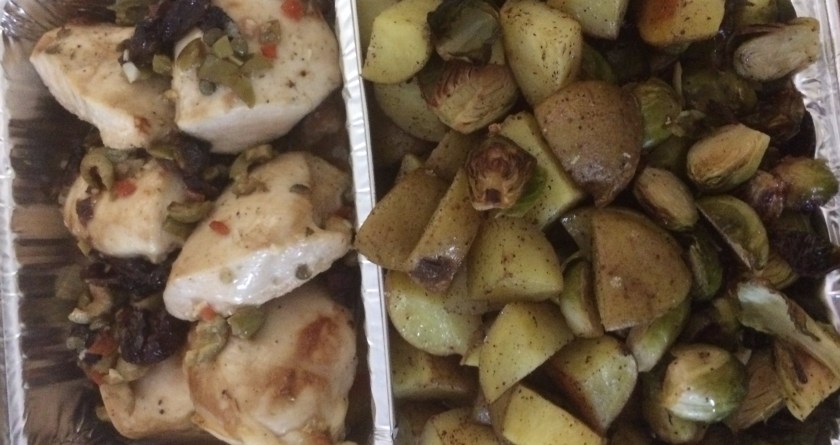
1-pan Dinner: Chicken Marbella with Roasted Potatoes and Brussels Sprouts

IMG_1859For a family of 2-4, this meal can be made using 1 cutting board, 1 chef’s or chopping knife, 1 mixing bowl, and 1 large baking sheet. You can make clean up even easier by lining your baking sheet with foil.

For this dinner, you’ll need

  • 4 boneless, skinless chicken breasts (or comparable chicken strips or chicken thighs)
  • 4 medium potatoes, scrubbed and diced (Yukon gold, red, russet – whatever kind you like)
  • 1 lb brussels sprouts, cleaned and halved
  • 1 Vidalia or sweet onion, large diced (optional)
  • 2-4 T good oil (olive, grapeseed, coconut)

For the Marbella marinade, you’ll need

  • 4 prunes, chopped roughly
  • 6-8 green Spanish olives stuffed with pimentos, chopped roughly
  • 1 T capers, chopped roughly
  • 1 large clove of garlic, minced
  • 1/4 cup good oil (olive, grapeseed, coconut)
  • 1/4 apple cider vinegar
  • 1/4 t salt
  • 1/4 t pepper

The night before you’ll be cooking this dinner, combine all of the Marbella marinade ingredients and whisk to mix well. Pour over the raw chicken (yep, it can even be frozen still); make sure the chicken is one layer when you put it in the fridge. It is super important that you marinate the chicken overnight.

For baking, prehead the oven to 375°F, line your baking sheet with foil and spray it down well with cooking spray.

Toss your diced potatoes and halved Brussels sprouts in good oil and salt and pepper. You can certainly add any other spices you like at this time; for pairing with the Marbella flavors, I recommend lemon pepper or dijon, something with a strong, tart flavor to contrast with the salty and sweet of the Marbella.

Lay out the chicken in a row across one end of the pan, layer the potatoes in the middle in one layer, and layer the Brussels sprouts and onions on the other end of the pan. Pour any remaining Marbella marinate over the chicken.

Place the pan on the upper rack in the center of the oven, and set the timer for 30 minutes.