Posted in Business Articles, Small Business Tips

Post, Share, and Comment at the Right Time Each Day

600600p3069EDNmain1112social-times-300-x-250Scheduling your social media checks and posts around high activity points can improve your lead generation rates.

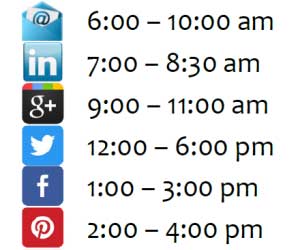
Knowing WHEN to post on each different social media and networking site is just as important as WHAT you post. Here’s a quick guide based on research from SendSocialMedia that will help you

  1. schedule your live social activity time each day – minimizing wasted time and maximizing “the moment”
  2. schedule your auto-posts directly or through a social media management platform – allowing you to set up posts for days, weeks, or months ahead of time!

Consider scheduling 30 minutes in the morning and 30 minutes in the afternoon to check on your social activity.

And don’t forget to follow Cleaning Business Today where you like to get your updates!


Originally published on August 19, 2014 at CleaningBusinessToday.com.

Posted in Business Articles, Ghost Writer, Housekeeping, Small Business Tips

Boosting Your Local Point of Differentiation: Champion a Charity through Every Part of Your Business

600600p3069EDNmain1027flag-and-ribbon-615-x-350Show-and-tell isn’t just for Kindergarten. Put your community ties on display and into action.

One of the most under-utilized marketing strategies by any company is highlighting its community service efforts. And with the continued growth of cleaning franchises and national cleaning referral services, a traditional small cleaning business can really maximize that “locally owned and operated” point of differentiation by partnering with local and national community-focused organizations.

The cleaning industry is particularly lucky to have a number of organizations around the US and Canada to make donating cleaning services easy:

Cleaning for a Reason (United States)
Cleaning for Cancer Patients (Canada)
Cleaning for Heroes (United States)
ComforTree (NJ)
Cleaning Angels USA (NY & DE)

Many business owners are finding that their affiliation with a local charity or cleaning-related charity helps their brand reputation, especially for those cleaning companies highlighting their local connections. In addition to the initial press releases when a cleaning company partners with a charity, there are a number of ways to incorporate the affiliation and even small donations into more common elements of your marketing and customer service plans.

American Maid owner Liz Trotter offers both staff and clients a way to join efforts to “Give Back Through Community Outreach.” She rotates through different local and national organizations and invites clients to become involved in her company’s efforts each month.

Joe Walsh of Green Clean Maine and Gemma Beylouny of Rejoice Maids both encourage community participation by making a donation to a client’s charity of choice when the client posts a review on one of four popular review sites. Click the thumbnail images to enlarge.

For small businesses – cleaning or other home services – making that “locally owned and operated” point of differentiation is a tough one to display. Highlighting your community outreach spirit and activities through your business is a great way to show the trust your current clients have in you and to catch the attention of those who are looking for your services.

Originally published July 21, 2014 at CleaningBusinessToday.com.
Posted in Business Articles, Housekeeping, Small Business Tips

The Intersection of Client and Technician: Annual Software & User Experience Survey

600600p3069EDNmain888woman-with-ipad-615-x-350From new mobile options to the addition of sales and marketing functions, new scheduling and user experience solutions are on the rise.

In the past 12 months, since our first field services and scheduling software comparison report, the #1 change in the competitive field is that most of the new options are being designed by current or former cleaning business owners. So what does this say about what cleaning business owners need for improving the efficiency and efficacy of their operational procedures?

In this 2014 User Experience Survey Report, two new software options join MaidEasy Software, all of which are designed by cleaning business owners and designed specifically for use in operating a cleaning business:

MaidEasy Software – 1999
MaidSuite – 2014
ZenMaid – 2013

CBT welcomes a growing group of more general home services software providers. While available and accommodating to the needs of home services other than cleaning, two of the most commonly adopted systems – ServiceCEO and Thoughtful Systems – are joined by emerging service providers, many of which fill open system niches.
CompassWave – 2010
Jobber – 2010
Launch 27 – 2013
PocketSuite – 2013
ServiceCEO by Marathon Data – 1984
ServiceProz – 2009
Thoughtful Systems – 1985

More than 50 software-as-a-solution (SaaS) providers were invited to participate in our survey at no cost.

OVERVIEW

As you consider the new data provided in our 2014 survey report, CBT can make the following observations based on new data and on changes since last year.

– 60% of software solutions are specialized pieces, filling a specific portion of the larger service delivery mechanism rather than complete enterprise systems
– 80% of solutions engage on some level in core job scheduling activities, with 50% heavily focused on scheduling
– 70% of solutions offer some level of employee recruiting and tracking, with 40% offering a robust system
– 70% of solutions offer commission-based payroll calculation
– 100% of the newest (post-2010) are exclusively web-based or mobile app-based, not offering a traditional office (downloaded and installed) version
– 40% of the solutions offer a robust operational reporting collection, with 100% offering some reports
– 20% of the solutions offer a basic personnel system, with another 50% offering less than 50% of common personnel data tracking activities

CLASSIC DEBATES

As new service solutions continue to emerge and enable the cleaning industry to evolve, our annual survey continues to validate the strength of several classic debates related to how and why to select different types of software solutions.

On-site versus Cloud
The move to more cloud-based and mobile app solutions is old news. Some of the evidence of that exists right here in the microcosm of this survey: not one of the 21st-century solutions started as or offers an on-site (or downloaded and installed) version of their solution. But data security continues to be the dominant objection by those holding on to on-site versions; with the Target and Heartbleed security breaches earlier this year, it’s clear that data security remains a valid concern.

All-in-One versus Mix-N-Match
The dominant trend historically has been for cleaning business owners to adopt one of the all-in-one solutions but with the improvement in solution integrations and open APIs, connecting solutions together to reduce duplication of work and error is becoming easier. This debate may be an old-school versus new-school battle.

App versus No App
The rising trend shows that as much as 75% of internet users are on their phone or tablet rather than a computer, and 82% of those are using an app rather than a web browser. This makes the consideration of a mobile app – especially one available for consumer interaction – a much more vital piece of an overall technology-based solution.

For a more detailed look at the process of evaluating and selecting the best solution for your company and clients, check out Quantum Sweep: How to Choose Service Software for Your Cleaning Business.

PARTING ADVICE

The trickiest part of evaluating the features based on a checklist or comparison is that you still don’t know how good a program is until you’ve seen it and used it. Whenever possible, try out a free trial of a program. Create a small sample of easy, medium, and hard-to-please customers, perhaps 20, which you use to test solutions during the free trial periods. You want to confirm that essential functions are part of the solution and that they operate in the way you need them to.

And remember that there’s no such thing as a one-size-fits-all solution. The variety in functionality and even how solutions are priced reflects the variety of business structures among cleaning businesses. This is the challenge faced by all service businesses – software as a service (SaaS) included: user reviews aren’t as reliable as we need them to be because what works for one business isn’t necessarily what works for another. Cleaning business owners become keenly aware of this every time a bad review is posted.

Think of it this way: shop software the same way you want your future clients to shop you:
– Ask for references – current user companies whom you can call and talk to about what it really takes to make the solution work
– Ask for number of current/active users – companies love to cite lifetime adoptions, but you want to know how many are using it today, not guess how many of that larger number have moved on to a new solution
– Ask what the last two upgrades were and when they were released – this will give you an idea of how quickly the company is moving on new developments
– Ask how customization opportunities work – what is the process for reporting a need and receiving a custom solution or even an upgrade for all clients

Whatever selling point tips the scales and convinces you to adopt a new software solution, be certain to give that solution your full attention and a fair chance at meeting your needs: use every feature in at least one campaign, consult the support team frequently, give it those extra few hours each week to make sure you understand. Don’t let poor implementation be the reason the solution didn’t work for you.

Technology progresses at a rapid rate – both the hardware and software options. This year’s report and reflections are dramatically different than what we were able to report just 12 months ago; 40% of our participants this year have launched in that time.

– Investigate solutions.
– Adopt what works.
– Implement to the fullest extent of the solution.
– Stay competitive in a changing industry.

CeCe Mikell is the Editorial Director for Cleaning Business Today, coming to the cleaning industry from a 15-year career as a college professor of communication and business. She also works with several cleaning business owners on business development projects.

Originally published June 18, 2014 at CleaningBusinessToday.com.

Posted in Business Articles, Small Business Tips

Infographic: Benchmarking Your Pay Rates

Cleaner WagesJanitors and maids are the third largest occupation in the US. Are you paying enough compared to national averages?

According to the 2013 US Occupational Employment Statistics Survey, 2.5% of the total number of employed in the US are cleaning someone’s home, office or commercial space. And that makes janitors, maids and housekeeping staff the third largest group of workers in the US.

The US Bureau of Labor Statistics provides the raw data for answering many of the most commonly asked questions in our industry related to having employees or contracted staff: how much should I pay my cleaning technicians?
A look back at the past decade of data shows that the cleaning industry has nearly grown back to its pre-2008 numbers in terms of technicians employed in the industry, but at higher cost to businesses as minimum wage and national mean wages have increased.

While the number of supervisors and commercial technicians has not fully recovered, the number of residential cleaning technicians has increased year-over-year, indicating not just a return to pre-recession demand but an increase.

The annual earnings of cleaning professionals have increased by an average $5073, with supervisors seeing the largest increase and residential cleaning technicians the smallest; the hourly rates reflect a similar trend.

Even 10 years ago, the mean hourly rate was at least $1.25 above the current national minimum wage, and today’s mean hourly rate is $3.39 above minimum wage.

The BLS also provides Occupational Employment and Wage Estimates by state to better inform your decisions based on local norms.

Originally published May 30, 2014 at CleaningBusinessToday.com.
Posted in Business Articles, Housekeeping

Resources for the Home Cleaning Mixologist

woman in apron with bottle and spoon
Graphic by Austin Walker, CleaningBusinessToday.com

If you’re selling your services on “homemade” cleaning products, make sure you’re doing it legally and with tested scientific information.

Making the decision to branch out of purchasing available and regulation-approved cleaning products for your business may seem simple, but can be more complicated than it’s worth, if you intend to comply with current regulation of products used in the delivery of a professional service.

Your first call should be to your business liability insurance provider to discuss what additional insurance you would need to move into the consumer products arena. You may learn that the financial and reputational burdens may not be worth the risk.

If you are willing to tak the steps your insurance provider requires, you’ll want to begin with The American Cleaning Institute’s “Some Facts about Mix-At-Home Cleaners” before moving on to the EPA’s guidelines for developing, testing, and registering a potential hazardous product.

Assuming you mean to begin by using your homemade or mix-at-home product in your professional cleaning business, the applied product must have a Safety Data Sheet (SDS) that meets OSHA standards. ISSA offers an excellent outline of the many ways cleaning products are regulated, including restrictions related to homemade products.

If you’re adding even one “innocent” ingredient to an existing product, then you are changing the chemical formulation and must have your new product tested and verified with an SDS. The EPA DfE Standard for Safer Products details the regulations and even the allowed and prohibited classes of additives before additional safety steps must be taken to protect and inform the consumer – your clients.

If you’re claiming that your homemade product sanitizes or disinfects, then you must also send your product fortesting and validation by the Environmental Protection Agency (EPA). Current green/natural disinfecting agents regulated by the EPA include peroxide and thymol; currently, no formulation of vinegar (acetic acid) or table/sea salt can be verified as disinfectants in home or institutional use.

If you’re considering offering your product for sale to your clients, you must also secure a Certificate of General Conformity from the Consumer Products Safety Commission.

And if you’re determined to follow all of these steps to validate a safe and effective product for your clients, you may also want to use these resources to confirm that the ingredients you’re using really are safe, and not just based on “everyone knows” myths.

CleanIngredients.org – an EPA-supported database of ingredient information intended to empower the development of safer products.

Guide to Healthy Cleaning – an EWG database of consumer and commercial-grade cleaning products intended to improve the quality of information available to consumers and businesses in making safer choices.

Toxics Use Reduction Institute (TURI) – an independent research organization dedicated to supporting the reduction of toxic chemicals used in a variety of industries; scientific reports available.
When you choose to provide a service or product to consumers who trust you, you assume the responsibility of double, triple, and quadruple checking your sources – all the way back to the original scientific study that proves the old wive’s tales and cleaning mythologies beyond a shadow of a doubt. Your very business may depend on it.

Originally published May 8, 2014 at CleaningBusinessToday.com.
Posted in Lighter Topics, Small Business Tips

17 Clean April Fool’s Pranks

April Fool's JokesYou know cleaning is a serious business when April Fool’s pranks like these keep us laughing for years.


Stephanie Harden
House Calls, Cincinnati, OH

Working for a builder in Cincinnati performing Final Cleans, our company was hired to perform maid service at the builder’s home. On April 1st quite a few years ago, myself and co-worker were nearing completion of his service, and it hit me!  I called the owner on his cell and proceeded to explain that after I had completed his top floor and headed down to the main level, I walked into the dining area and his ceiling had dropped to the floor in the area of the Jacuzzi tub in his master, and water was gushing everywhere; we could see the bottom of the Jacuzzi above us.

It must have been at least a minute before I finally asked, “Josh, are you there?”  A few more moments went by until I heard a very low and drawn out, “What!”  I waited another 30 seconds and said, “Josh?” …a few more seconds…he answered in the same tone “What?”  I REPLIED, “APRIL FOOLS!”

He made several attempts to repay me. On one occasion, he called our office after we performed a cleaning for him that day and proceeded to let me know in no uncertain terms that we had closed his cat in the master closest and the cat had freaked out and s&%t all over floor, walls, clothes and shoes!!! And “when were we coming to take care of the mess!!!!???”

It took me a few seconds with my response of, “Won’t work, Josh!”  He mumbled under his breath and hung up.

Mike Rathbun
Freedom Cleaning Services

One April Fool’s Day several years ago, I posted on our Facebook page an elaborate story about opening a new location in Billings, MT (my home town). The story mentioned that we would be transferring most of our staff to Billings to help the new location get up to speed.

I had a couple of resignations, and words that cannot be repeated here, that morning when the staff gathered. I think that was the last time I pulled an April Fool’s joke on my staff.

Brenda Stankus
Classic Touch Cleaning

The funniest prank was when a customer lifted one of her toilet seats, both parts, and stretched saran wrap over the porcelain bowl and then put the seat and lid back to normal.  When we put product into the bowl, it all just sat on top until my employee realized what was going on. The children were outside the door watching and giggling so then she caught on. It was fun and we all laughed about it at the office too.

Brad Smith
Mr. Carpet Cleaning Company


Liz Trotter

American Maid Cleaning Service

One year I did a bunch of small stuff:

  • Cotton balls in everyone’s shoes so they were tight
  • Turned the office’s computer screens upside down (In Control Panel, enable Rotation; then use ctrl, alt, up/down arrow to switch)
  • Switched the keys for our cars on the key rings
  • Changed the language on the company phones to French
  • Changed the covers on everyone’s cells so they all had the wrong ones
  • Switched cabinets in the kitchen
  • Hid in my closet so when they came in I wasn’t there
  • Wrote funny things for them to do on their work orders, like scratch the dog for five minutes and use a brush to clean all baseboards by hand, especially behind furniture.

Here are some of the more complex April Fools pranks I have pulled on my staff:

All of our people leave the keys to their cars when they leave in the morning.  I moved them all around; the ones that were far away I moved up close and vice versa. It was funny how many people walked out to where their cars always are and thought their cars had been stolen.

I called a team and told them that one of their clients had cameras on in the house yesterday, and I was giving them a chance to tell me what happened before I take further action; call me when they were ready.  They called about an hour later and said that two of the girls had switched bras, but they never would have done it if they thought the client was watching!  So weird!

TC called me to prank me, and said she had just spilled Shooter (a chemical) on our client’s $25,000 rug. Her voice just sounded weird, so I told her I’d call her back. I decided to prank her back and called back really upset sounding, saying I can’t afford this and it will actually potentially bankrupt me, so I needed them to roll it up and bring it back to the office right now; we’ll throw it in the dumpster and pretend we have no idea what happened.  She was dumb-founded and broke into tears!  I felt a little bit bad, but she did start it!  We all got a good laugh.

One day I called the teams around mid-day and told each one of them that we got this huge job added on that we couldn’t pass up.  They would be working until about 8:00 pm, and I would bring them Taco Bell to get by.  They weren’t happy, and I learned a valuable lesson about throwing jobs on and expecting people to just do my bidding!

Once I changed all the clocks in the office forward an hour.  After we got about four people here, I got them all in on the gag and they would all hide.  When the next person would come in, I’d act surprised and say, “What are you doing here?  I already took you off the schedule.”  It would last until the next person got there and they’d join the hiders who were listening. This was funny.

Internet Spring Cleaning

In 1997, an email message spread throughout the world announcing that the internet would be shut down for cleaning for 24 hours from March 31 – April 2. This cleaning was said to be necessary to clear out the “electronic flotsam and jetsam” that had accumulated in the network. Dead email and inactive ftp, www, and gopher sites would be purged. The cleaning would be done by “five very powerful Japanese-built multi-lingual internet-crawling robots (Toshiba ML-2274) situated around the world.” During this period, users were warned to disconnect all devices from the internet. The message supposedly originated from the “Interconnected Network Maintenance Staff, Main Branch, Massachusetts Institute of Technology.” This joke was an update version of an old joke that used to be told about the phone system. For many years, gullible phone customers had been warned that the phone systems would be cleaned on April Fool’s Day. They were cautioned to place plastic bags over the ends of the phone to catch the dust that might be blown out of the phone lines during this period.

Originally published on April 29, 2014 at CleaningBusinessToday.com.

Posted in Business Articles, Small Business Tips

3 Declining Metrics You WANT to Have

600600p3069EDNmain829skate-board-arrow-615-x-350Sometimes, when things are looking down, it’s time to smile. The lower you can get these three metrics, the faster you can reach those higher goals.

As a society, we are well conditioned to focus on “up is good; down is bad” as a general rule of judging measurement, especially when talking about business. You know what you want to see going up: Revenue, Profit, Number of Clients, Visitors to your Website, Followers on Facebook.

But there are three key metrics that give you an even better understanding of your business’s health. And with these, the lower the number, the healthier your business and more successful your efforts.

1. 
Client Attrition or Loss Rate
Your Client Attrition rate measures how many customers you lose over a specific period of time. Most businessesreport retention as a monthly percentage, but all businesses that are committed to developing a high level of customer loyalty and are putting in the time and effort are measuring this number weekly – sometimes daily.

It’s simple: How many customers cancelled service forever today? Now answer that question every day from now on. At the end of the month divide the number of customers on the last day by the number of customers on the first. That’s your Client Loss Rate – and you want that to be as low as it can be. Why? Because when it’s high, the next metric climbs, costing you money.

2. 
Cost of Customer Acquisition
You probably know that to figure up your profit, you have to subtract your supplies, labor expenses and overhead from your revenue; but did you remember to also subtract the cost of your marketing, advertising, lead nurturing, the estimator’s time and travel? All of those expenses went in to helping you get that customer to agree to pay you for your skilled services. You need to make sure you aren’t spending more than a customer is worth.

This is another one that is often reported as an annual figure, but tracked and measured monthly. Add up all of your marketing and sales expenses for, say, a one month period: email service subscriptions, cost of prizes given out as incentives, add agency fees, television spots, flyer and business card printing, etc. Then divide that by the total number of new customers gained during that month. Compare the dollar figure month to month. If it’s going up, something’s not working in your favor; if it’s going down, keep up the good work.

Note: if you track the referral source of each lead and new customer, you can also figure up the cost of acquisition for each separate marketing tool. This can help you know which campaign to scale back when it stops working for you.

3. 
Website Bounce Rate
One of the most misunderstood metrics in all of online marketing is the bounce rate: how often website visitors are leaving your website after seeing only one page. The goal of online marketing is to get people to click through to your website. The goal of your website is to give them a reason to click around to the different pages and learn things that will make them call or email or book service right online.

The great part of this metric is that Google Analytics will tell you what your bounce rate is. Even better, Analytics lets you set up time period comparison so you can see how you’re trending. And even better than that, Analytics color codes the rate to remind you that a downward angle in green is a good thing.

Why do you care? Well, if visitors are leaving your site before they get to the good stuff, then your website isn’t doing a very good job of convincing a lead to do something: click for more info, download a freebie, ask a question in your live chat bubble, share an article from your blog, or anything else that requires them to click on something on that page. The interaction stopped, robbing you of that lead and potential customer.

Metrics tracking doesn’t have to be hard, but as the saying goes “What gets measured gets improved.” ~Robin Sharma, The Greatness Guide: Powerful Secrets for Getting to World Class  

CeCe Mikell is the Editorial Director for Cleaning Business Today, coming to the cleaning industry from a 15-year career as a college professor of communication and business. She also works with several cleaning business owners on business development projects.

Originally published on April 16, 2014 at CleaningBusinessToday.com.

Posted in Business Articles, Small Business Tips

Stop Asking the Wrong Questions about Pricing Your Service

600600p3069EDNmain841woman-with-calculator-price-tag-615-x-350Each company’s pricing sweet spot is different, so dig in to the full complexity of figuring up your perfect service price for your market.

Yes! Yes, there is a WRONG question to ask about pricing your service. You know it already. You’ve seen it a million times on LinkedIn boards, on Facebook, in listservs, at conferences. And it comes in a couple of variations:

– What do you charge for your services?
– What should I charge for my services?
– What is the industry average rate for cleaning services?

What! You didn’t know that was the WRONG question? That’s okay. You’re not alone.
Benchmarking your prices against those with similar sized businesses and in similar markets isn’t a bad idea. But even benchmarking doesn’t help you sort out why you’re having a hard time turning a profit if you haven’t answered three basic questions. Cue the math lesson!

1. What does Getting the Customer Cost You?

This question popped up on the ARCSI LinkedIn board just last week, with most responders citing anywhere from $200-$600 spent for each customer acquisition. To recoup that cost, you need to be able to account for it as part of your price. Calculating the cost of customer acquisition is pretty simple:

Total Cost of Campaign / Total Number of Customers Gained Through Campaign

Keep both the cost per campaign and a running total to inform your Marketing Plan and your overall business budgeting decisions each quarter.

2. What Does the Cleaning Cost You?

Of the three questions and calculations, the cost of a cleaning is a lot more complex that it seems.

If you’ve never calculated the cost of a cleaning before, start with the simplified version to get a baseline: (labor*hours) + supplies and equipment. This calculation is useful and reasonably accurate for companies with no office or support staff.

When you’ve got the hang of tracking the cost of each cleaning job, you can begin to run an overall average as well as averages based on zip code, neighborhood, square footages, number of rooms, frequency or any other way you’ve chosen to segregate the various types of jobs you book.

3. What Does Keeping the Customer Cost You?

Also called Customer Retention, the cost of keeping a customer long-term is a combination of service delivery, following up with the customer on a regular basis, and adding value the longer the customer is with you. Use this video to begin calculating the cost of customer retention and compare the value (or savings) of retention over acquisition.

So while that classic but “wrong” question is direct, the answers you get are not useful to you unless both you and the other companies answer those questions above with almost the exact same answers. But even then, your goals and timeline are likely different, as is your market; both of those factor in to what you eventually decide to charge.

Lucky for you, ARCSI recently published an industry benchmarking report for residential cleaning services. The report is available for purchase by non-members and is free to members.

Finding the Sweet Spot for Your Price Levels
Here’s the good news. Research into how customers perceive price differences indicates that, in general, the first number in a price is perceived as the most important and gets the most priority when two or more prices are compared. For example, people tend to think of $4.99 as being more closely related to $4 than to $5.

How does this work for your pricing levels? Well, most cleaning companies expect to earn the most revenue from customers who schedule more frequent cleaning jobs, namely weekly and biweekly. Those customers who schedule monthly or “special” cleanings may pay a higher one-time price – always nice in the bank – but you lose out on the build up from recurrence. So set your higher frequency cleaning rates in the lower bracket ($20s or $30s) and the lower frequency cleaning rates in the higher bracket ($30s or $40s).

Remember, the research shows that the first number is more important to the consumer in influencing the buying decision.

To Publish or Not to Publish Your Rate
Armed with real numbers from inside your own company, you are now in a much better position to judge where your rate will fall within the commonly cited $25/hour – $45/hour rate range for residential cleaning (or per room or per square foot, whichever you determine is most effective for your operations).

But making your rate “fit” in that range isn’t a magic pill for getting more customers, especially if you aren’t publishing your hourly rate as several newcomers are doing: Homejoy is proud for all to know that it charges $20/hour, and smaller online cleaner referral services encourage cleaners who register with them to publish their rates by the hour, by the room or by the job. Beyond that, lead generators like HomeAdvisor and RedBeacon are collecting data from every estimate provided through their system and show shoppers what they can expect to pay for various home services, nationally and in their local area.

There’s something to be said for price transparency. For many consumers, it’s a point of trust; if they can’t replicate your estimate in some reasonable fashion, then there must be something fishy about how you’re coming up with their rates.

For cleaning business owners, price transparency seems scary. Why? Ask even the multi-million dollar cleaning companies, and they’ll tell you that margins are small and labor costs more than they want it to. And telling the competition what you’re charging seems to give them an edge, either in figuring out what your costs are or even just flat out undercutting your prices to take business away.

But the precedent for price transparency in cleaning services is being set even as we track this week’s revenue. Start small. Use open-ended phrases like “starting at $29.99/hour.”

CeCe Mikell is the Editorial Director for Cleaning Business Today, coming to the cleaning industry from a 15-year career as a college professor of communication and business. She also works with several cleaning business owners on business development projects.

Originally published on April 15, 2014 at CleaningBusinessToday.com.
Posted in Content Marketing, Lighter Topics

Happy Birthday,CBT! Our First Year in Review

600600p3069EDNmain840baby-birthday-615-x-350CBT celebrates its first year of delivering the best news and business information to cleaning business owners.

As we release the thirteenth issue of Cleaning Business Today, we reflect on the wonders of our first year of bringing you breaking news, unique insights, hidden issues, videos and downloads of business tools, and controversial ideas and projections for the future.
As you read this article, take a moment first to look at the screen. It’s different from last month and the 11 previous months. For our anniversary, we’ve upgraded our digital magazine to a sleek new format so that you can more easily:
– Search the entire issue for any word or phrase
– Make the page bigger by double-tapping or double-clicking on the screen
– Flip pages any way you like on your phone/tablet – tap the ? to personalize your settings
– Bookmark specific articles
– Share and print an individual article
– Watch videos without changing webpages or apps
– Skim the entire issue on Slide Show mode – without ever tapping the screen or clicking your mouse

Why? Because clearly cleaning business owners and industry leaders crave this new focus on the whole business:
– 600 average views per article
– 30,000 page views/month
– 2,200 unique visitors/month
– 3,750 total visitors/month

Cleaning business owners are spending a lot of time in the magazine, using the Search Bar to find articles on the topics that challenge them most as they work hard to grow their businesses.

MOST READ / MOST POPULAR

future-of-the-industry-thumb-200Future of the Industry
Our first feature article, “Future of the Industry” remains our most read article. When we break down the average monthly views for every article we have ever published, this one is at the top. What’s truly revealing is that the expectations for the industry and its development are materializing right before our eyes!

Runner Up: May Extra: Cleaner’s Corner (free download)
Third Place: Midnight Adventures in Business Ownership

TOP CONTRIBUTORS

In our first year, Cleaning Business Today published over 330 original articles and news commentary and featured more than 60 contributors from within and outside of the cleaning industry.

don-aslett-150-x-200Don Aslett, The Last Word Columnist
As our original Last Word columnist, Don Aslett used his unique perspective to reflect on the theme of each issue and offer motivation for all of us to continue working toward a unified, professionalized and respected industry.

Other Favorites Columnists:
Gary Goranson, Leadership, HouseCleaningBiz101.com
Cherylanne Skolnicki, The Big Picture, Nourish
Rebecca Spath, The Big Picture, Breathing Room Therapies

MOST TALKED ABOUT

money-umbrella-smHouse Cleaning Marketplace Gains $38M for New Developments
Join the Discussion on LinkedIn

Dealing with Theft
Join the Discussion on LinkedIn

Do Traditional Small Cleaning Businesses Face Extinction?
Join the Discussion on Facebook

MOST POPULAR NEWS RELEASES

Oreck Bankruptcy in May 2013
Not long after launching that first issue, we were able to break our first story with Oreck’s announcement of the bankruptcy filing of their consumer division. We’ve been privileged to continue breaking some of the most sensational stories of 2013 and into 2014.

Runner Up: Two Maids and A Mop Franchises
Third Place: XCharge Credit Card Processing Users to Pay $199 for Class Action Settlement Services

MOST DOWNLOADED

software-comp-smScheduling Software Comparison Chart
In June 2013, CBT led the Information Technology issue with an unprecedented feature comparison of eight of the most commonly used customer management, scheduling, and field services systems in the cleaning industry. This article and its downloadable chart have become the single most viewed items we’ve ever published, and that’s why we’re repeating and expanding the comparison again for the June 2014 IT issue.

Runner Up: Cleaning Chore List for Kids
Third Place: Calculate Pay or Play Costs to Your Cleaning Business
Fourth Place: Pet Hair Removal

MOST WATCHED VIDEO

Calculating Employee Turnover Rate
Hands down, measuring employee turnover – or how quickly your employees leave and you have to get new ones – is our hottest KPI and video article. Publisher Tom Stewart narrates you through a spreadsheet showing you how to calculate the rate; especially when paired with the companion video on The Cost of Employee Turnover, knowing and using this metric is a huge bonus in helping you keep costs down.

Runner Up: Understanding the Basic Science of the pH Scale and What it Means for Your Cleaning Supplies

Third Place: Hydrogen Peroxide: New Uses for an Old Household Favorite

THE TEAM

Tom Stewart and his wife, Janice Stewart, are co-owners of Castle-Keepers, the 1st company to achieve CIMS certification. Tom is a nationally-recognized leader & innovator in the house cleaning industry. He is co-founder and Publisher of Cleaning Business Today.


Derek Christian
 is founder and owner of My Maid Service, Cincinnati’s largest, independent professional cleaning company. Prior to that, he spent twelve years at P&G working on household cleaning products. Derek is co-founder and Publisher of Cleaning Business Today.

CeCe Mikell is Editor-in-Chief for Cleaning Business Today, coming to the cleaning industry from a 15-year career as a college professor of communication and business. She also works with several cleaning business owners on business development projects.

Austin Walker is Creative Director for Cleaning Business Today. He has over three decades of experience in television and corporate video production, including four years with CNN and seven years in management at an ABC affiliate.

You can meet the Cleaning Business Today leadership at the ISSA/InterClean Trade Show in Orlando, FL, November 4-7, 2014.
Originally published on April 1, 2014 at CleaningBusinessToday.com.
Posted in Business Articles, Ghost Writer, Small Business Tips

Insider Voices: Leading the Support Staff Inside Your Cleaning Business

600600p3069EDNmain7843-lionesses-615-x-350Three internal leaders/managers talk candidly to owners about being the “middle child” in the cleaning industry.

It should not be surprising that with more than 30 years’ experience between us with our current cleaning business owner/bosses that we’d say that our current boss is the best leader we have ever worked with. Who are we? We are the leaders of the support staff for three of larger cleaning companies in their markets:

Rachel Farquer
Leader: Derek Christian, My Maid Service, Cincinnati, OH
Current: Owner/Operator of My Maid Service – Dayton, OH
Previous: Technician, Customer Service, Trainer, General Manager for My Maid Service – Cincinnati, OH
Tenure: MMS-Cincinnati for 7 years; MMS-Dayton launched February 3, 2014


Mindy-Stewart-150-x-200Mindy Stewart
Leader: Liz Trotter, American Maid Cleaning Service, Olympia, WA
Current: Office Manager
Previous: Team Member, Coach, Trainer, Customer Service, Office Manager
Tenure: 15 years

 
Orvetta Treasure
Leader: Tom Stewart, Castle Keepers of Charleston, SC
Current: Office Manager
Previous: Technician, Customer Service, Office Manager
Tenure: 12 years

And we want to tell you want it’s like to become a leader in someone else’s company.

Oh, and the answer to your burning question is “Yes” – you will see glimpses of owner/leaders Derek, Liz, and Tom in this article, but they are not who this article is about. This article is about US – the support staff – and how we became leaders.

Being the “Middle Child”
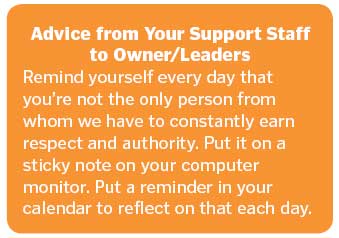
advice-from-your-support-staffIf you have three or more children or have read the traditional profile of a “middle child,” then you know that the person stuck in the middle generally ends up being a balancer, a negotiator, a diplomat. Why? Because that middle child has to be both a follower of the older and a leader to the younger. That’s where we are coming from: the support staff that owners need to follow them in turn provides leadership to the cleaning technicians.

Ronald Miller, Director of Career Development at Francis Marion University, describes how a support staff manager/leader feels like this: “I’m not a leader. I’m one of the guys who gets things done and keeps the place running so the leaders have something to lead.”

It’s not uncommon for a newly promoted support staff member to feel like she’s not a leader. The fact is that she’s probably not. What’s worse is that the other staff don’t see her that way yet either. In this new role, we all had to prove ourselves not to just one person – our bosses – but to the staff whom we now lead.

Think of it this way: yesterday, before being trained to work in the office, we – my fellow technicians and I – were equal; today, we’re not and no one knows what it means or what to do. So it ends up looking like this:

·         We are seen as the winners in a brown-nosing contest, power-hungry, and snobbish.

·         Our job in the office is not seen as real work, as if what we do is not as important or deserving of an assumed pay raise.

·         Staff who are older in age or who have been with the company longer constantly challenge us based on that fact alone – not performance or achievement – but a factor unrelated to our skills.

·         We aren’t respected as leaders or managers by the cleaning technicians, a fact often illustrated by their attempts to bypass us and go straight to the owner with minor problems…or worse, playing us and the owner against each other on the same problem.

·         We’ve been trusted with an owner’s heart and soul, something that owner has put love, sweat, and tears into (and probably still does); that’s a lot of pressure, something we might not have learned to the skills and strategies to manage yet.

·         We’re responsible for knowing the company culture, living it, and coaching others to live it; there’s another area where we have a passion and desire to make it work but not always the strategies.

Some of these are challenges you’ve already faced down during your days at the single leadership level, but your role as the owner offers you special protection that doesn’t extend to us. But it’s the ways our various leaders have treated us that gave us the most confidence in becoming the leaders we are today.

Empowering Support Staff into Leadership
You might be wondering how this happened – how we grew to be leaders in our own right. Well, the first thing you should know is that we’re still not the leaders we know we can be and that our bosses know we can be, even though we collectively have been on this journey for many years.

Create a Safe Place for Us to Mess Up
Even when you’re lucky enough to hire or promote someone with a business/management degree or some experience from a previous career, we need to know that we can mess up and learn from our mistakes. We need that support, encouragement and sometimes a sharp poke in the ribs to try something new, push beyond what you know we can do or even what we think we can do.

Provide Personal Coaching and Goal Setting
Every boss does this differently and at different times in an employee’s tenure; but if you really want to build a leader who’s going to embrace your company the way you do, you have to make it personal. Work with leaders-in-training to tie our life and professional goals to achievable milestones within the company. And then loan us your network and your time in mentoring to help make it happen.

Open Up Leadership and Management Training to Us
It seems so simple to remind bosses to provide training, but as we’ve met “others like us” in the industry, we know basic leadership skills aren’t taught, practiced, and reinforced. We might get an article or a 1-hour free webinar once in a while, but a focused, concentrated effort is rarely part of the package. Change that. Between community colleges and online universities, good basic leadership and management training is available and a necessary investment if you want a competent leader in your office.

Get Out of the Way
Along the way, we like that you’ll stop and teach us something new and ask us to gradually take charge of that part of the business routine or even a whole project. But at some point, you have got to stop hovering and let us do it. Especially when it comes to our role as a leader to others in your company, we need to be seen as authoritative at least in the areas we’ve been given. And remember, we’ll mess up, so we encourage you to follow the Praise in “Public; Correct in Private” model not only for our own growth but also for reinforcing our role publicly within the company.

Be open to learning things from us.
This may be the most important thing you can do. We have had to teach our bosses some things about themselves. All bosses have some common behaviors that they can sink into that really stress out everyone: micromanaging, tracking your activities (as if they don’t trust you really did them), expecting genius on a moment’s notice, things like that. The trick is once again to get out of the way – this time out of your own way, bosses. Let us tell you what the specific behavior is, how it distracts us from actually doing what you need/want, and what we can say or do to alert you to the behavior before it derails a day or a project. (Whew! That last part was the hardest to get out.)

And at the end of the day, always remember that we – your support staff and internal leaders – follow because we believe in you and you have given us a reason to believe in ourselves.  You have given us trust, an open mind toward change, clear expectations, and tools for improvement. But most of all, you have given us a model to follow, as the leader we aspire to be.

Originally published on March 19, 2014 at CleaningBusinessToday.com.