How We Found Each Other
In late October 2021, I lost Shadow suddenly to cardiac arrest. For the first time in fifteen years, I had no cat in my house at all. I didn’t know how long I’d need before I was ready to look again — it turned out to be about a week.
I logged onto the Orange County Animal Shelter’s website, where they post photos of the cats available. I was specifically looking for an adult — didn’t need to be a senior, just not another kitten. My first three cats, Miles, Angel, and Shadow, had all come to me as brand-new babies, and after having Shadow as a solo cat for so long, with a rhythm I’d come to love, I was only thinking about bringing home one more.
That’s when I saw him: a cat named Richard. Of all the names you could give a cat, Richard stood out. I had no real commitment to adopting that day — I just thought, why not go meet him?
So my niece and I drove over. When I told the shelter staff I’d come to meet Richard, they seemed surprised and a little excited, though I didn’t understand why yet. In the meet-and-greet room, I noticed — just barely, in the back of my mind — that there were two cats in the little holding cage.
They brought out Richard first. He was standoffish. Not scared, not aggressive — just reserved. Behind him in the cage, I could see another cat pacing, watching, active.
As we were getting ready to put Richard back, I asked some questions, and the man helping us said: “This is Zoe. Richard’s part of a bonded pair. So far we only have applications on Richard — we hold bonded pairs for forty-eight hours to see if anyone wants both.”
I’d never heard the term bonded pair before. He explained: cats who become so emotionally attached that separating them changes their behavior — they can act out, decline quickly, even get sick and die from the separation of the bond.
That sounded significant. So I said, let’s meet Zoe. If Zoe and I click too, then it’s fine.
Zoe came out and was an instant love bug — she’d never met a stranger, hugging on me the way Shadow used to. I thought, no big deal, I’ll take them both. Because I was willing, I brought them both home that same day.
While I was still at the shelter, I learned something else. Richard had been at that shelter once before, as a kitten, and they still had his old intake record — including a birthday: October 31st. My birthday. They don’t do rigorous verification on a kitten’s exact birth date, but it was close enough.
Zoe didn’t have an original record like his, so nobody knew her real birthday. But since they’d always been brought in together, and had been surrendered a week before October 31st, the shelter had simply given her the same date on her paperwork. Another October 31st.
The story behind why they’d come back to the shelter as adults was simple and sad: their owner had died. Neighbors across the street took the cats in temporarily while the family came to settle things, and when no one in the family wanted them, the neighbors surrendered them.
Between the name, the bonded pair, and two cats who — one way or another — shared my birthday, it felt like too many signs to ignore. It was just easy.
The shelter adopted both of them out to me for the price of one, sent us home with food and toys, and I loaded two very unhappy, crying cats into carriers for the thirty-to-forty-five-minute drive home. One of them — probably Zoe, who still gets carsick from stress — pooped in the carrier. I filmed the unboxing when we got home, so somewhere I still have that first footage of the two of them, fresh out of their boxes, becoming part of my life.
The First Eighteen Months
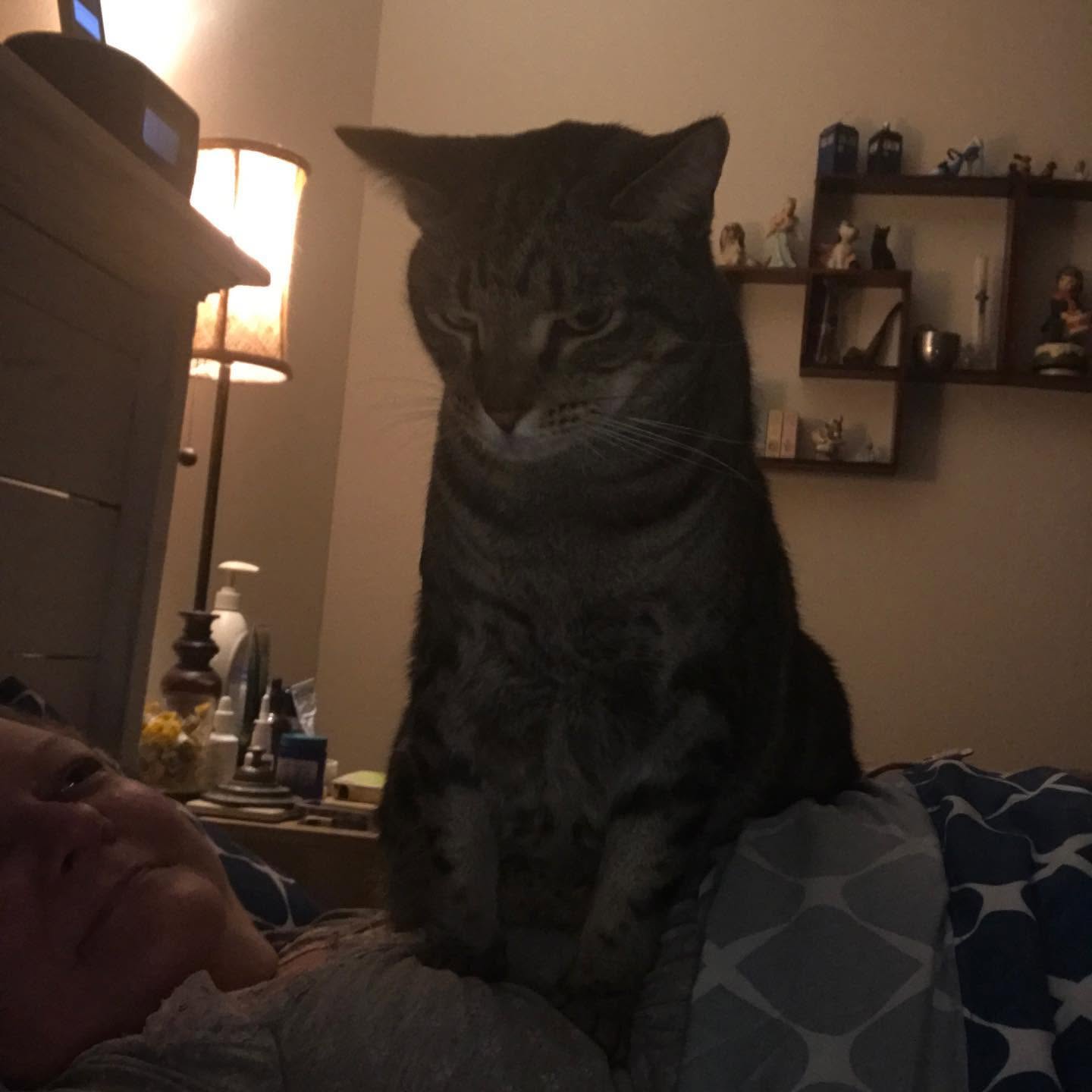
Coming home that first day, it was easy to assume the roles: Richard, a giant twenty-pound (slightly overweight, but not really) boy, must be the dominant one. Zoe, a teeny seven or eight pounds and still kittenish enough that I wondered if her age had been overestimated to match his, must be the follower.
Eighteen months in, I understood it was the opposite. Zoe was the one taking care of Richard. Zoe had adopted him.
During that first year and a half, I started paying close attention to Richard’s behavior — even posting some of it on Facebook at the time — because I came to believe it told a story. Not one of active abuse, but of neglect and isolation.
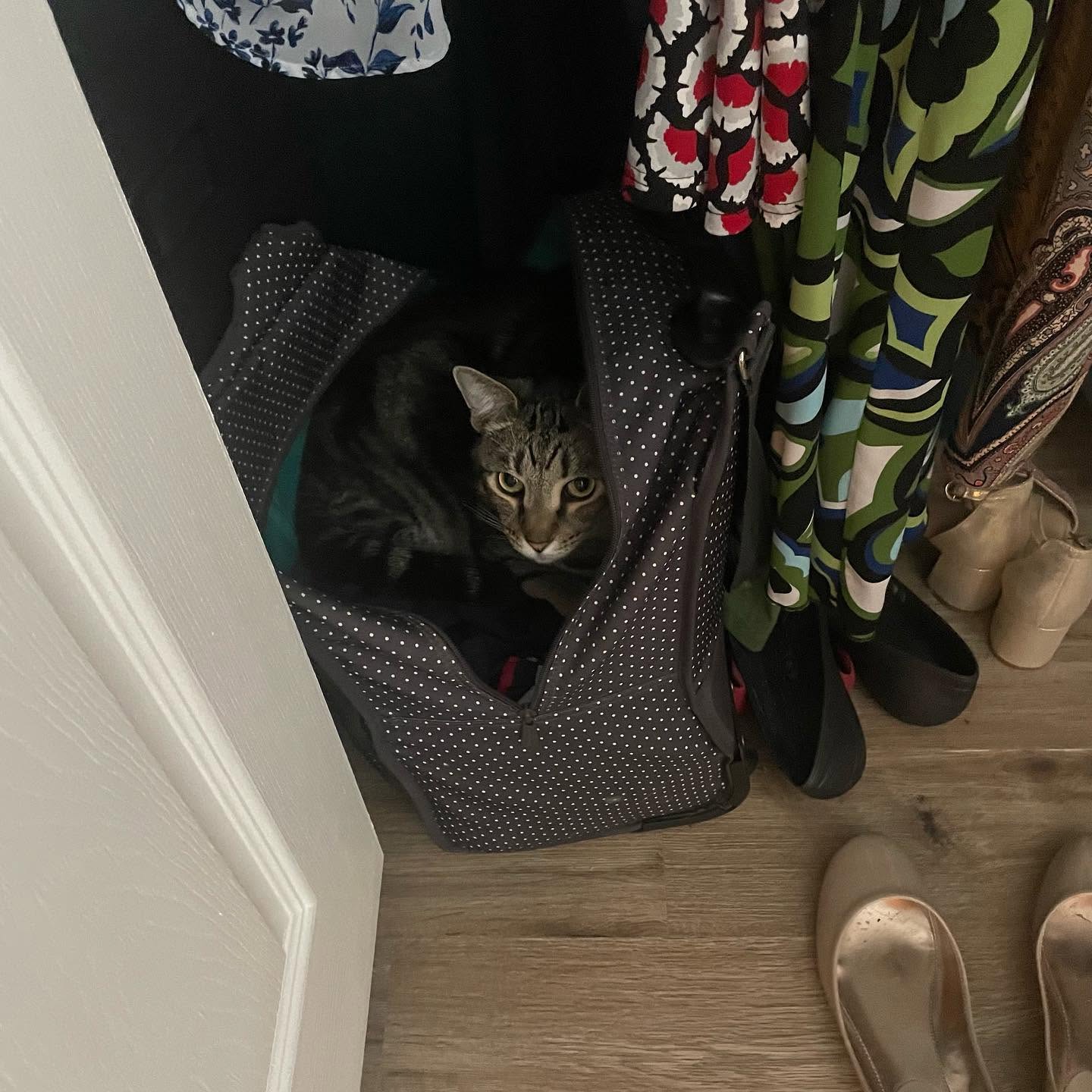
There was a clear line between his daylight self and his nighttime self. During daylight hours, I’d find him in one of three places. If he needed to fully disappear, he went to the bottom shelf of my closet, tucked behind and underneath my hanging shirts where he couldn’t be seen. He wasn’t cowering there — he’d curl up and actually sleep.
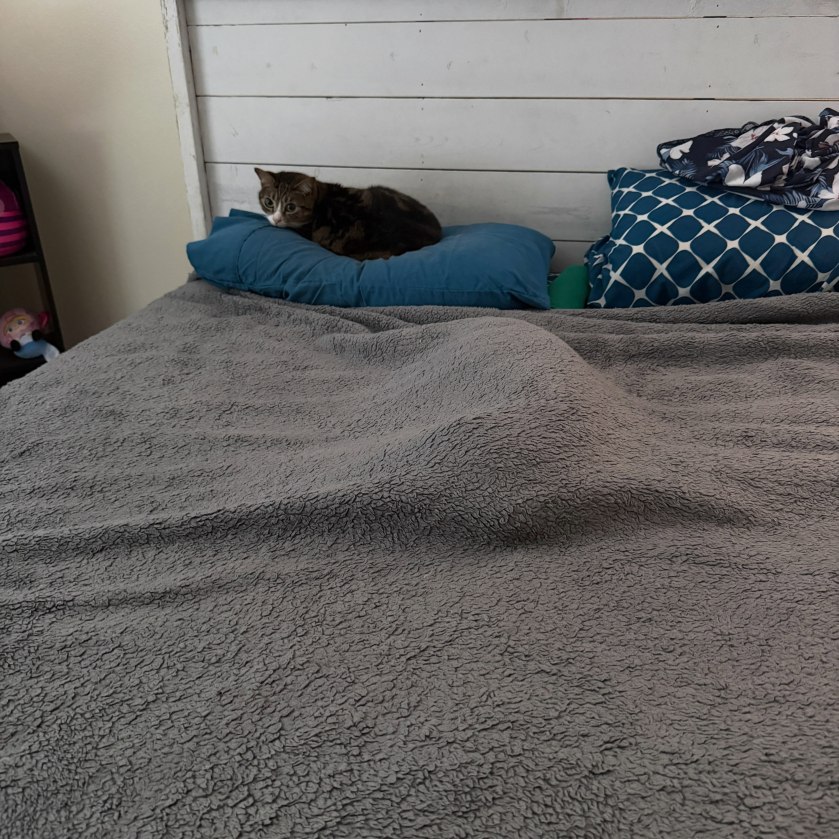
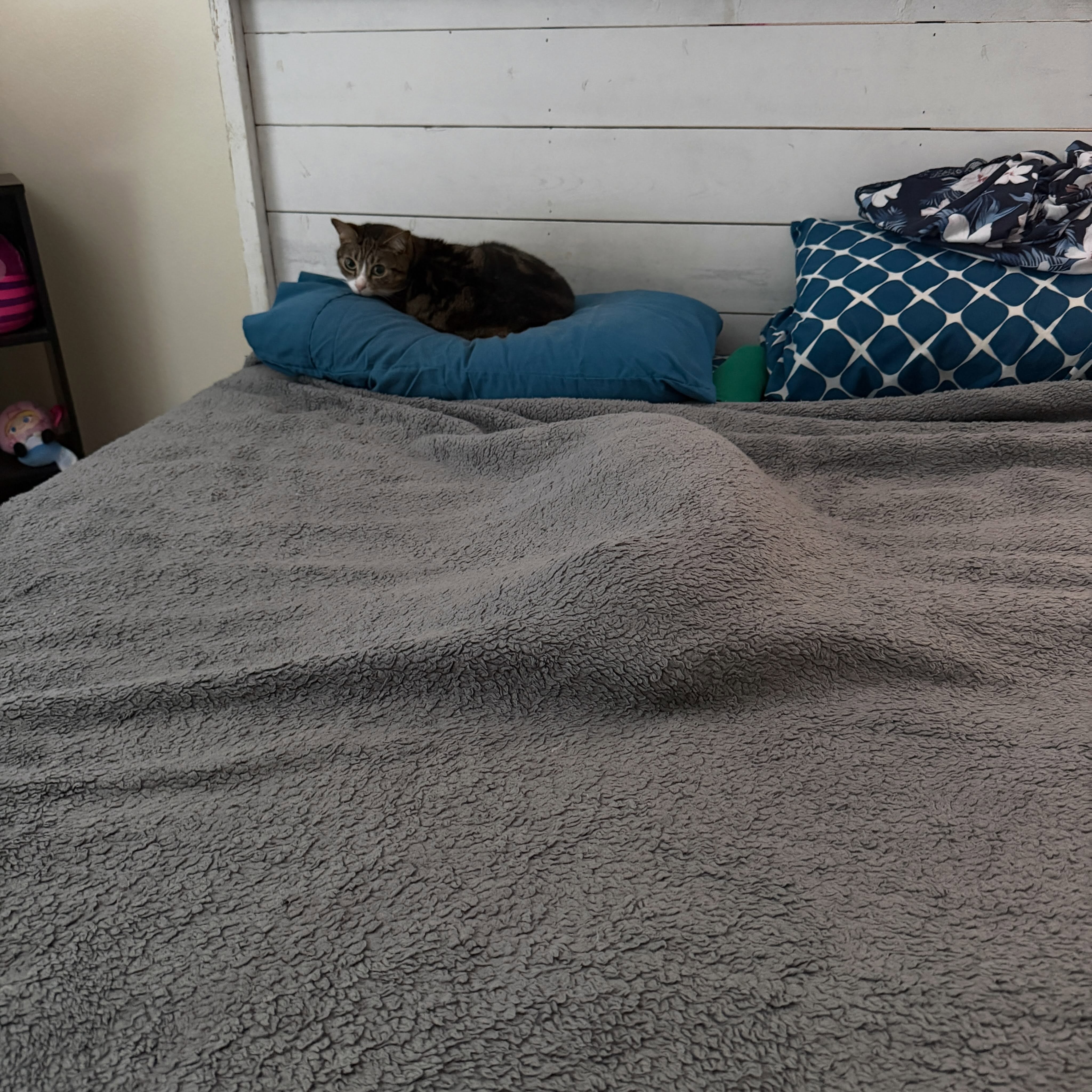
When he felt a little braver, he’d wedge himself between the top blanket and the top sheet of my bed. I called him “the lump in the bed.” That became his standing afternoon routine — reliably there between about one and five o’clock. But once it hit five, especially once winter made it dark by then, he’d start to emerge.
His third spot was the bathroom — the darkest room in the house. He wasn’t squeezed behind the toilet or hiding in a cabinet. He’d just lie out in the open, on the rug, in the dark. That one always read to me as isolation rather than simple hiding — like he might once have been shut away somewhere dark and alone.
Zoe never did any of this. She was always visible — on the pillow if she slept on the bed, on top of everything if she slept on the sofa. The only time she ever got under the covers was to snuggle next to me once I’d already covered up myself.
My guess is that Richard had spent real time as a solo cat, and this was how he’d learned to cope with the loneliness.
Learning to Trust
It took about eighteen months for Richard to fully come out of his shell — and the first real sign of him accepting me came around the six-month mark.
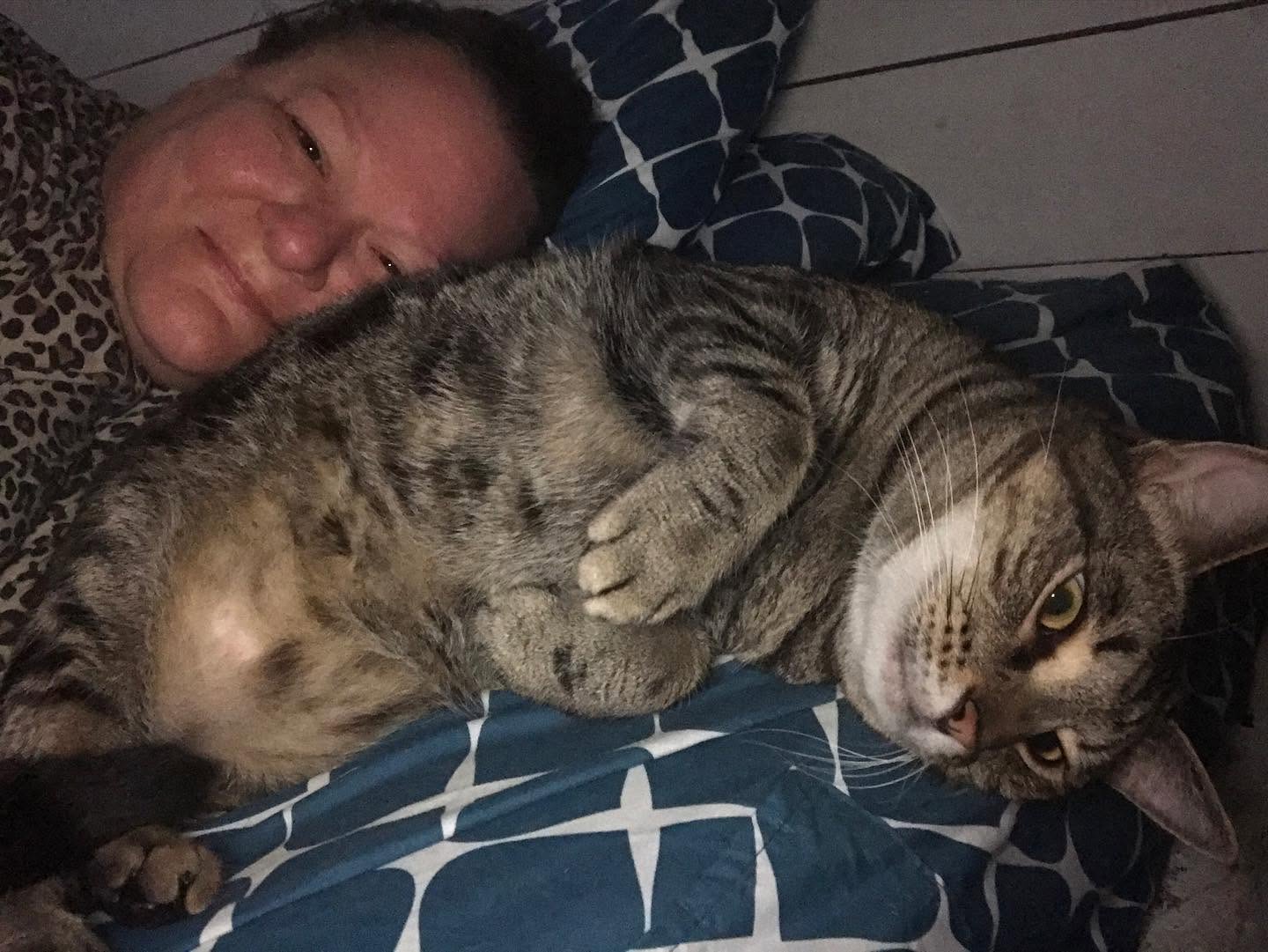
It always happened at night, in the dark, while I was asleep — sometime around two or three in the morning, based on the couple of times I woke enough to notice. However I was lying, he’d come and snuggle against my back. He still wasn’t ready to be touched or played with on demand; he wanted to control the interaction. But he chose to be there, against my back, in the dark hours before sunrise, and I loved it.
A few months after that came a rarer, second stage — maybe a couple of times a year, I’d wake up and find him curled against my front instead, right against my torso and arms, close enough that all I had to do was twitch my fingers to start petting him. That was one of my favorite ways to wake up.
Toward the very end, as he got sicker, that spot against my torso became something he asked for as soon as I got into bed each night — sometimes for twenty minutes, sometimes thirty or forty. One of the last nights, he stayed there a long time, wanting those pets.
Around eighteen months in, he also started joining me on the loveseat where I spend my evenings — my dinner spot, my TV spot. He’d jump up onto the open seat beside me and curl up to sleep. He wouldn’t want to be touched, tolerating maybe a couple of pets after he’d settled, but mostly he just wanted to be near me on his own terms. That became part of our routine, and it eventually grew into him actively asking for affection.
That asking evolved over time, too. First it was just sitting and staring at me. Later, a light paw tap on my arm — no claws, just a signal. Eventually it became headbutts, sometimes paired with a gentle reach-and-grab with his claws to pull my arm toward him.
The Butt Pats
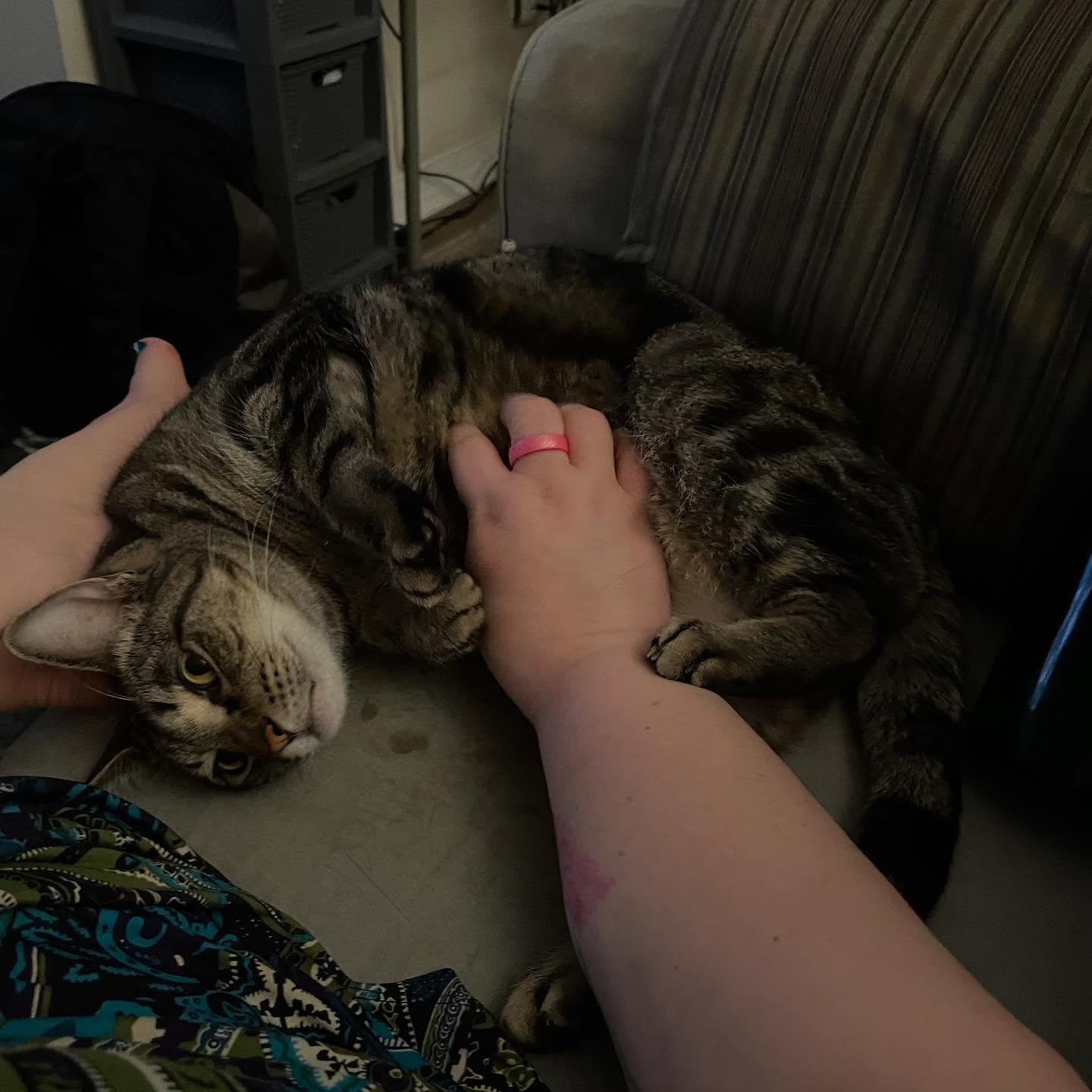
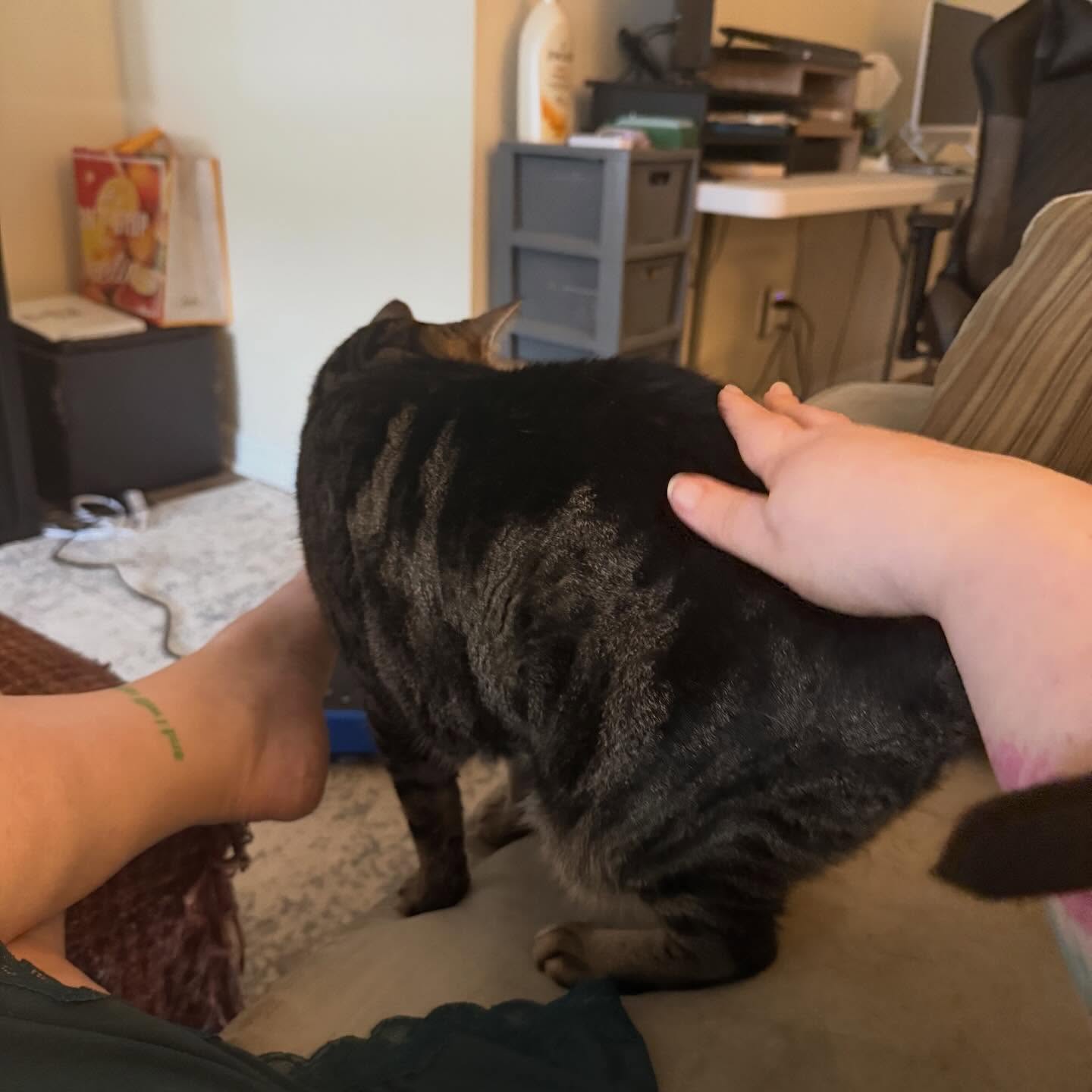
Richard loved having his butt patted — that dopamine hit cats get — more than almost anything else, and it always came bundled with another ritual: smelling my feet and legs to check where I’d been.
If I’d been out of the house, the moment I walked back in, he wanted both: sniffing my feet and shoes to see if I’d been “stepping out on him,” while I patted his butt at the same time. If I’d been gone a long stretch, I’d actually sit down on the floor so he could sniff up my whole legs before he was satisfied.
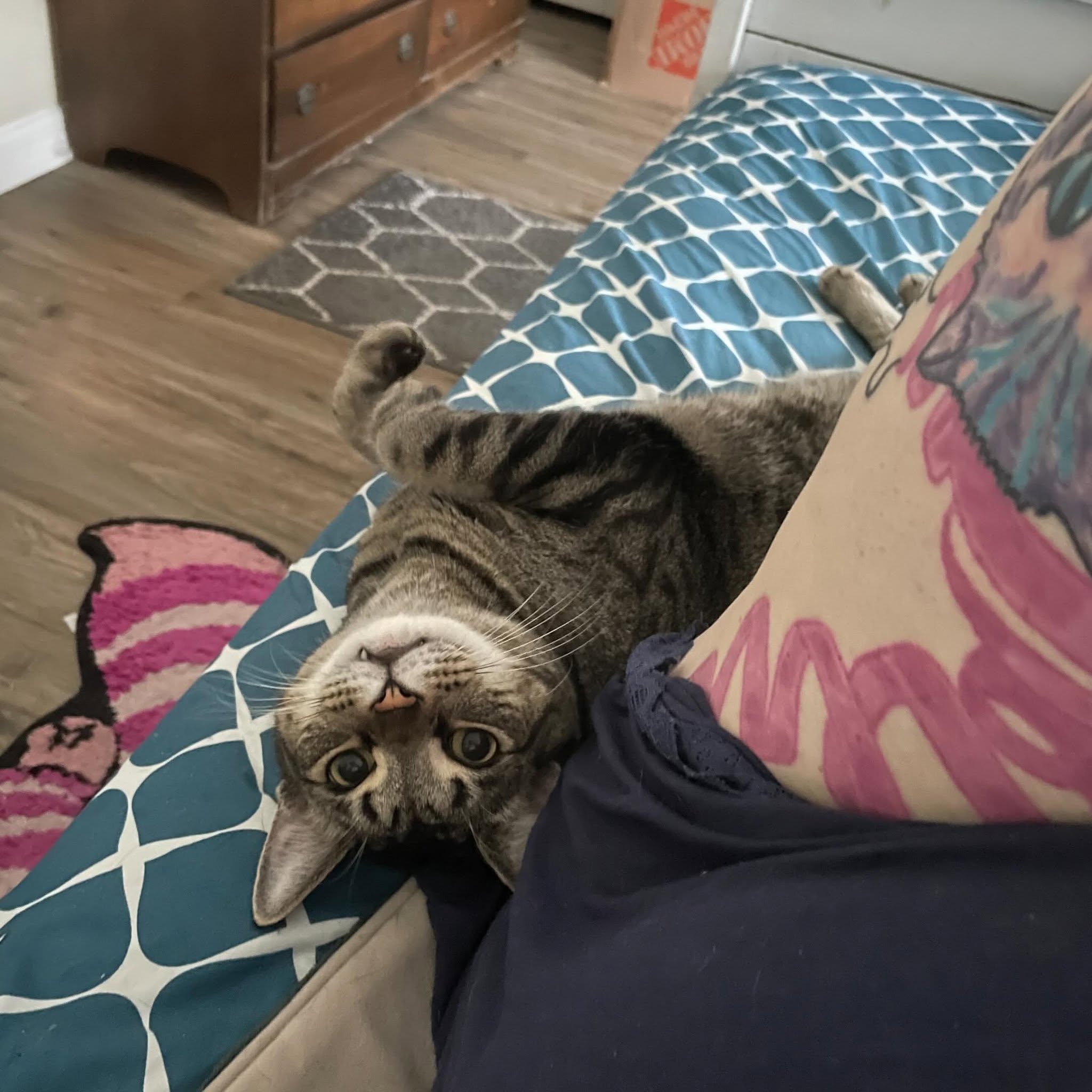
The same combination showed up in two other regular spots. If I was sitting on the toilet, he expected butt pats while he confirmed my scent around my feet and lower legs — sometimes rolling onto my feet afterward and asking for belly rubs. And on the sofa, the same ritual would turn into him wanting to smell my feet, which meant crossing my legs to bring one foot up close enough for him.
In his last couple of weeks, this became one of the ways I checked in on him throughout the day. I’d lightly tap his butt — if he lifted or moved even a little, I’d keep going. If he didn’t respond at all, I took that as a sign of how much discomfort he was in, and I’d switch to just gentle regular pets instead.
Health
Richard came with a couple of ongoing health issues I managed with the vet over the years. He had a persistent yeast infection in one ear — he both loved and hated the cleanings, hating the liquid and the swab, loving the relief once it was over.
One of his canine teeth was compromised, though it never fully infected. It gave him occasionally terrible breath but never once stopped him from crunching his favorite treats.
The Cat Bed
Any time I was pulling clothes out of my closet or dresser to donate — even freshly washed, straight out of the laundry — I’d find Richard curled up in the box. No matter how many times you wash something, it still smells like you, and he wanted to be in it.
Around the same time, I’d left a couple of empty shipping boxes out after ordering something online — Zoe-sized boxes. I’d put a blanket in one and some packing paper in the other, and Zoe claimed one of them as her sleeping spot. It made me wonder if she’d actually like a proper cat bed, so I picked up a five-dollar one at Five Below, figuring it was cheap enough to try and lose nothing if it didn’t work out.
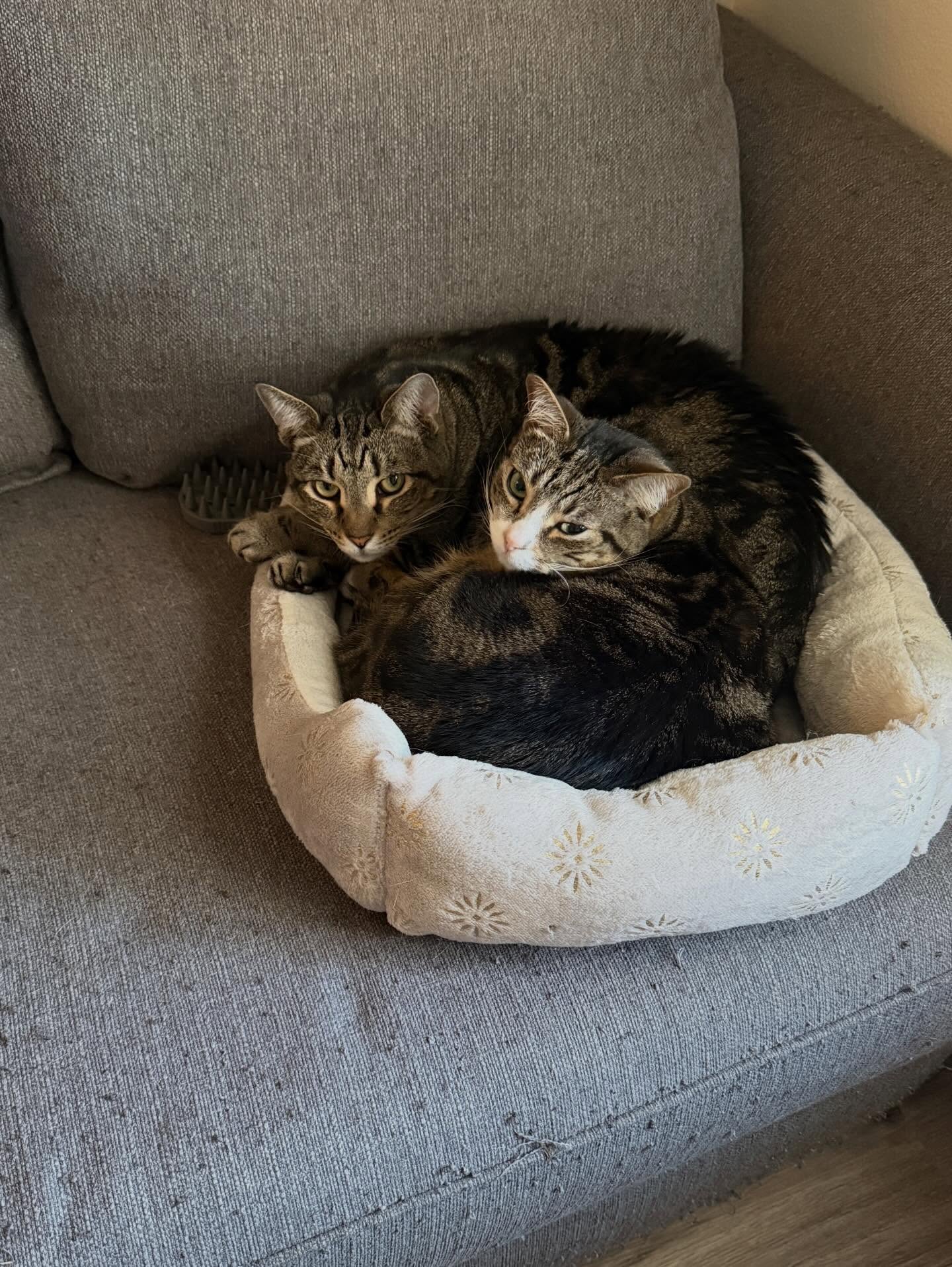
The next thing I knew, Richard was the one in it. A cat who almost never used a clothes box, who preferred sleeping tucked under covers, in a closet, or in the bathroom, had suddenly claimed this small bed I’d bought for Zoe. And then, more often than not, I’d find them both in it together — one of the most adorable things about their bond was how they slept curled up in that little bed side by side.
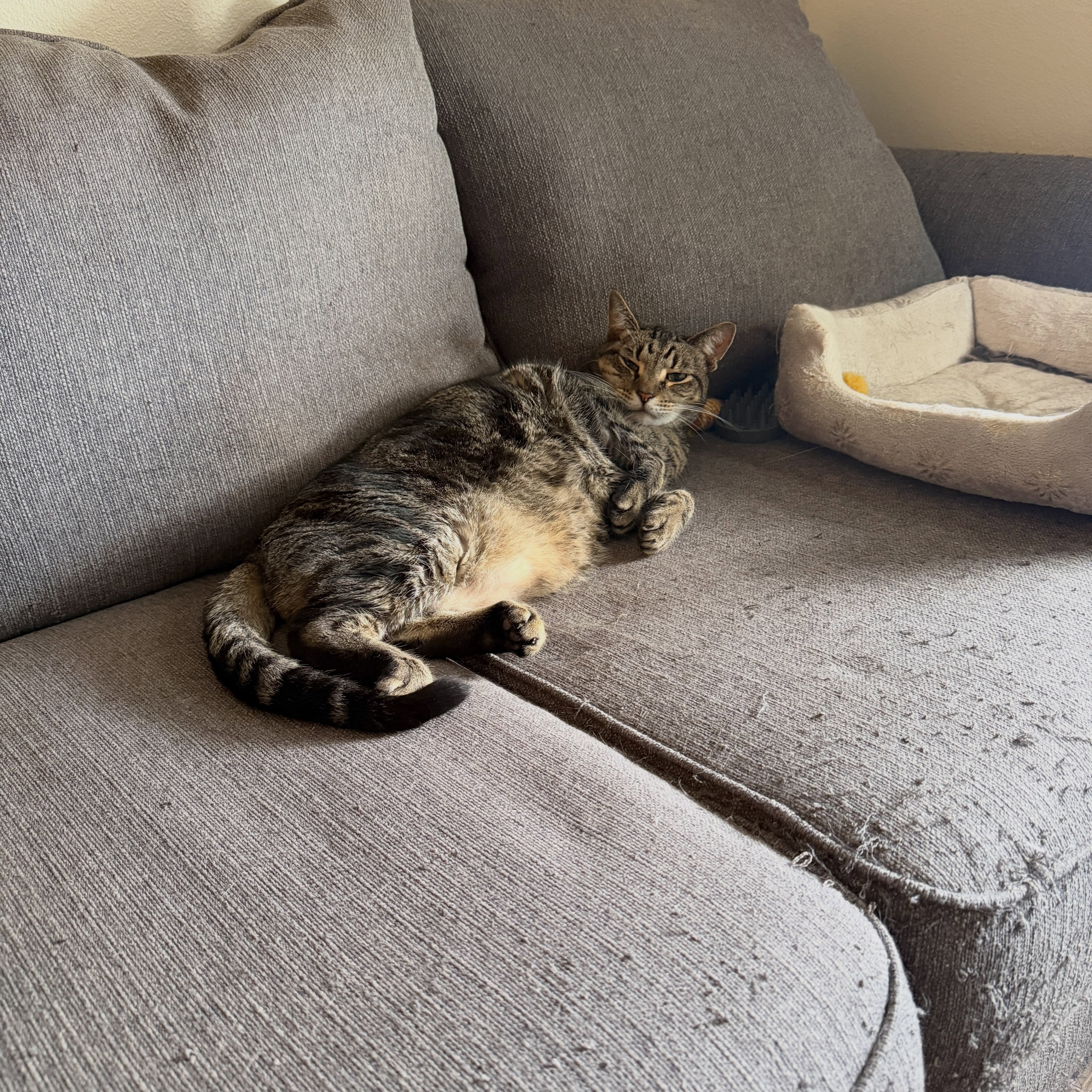
Since Richard died this week, Zoe hasn’t touched that bed. She hasn’t even gone up on the sofa it sits on — the same sofa where the two of them used to sleep before the bed even existed. It turns out that bed was really his all along, and Zoe was just a guest who dropped in now and then. She’s still got toys scattered through it that Richard never once played with. It’s one more way he surprised me, and one more thing I didn’t expect to learn about him only after he was gone.
Play, Water, and Food
Richard was about three when I adopted him — young enough to still be kittenish, the way Zoe very much was — but he rarely showed it, except every so often when I’d catch him going to town on one of Zoe’s toys. The second a camera came out, though, he’d stop. I have almost no footage of him playing.
The one thing he’d never back down from, even with Zoe around, was rugs. Lift the edge of a rug with a foot or hand, bounce it lightly, and he’d go wild — chasing it, grabbing it, pulling up the edge. We had one long runner rug that, curled up like a tunnel, he’d jet straight into every time.
He loved water in a way that never quite made sense for a cat. Mornings, he’d sometimes climb straight into the shower before I turned it on, and stay there while the water warmed up, as long as the spray didn’t hit him directly. After my shower, he’d get in and lick up the leftover droplets. He’d sit in the kitchen just to listen to the sound of running water while I did dishes — though the moment an actual drop touched him, he was gone. And on Fridays, when I filled the pitcher to water my cat-safe houseplants, he’d come running to watch the water pool on the glass catch-plate underneath and drink it straight from there.
Food was a harder subject by the end, because it was what first told me something was seriously wrong — a day of sudden, repeated vomiting, until he associated eating with getting sick and stopped eating altogether.
But when he was well, he loved seafood without question — salmon, tuna, sushi the moment I opened the container, shrimp most of all (I learned fast to always save him one). He wasn’t especially food-motivated otherwise; that was more Zoe’s department. He did love soft cheeses — American, Havarti, Fontina — in tiny pinched-off bits, and hot dogs, the meat itself rather than the bun Shadow used to beg for.
His Last Three Weeks
There was no warning. On a Tuesday, Richard ate his regular breakfast like any other morning. Then, out of nowhere, he threw up a massive puddle of partially digested food — something I don’t think had ever happened with him before. He went back and ate again. He threw it up again. That was the first signal, and it echoed the exact same first signal my very first cat, Miles, had given me when he first got sick years earlier.
The timing couldn’t have been worse. It was right before the Fourth of July weekend, when vets and animal hospitals are closed. We couldn’t get seen until the Monday after — almost a week from when the vomiting and the not-eating first started.
We limped through that week however we could. We tried churros for the first time, and for about two days it was the one thing that got food into him without it coming back up — until it just stopped working, and he wouldn’t touch another one. Otherwise, he’d lick the juice off his favorite canned foods but leave the food itself untouched. The one time he actually ate some, he threw it up almost immediately. He’d clearly connected eating with getting sick.
When we finally got in and ran diagnostics, we found a massive tumor in his liver. I’d been through something similar before, with Miles — digestive organ compromise, the surgeries, the supplements, the force-feeding pills, the stress on their small bodies — and Miles never got a lovely long life or a real recovery out of that fight. I wasn’t willing to put Richard through that same road for the same likely outcome. I chose supportive, palliative care instead, and my vet was fully on board with that decision.
We came home with supplements and appetite stimulants, and for a couple of days it seemed a little easier. But he never really got back to eating — maybe a tablespoon of his regular dry food once, otherwise just licking the juice from a can. I tried a whole rotation of new brands and flavors, since even the wet foods he’d loved for years weren’t working anymore. He did get back to peeing normally, but in three full weeks, that poor cat only pooped once.
The liver damage was already so advanced that one of his test readings came back higher than the test was even able to measure. We were past any chance of a material recovery.
Still, he rallied a little in the second and third week — coming out more, asking for pets, snuggling again for a bit. Zoe noticed the rally too, but she read it as things going back to normal. She’d kept her distance the whole time he was actively sick, only snuggling with him at night in bed, sensing that he didn’t want to be touched or bothered. But during the rally, she started trying to go back to him, rubbing against him playfully. He yelled at her. He hissed at her once. That’s when I knew he was done.
I made the decision to keep him with me through that final weekend and take him in on the Monday afternoon, on purpose — I didn’t want work as a distraction, I wanted to be fully present. Maybe that was selfish of me. I’m okay with that. I watched him closely those last couple of days. He’d still come up onto the sofa, but he wouldn’t curl up anymore — it wasn’t a comfortable position for him. He wasn’t asking for pets either, because being touched didn’t feel good anymore. He’d just sit and look at me. And I knew that look was him telling me he was ready. It turned out I had the timing exactly right.
His Last Day
That last morning, we got up when it got light out, and he sat in the front window watching the world start its day — people on their morning walks, cars pulling out for work, the sun coming up, the birds and the bugs. He took his usual nap tucked under the covers. We had some sweet, quiet moments together. At one point, he held my hand.
Richard and Zoe are the first cats I’ve had with no overlap with the ones who came before them — no crossover time with Miles, my first cat, or Angel, my second, or Shadow, my third. So that last day, while he slept, I talked to him more than once. I told him to go find Miles, because Miles had gone through this same thing at almost exactly the same age, and Miles would know what he was feeling. I told him to go find Angel, because Angel was so much like Zoe and would want to take care of him, snuggle him, make him feel loved. And I told him to go find Shadow, because Shadow loved being outside in a way Richard never got the chance to safely enjoy, and Shadow would teach him to climb trees.
As the sedative started to take him under, I told him once more: go find Miles. And after the doctor confirmed there was nothing left, in the quiet of that room, I said it to him one final time. I know it was just a reflex, nothing more, but it felt like Richard gasped. I needed him to have that instruction, that connection, so that when he crossed over, there’d be somebody already there waiting for him.
When I got home that night, I put the shirt I’d been wearing that day on the bed, not knowing what Zoe would need. I left his pillowcase and bedding out too, keeping his smell close by for Zoe. She hasn’t seemed troubled by any of it. I think, somehow, she already knew.
Coming Home
Every pet I’ve had before Richard went to communal cremation when they died — I got back a small nose print and paw print stamp, shared with other animals, and that was enough. This time was different.
While we were in the vet’s special room for passings, Richard walked over to a shelf where there were end of life brochures and different urns and boxes. I held them up, one at a time, and Richard looked right at them — and at me — and very clearly signaled the one he wanted by reaching out with a paw and pulling it to him. So this time, I chose individual cremation, with a plaster paw print made just for him.
I picked him up this past Friday, July 24th. He’s home now, urn and paw print both, with me and Zoe. I’ll figure out how I want to display him, and I’ll add a photo here once I do — but for now, he’s just home.



 Singing about Cooking