The Problem with the Seuss Default
Oh, the Places You’ll Go has become the default graduation gift for one simple reason: it feels meaningful without requiring much thought. It’s colorful, familiar, and its message — you’re special, life will be an adventure, you’ll figure it out — is warm and easy to receive. For a gift-giver, it checks every box.
But that’s also exactly the problem. The book is vague by design. It acknowledges that life will be hard (“the Waiting Place,” the slumps) but offers no tools, no framework, no honest reckoning with what hard actually looks like. Its central promise — that the graduate is destined for great places simply by virtue of being themselves — is comforting in the moment and quietly unhelpful afterward. It mistakes encouragement for wisdom.
There’s also a more uncomfortable possibility worth naming: Oh, the Places You’ll Go may resonate less with graduates than with the adults giving it. Its vision of the child as a singular, destined protagonist — launched into the world but still defined by the wonder and innocence of childhood — is deeply comforting to a parent who isn’t quite ready to let go. The book keeps the graduate small in the most loving way possible. It whispers that the world is theirs, while quietly preserving the parent’s role as the one who believed in them first, who shaped who they are, whose hopes and dreams are woven into their future. For a parent grieving the end of a particular kind of closeness — the daily influence, the shared household, the child who still looked to them for answers — Seuss offers a gentle farewell that doesn’t fully acknowledge that the farewell is happening. That’s understandable. But it’s the parent’s emotional need, not the graduate’s. And the graduate deserves a gift chosen for them.
Graduates, whether leaving high school or college, are standing at a threshold that deserves more than a well-meaning shrug. They need books that take their intelligence seriously, that grapple with real questions — about meaning, identity, failure, work, and what a good life actually requires. The books below do that.
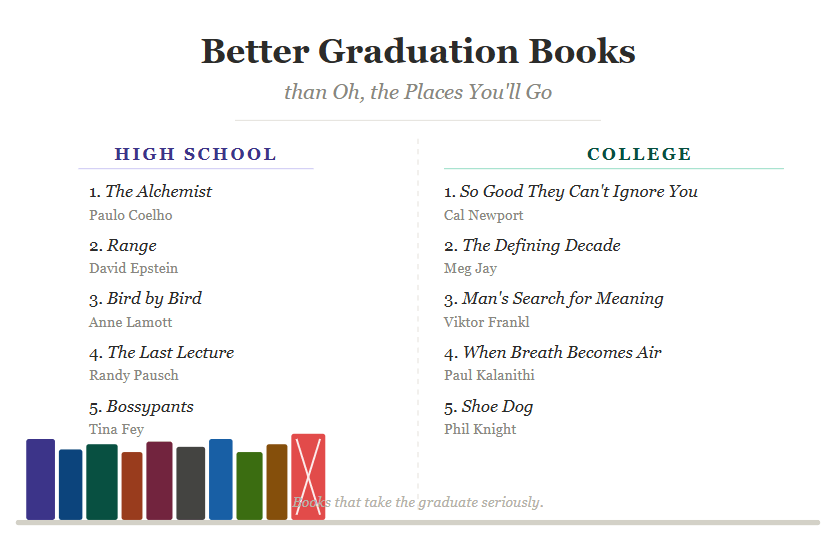
For High School Graduates
These books are accessible, relatively short, and speak directly to the experience of being 17 or 18 — full of possibility but uncertain about identity, direction, and what comes next.
1. The Alchemist by Paulo Coelho A slim, allegorical fable about a shepherd boy who sets out to find treasure and discovers that the journey itself is the point. It romanticizes purpose without being naive about the cost of pursuing it. Readable in a weekend, resonant for years.
2. Range by David Epstein A research-driven argument that generalists — people who explore widely before specializing — tend to outperform early specialists in the long run. An enormous relief for any 18-year-old who doesn’t know what they want to do with their life yet. Spoiler: that’s a feature, not a bug.
3. Bird by Bird by Anne Lamott Ostensibly a book about writing, but really a book about showing up to hard things in small, manageable pieces. Her concept of “shitty first drafts” applies to college essays, careers, relationships — essentially everything. Funny, honest, and deeply practical.
4. The Last Lecture by Randy Pausch A Carnegie Mellon professor, given a terminal cancer diagnosis, delivers one final lecture about achieving childhood dreams and enabling others to do the same. Warm, specific, and full of concrete life lessons. Reads in an afternoon and lands hard.
5. Bossypants by Tina Fey (especially for young women) Part memoir, part comedy masterclass, entirely honest about ambition, imposter syndrome, and navigating institutions that weren’t built for you. Makes the case — through laughter — that confidence is built, not born.
For College Graduates
These books assume a bit more life experience and engage with harder questions: career, meaning, mortality, and what it actually takes to build something worth building.
1. So Good They Can’t Ignore You by Cal Newport A direct challenge to “follow your passion” — arguably the most damaging advice given to young people. Newport argues, with evidence, that passion follows mastery, not the other way around. Essential reading for anyone anxious about finding their “calling.”
2. The Defining Decade by Meg Jay A clinical psychologist makes a calm, compelling case that your 20s are not a throwaway decade — that the choices made between 22 and 32 have an outsized impact on the rest of life. Not alarmist. Genuinely clarifying.
3. Man’s Search for Meaning by Viktor Frankl A psychiatrist who survived Auschwitz writes about how meaning — not happiness — is what allows humans to endure almost anything. Brief, devastating, and one of the most important books of the 20th century. Every graduate should read it before they’re 25.
4. When Breath Becomes Air by Paul Kalanithi A neurosurgeon facing terminal lung cancer writes about what makes a life worth living. It asks the questions that a diploma doesn’t answer: What do I value? What do I owe others? What will I leave? Beautifully written and impossible to put down.
5. Shoe Dog by Phil Knight Nike’s origin story, told as a raw, unglamorous memoir. Knight was broke, uncertain, and frequently on the verge of collapse for over a decade. More than any business book, it captures what building something actually feels like — and why it’s worth it anyway.
Any of these will outlast the Seuss book on a shelf — and more importantly, in the mind of the person who reads it.