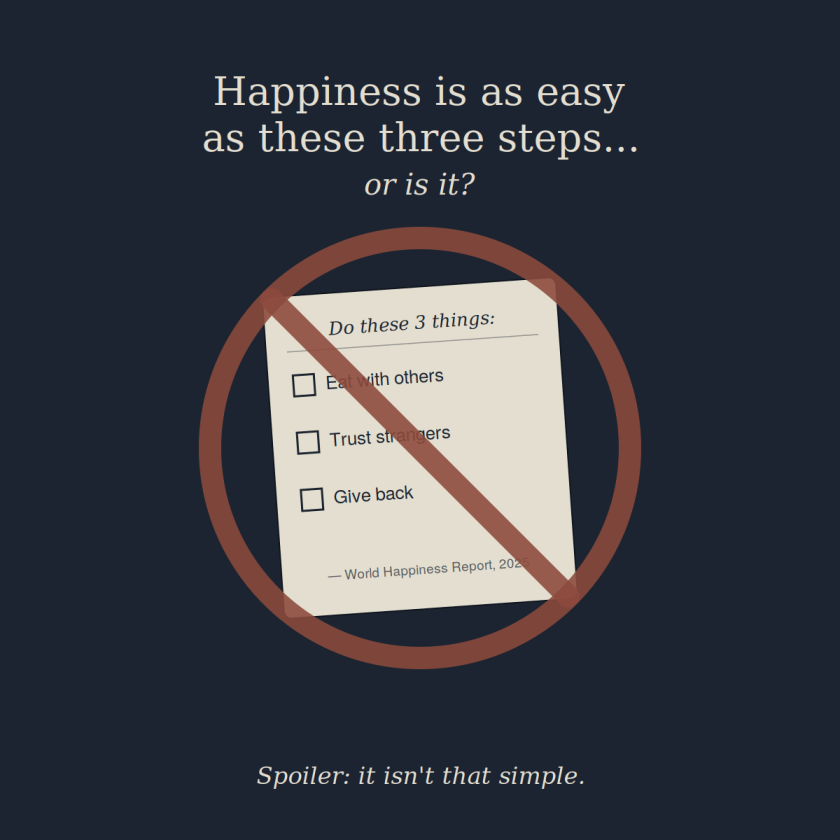
A response to Oxford’s World Happiness Report: three “happiness questions” that assume you’re partnered, trusting by default, and flush enough to give — and leave the rest of us out.
Inc.com ran a piece this week distilling the 2025 World Happiness Report into three questions that supposedly predict life satisfaction better than money or success. Eat meals with other people. Expect strangers to be trustworthy. Do things for other people. Answer yes to all three and, according to Oxford’s data, you’re happier than the people chasing a raise.
I read all three and thought: this is a survey built by and for a very specific person. Partnered. Extroverted by default. Financially stable enough that generosity is a free choice rather than a math problem. Socially trusting because nothing ever taught them otherwise. That’s not most people. It’s certainly not me.
Question one: eat with other people
No.
Eating alone, in public, with no one to coordinate around, is one of the more reliably pleasant parts of my week. The article frames solo meals as a loss — missed connection, missed networking, missed happiness you didn’t know you were leaving on the table. What it doesn’t count is what a shared meal actually costs to produce. Making plans and then having to break them. Working around someone else’s dietary restrictions or medical needs — timing a meal around a dining companion’s diabetes management, for instance, means the food itself becomes a coordination problem before anyone’s taken a bite, because insulin gets dosed against what’s actually delivered, not against what the menu implied it would be. Add in managing conversation, gauging whether the other person’s having a good time, and reading a room while also trying to eat in it.
Then there’s the part the survey has no column for. I’m a recovering anorexic of almost forty years. Eating in front of someone is never just eating. There’s a background process running the entire meal, tracking whether the person across from me is clocking what’s on my plate, whether they think I should have ordered something else, whether they’re doing math about my body while I’m doing math about my body. That process doesn’t turn off because the research says shared meals correlate with happiness. It’s exactly the mechanism the research is asking me to opt back into, framed as self-improvement.
Solo meals aren’t a consolation prize. For a lot of people, they’re the only version of eating that isn’t also a performance.
Question two: expect strangers to be trustworthy
What.
I’m Gen X. Stranger danger wasn’t a suggestion, it was the entire curriculum. Nobody under fifty was raised to assume the person they don’t know is safe by default, and treating that instinct as a happiness deficiency gets the causality backwards. The examples the article reaches for — ride-share, in-home services, marketplace platforms — aren’t evidence that people trust strangers. They’re evidence that an entire economy got built specifically because people don’t. Uber doesn’t run on faith. It runs on ratings, GPS tracking, background checks, and a review layer that exists precisely so nobody has to extend blind trust to anybody. That’s not trust. That’s trust infrastructure, built by companies that understood the default answer was no and monetized closing the gap.
Conflating “I’ll use a platform with five layers of accountability built in” with “I generally expect strangers to be trustworthy” is doing a lot of quiet work in that research question. They’re not the same disposition. One is caution with guardrails. The other is the thing I was specifically trained out of by 1985.
Question three: be kind to others
Here’s where the neurodivergent point comes back around, because it always does: volunteering, donating, and “helping strangers” all assume a baseline of social bandwidth and extroverted engagement that isn’t universal, and treating that baseline as the default path to happiness quietly pathologizes anyone whose brain doesn’t run that way.
But set that aside, because the bigger problem is economic, not psychological. This research keeps getting used as a stand-in for the happiness of the average person at the exact moment the average person is single, in a K-shaped economy, watching the middle class shrink in the rearview mirror. Prices are outrunning inflation. Compensation is lagging behind it, even for people who did everything right and stayed salaried. Benefits are getting trimmed. Pricing structures across housing, insurance, and household costs were built around two incomes and haven’t adjusted for how many people are now running a household on one. “Live within your means” only works if your means hold still. When price keeps outrunning what you’re paid, your means shrink every year — a second job, a side hustle, just to keep living within them. Eventually the means shrink enough that you can’t even afford to move somewhere cheaper. There’s nothing left over for a place where donating feels like an option again.
Telling that person their happiness is one volunteer shift away isn’t wrong because it’s unkind. It’s wrong because it’s not describing their economy.
The gap
Three questions, one implied profile: partnered enough to always have a dinner companion, safe enough in their formative years to default to trust, and flush enough in time or money that generosity is a choice rather than a luxury. Introverts, single people, independent people, and anyone currently underwater just don’t show up in that model — not because they’re less happy, but because the questions were never built to find out.
 Singing about Cooking