Fifty, done with organized religion, and finally naming a lifelong pattern of choosing solitude, judgment, and mortality on her own terms. One woman’s case for the crone.
Earlier this week I was talking to my neighbor (F, 25-ish), who is roughly half my age, about what I’ve been watching lately. Vampire Diaries. I’m nearing the end of the series. She lit up — oh, you have to watch Originals next, oh, you have to watch Legacies. I told her I’d already seen both. In fact, I’d seen them first. I watched Legacies before I ever touched Vampire Diaries, got curious about Klaus Mikaelson’s backstory, went to Originals, and only then worked my way back to the beginning. I’ve been going backward through the whole thing on purpose, which is apparently not how anyone else does this.
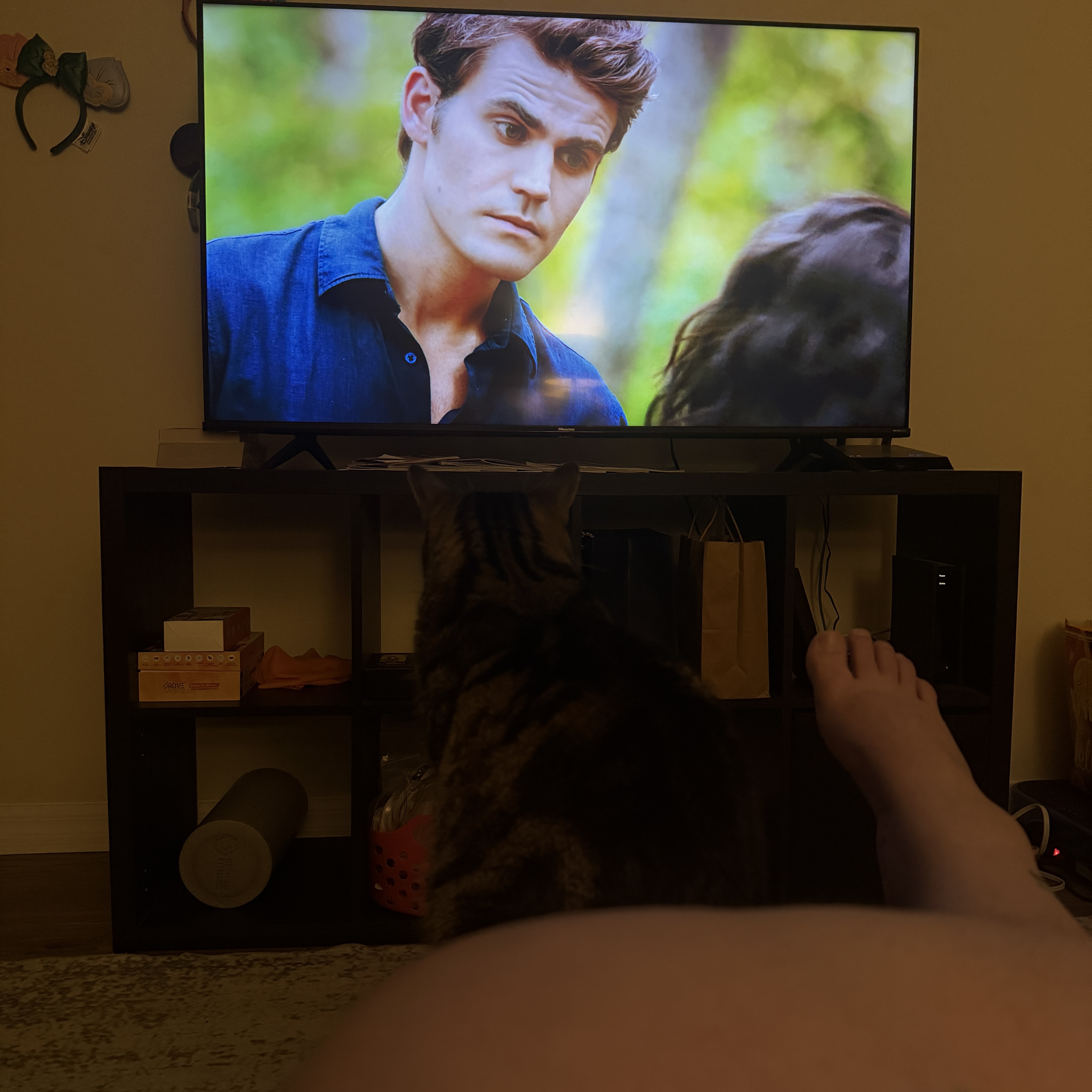
She also asked if I’d seen Gilmore Girls. I told her that one aired a little after my time as a young adult — I was already past the demographic it was written for when it aired. Now I have to go back and watch it anyway, because I’ve spent twenty years watching most of that cast grow up and get better at their craft in other things, and there’s no reason not to close the loop.
None of that is the point. The point is what happened after she left: I sat with the fact that a conversation about teen vampire shows had somehow confirmed something I’d suspected for a while.
I don’t think I’m entering my crone era. I think I’ve been in it since I was much younger, and I only just found the word for it.
What Crone Actually Means
The maiden-mother-crone triad shows up across a lot of pre-Christian and folk traditions as a way of mapping womanhood in thirds, roughly tied to a woman’s relationship with fertility rather than to age or ungendered life experiences. The maiden is beginning — curiosity, discovery, a life not yet spent on anyone else. The mother is the productive middle — creation, caretaking, output, whether that’s children or work or anything else built for others to use.
The crone is the third phase, the one that arrives after the culture stops expecting fertility and production from a woman, and it gets read two very different ways depending on who’s doing the reading.
The unflattering version, the one baked into most fairy tales, treats the crone as used up — a woman past her use, cast off, shriveled, dangerous in a bitter way. The older, more honest version treats her as the one who’s finally free of the expectations that ran her first two-thirds, and dangerous in a completely different way: she has nothing left to prove and nothing left to lose, which means her judgment finally belongs entirely to her. She knows things because she’s outlived the point of performing for anyone. She’s associated with wisdom, with the ability to sit with death without flinching, with cutting straight past politeness to what’s actually true.

That second definition is the one I mean. Not withered. Unmanaged. I’m not describing a phase I’ve entered at fifty. I’m describing a way of operating that the culture doesn’t have a slot for until a woman is old enough that it stops trying to sell her something.
Judgment Is Not for Rent
I read constantly as a kid, which in the capital “S” Southern culture I was raised in meant one thing if you were a girl: you were going to be an English teacher. Not asked. Told. By everyone. I started college in that degree program, got into the program, and hated almost every minute of it — not the literature, the bureaucracy of the K-12 education system. A room full of people who had never met me deciding how I was supposed to think and what I was supposed to do with a skill I already had. I left the systemic education path but continued on exploring language and literature. The teaching I did in higher education and the teaching I do now in business, much later and in a completely different form, is mine.
There’s an older, heavier version of that same expectation that follows a lot of women: you are the eldest daughter, so you will be the one who manages your aging parents, financially and otherwise, no matter what that costs you. I’m not going to get into the specifics of that one here. What I’ll say is that I looked at what was actually being asked of me, weighed it honestly, and said no. That decision cost me a relationship a lot of people would have kept out of obligation. I don’t regret it.
Somewhere in between those two things sits something much smaller and much more physical. A few months after I turned fifty this year, I stopped shaving. Legs, underarms, all of it. I’d already been drifting that direction for a decade — weekly, then biweekly, then monthly — but this year I just decided to stop doing it at all. The hair grew in sparser than I expected and softer than I expected. I don’t feel it unless the wind picks up. I’m not making a statement when I shower. I’ve just stopped thinking about it, which might be the most honest measure of how little it ever mattered to me in the first place.
Even punishment when I was a kid came with an expectation attached, and I never met it. Getting grounded is supposed to feel like a loss — kids are supposed to want to run around and make noise and messes, want the TV, want the phone, and sulk when all of that gets taken away. Instead, grounding meant a closed door and permission to read in silence for as long as I wanted. When they took the phone away too, it barely registered.
None of these three things are the same size. But they’re the same shape. Somebody hands me an expectation with their confidence attached to it, and I check whether it actually serves me before I put it on.
Trusty Old Reruns
The shows and movies I go back to on purpose have a pattern I hadn’t clocked until I said it out loud: Big Bang Theory. Charmed. The old Roseanne, before the reboot muddied it. Hackers, from back when being a teenage computer expert on dial-up was genuinely disruptive. Goonies, because I had that exact childhood — a pack of kids building forts in the marsh behind our neighborhood and disappearing into our own version of an adventure nobody adult had sanctioned. Fast and Furious. Pitch Perfect. Harry Potter and the unfinished Fantastic Beasts run.
What ties them together isn’t nostalgia for its own sake. It’s that almost all of them center people who are marginalized, odd, or building something outside the system they were handed — witches, hackers, outsiders, a family that doesn’t look like the sitcom standard — and I go back to spend more time with them on purpose. Watching a show out of publication order, it turns out, was just a streaming algorithm doing its job. Rewatching is the actual habit, and it’s not about knowing what happens next. It’s about choosing, deliberately, whose company I want to keep for a few more hours.
I’d rather stay in on a weekend night in pajamas with a rerun with a predictable story arc and ending than go out for the sake of going out.
I know that reads as introverted at best and neurodivergent at worst to some people.
I’m fine with both readings.
The Church I Was Handed Back
Part of why this has been on my mind this particular week: the drag performer Jinkx Monsoon made news arguing that children shouldn’t be raised inside a single religion at all — that they should be left alone to explore belief once they’re old enough to actually choose it, with real consent, instead of having a faith installed before they’re capable of agreeing to it. The word doing the work there is “consent.” Every infant baptism, every confirmation, every first communion is a parent deciding what’s right and then installing it in a child who has no vote. That’s not a technicality. It’s the actual mechanism.
I’ve watched this play out at both extremes. One person close to me was raised Catholic, later questioned her gender identity in a way the church wouldn’t accept, and was rejected outright for it — a door closed permanently over something she didn’t choose and the church refused to make room for. Someone else I know spent years questioning his own gender identity and left religion early in life partly because of it, then later in life settled into a more traditional identity, got married, got baptized, and now practices comfortably. I’m not saying either path is wrong, or that you can’t leave and come back. What unsettles me is the size of the gap between those two outcomes and the question sitting underneath it: is a return to religion, at that point, a genuine belief, or is it the price of being accepted somewhere? “Acceptable” and “true” aren’t the same word, and I don’t think organized religion has ever reliably known the difference between them, especially not with children too young to ask the question themselves.
There’s one expectation I left out above because it’s bigger than the others and it deserves its own room: I was raised in the church, and I don’t practice any religion now. For clarity, I define “religion” as a systemic and observable set of rituals and doctrines accepted as fundamental to identifying as a [name of the religion or religious sect]. Religion is not limited to Judeo-Christian options or even to theistic options.
I was baptized as an infant into the Evangelical Lutheran Church in America, and raised in one of the oldest continuously operating Lutheran congregations in the country, in Charleston. My mother’s family were Southern Baptist for generations before a family friend brought her to that Lutheran church instead, and it stuck hard enough that it became the church she was married in and the one she raised us in. My father, Southern Baptist by birth, never practiced anything in my lifetime; in him I have a model for agnosticism sitting across the dinner table from me my whole childhood, and he’s a perfectly good person. I was born on October 31, which is Reformation Day — the anniversary of Martin Luther nailing his complaints to a church door in 1517 and launching the protestant reformation that would result in the establishment of the Lutheran church — and my mother took that as confirmation, literally, that she’d picked the right religion.
So I was raised to be Lutheran the way most kids raised in liturgical traditions are: infant baptism, Sunday school, no vote in the matter. In ninth grade I ran a small project, half school assignment and half genuine curiosity, visiting other kids’ churches and talking to their families about what they believed and why. That was the beginning of treating religion as something to investigate rather than something to inherit, though I didn’t have that language for it yet. And it’s a key reason that after confirmation, instead of continuing on into high school Sunday School and the youth group, I joined the choir instead — a small, quiet redirection that in hindsight was the first step out the door rather than further in.
College made it even more obvious. I went to a Lutheran college, one my home church had helped found, in a town built around it. I stopped going to church entirely. Not the weekly campus chapel, not a local church, nothing. I came back to church four years later while in my first bought of graduate school; again I joined a choir in a church I chose myself, and reconstructed years later how much of that was actually about the music. The second time I went through graduate school at that same university, I didn’t go back to church at all, for three years, and nothing about my life felt unfinished.
When I moved to New York, church became a way to build a social life in a city where I knew no one, and it worked, mostly through the choir again — the friends I made there were fellow paid singers, not members of the congregation. I even served on the church council and substituted as worship leader and sermonizer twice. I was good at it. The service is so patterned it’s easy to run once you know it. I can still recite the entire liturgy from memory. I can sing the cantering without opening the book. That’s pattern, not faith. Being good at leading it and finding it meaningful turned out to be two completely separate things, and I knew that even while I was up there doing it well.
The clearest moment came when I moved back to South Carolina to help with my parents and was expected to return to the church I grew up in. I couldn’t. Not because of doctrine — because of identity. To that congregation, I wasn’t a person; I was Marsha’s daughter, expected to be a younger copy of my mother. At a women’s retreat, someone called out that they needed Marsha’s daughter to come lead a song. I stood up and walked out. That was the hard stop. The next time I went to church, I had found two workable substitutes after that: a paid singing position at a Presbyterian church, which was a job, and membership somewhere large and casual enough that no one would ever ask me to lead anything or know who my mother was. Both let me be present without being claimed.
Then in 2020 I moved during COVID, and church simply stopped. No congregation to return to or establish a connection with, easy livestreams to half-watch instead of attend, and once that habit of engagement broke, it never came back. Two more moves came and went — a couple of visits in North Carolina, none at all in Virginia — and by the time I landed in Florida I was watching family navigate their own version of this: they’d left one church over its stance on nontraditional life choices and found a Lutheran congregation that welcomed the same people fully, in membership and in leadership, which mattered enough to them to make the switch. I went with them occasionally, filled in as the responsible adult getting the kids to church when their parents traveled, and enjoyed all of it exactly as much as you’d enjoy a pleasant, low-stakes social occasion. When those same kids, no longer needing the Lutheran church’s acceptance, drifted back toward the Catholic church that had pushed them out in the first place, I didn’t go with them. By 2025 I was telling my family plainly that I was done with church, even for the occasions they considered significant. My local family has accepted my choice.
What replaced it started around my fiftieth birthday in 2025. My birthday, that same October 31st my mother once read as proof of her own correct choice, is also Samhain — a pre-Christian holiday marking the turn toward the dark half of the year. I don’t celebrate it. I don’t ritualize it. But sometime around turning fifty I started taking seriously an idea I’d been circling for years: that the word “magic” and the word “faith” describe the same thing, and the only difference is which one your culture has agreed to protect.
Consider this example: Rose quartz is supposed to open you up to love, and I can’t prove how, scientifically, and that gets called magic. Wine and a piece of bread are supposed to become the actual body and blood of a man who never handed either out at a table for people to eat, literally or otherwise, and that gets called faith.
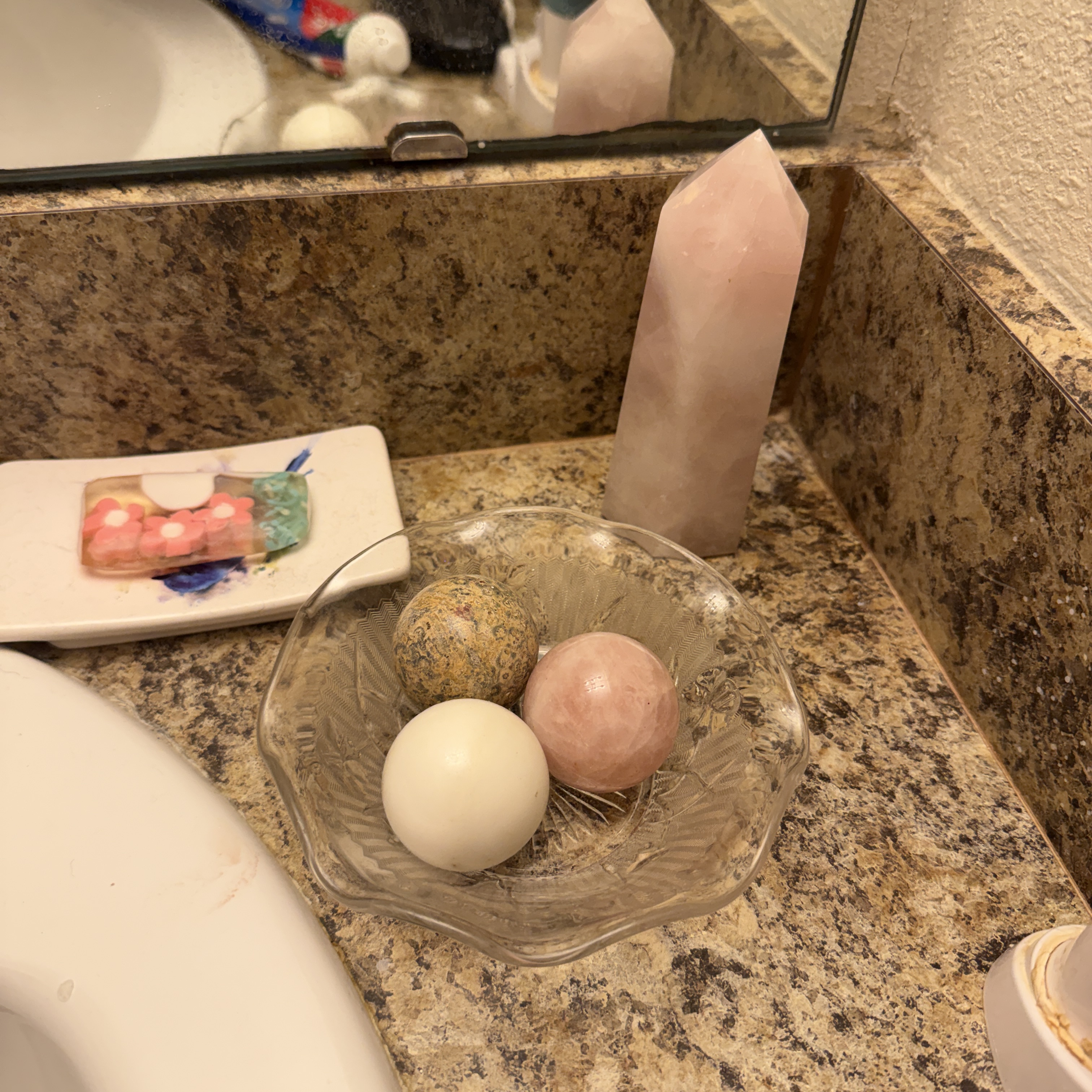
Both are claims about the unseen that nobody can produce evidence for. One of those claims used to get women burned. I’ve never been able to unsee that asymmetry once I saw it, and I have no patience left for a culture that spends December insisting one specific unprovable belief is the reason for the season while treating every other unprovable belief as a threat.
I used to think this started in the last year or two. Looking back at the ninth-grade project, I think it started closer to age fourteen or fifteen.
Domestic, Witchy, Wild — Same Thing
This year I expanded from quick refrigerator pickling, which is really just a fast infusion, into actual heat-processed canning/pickling and fermentation. Shelf-stable, not quick-fix. Partly that’s for its own sake. Mostly it’s practice — I’m preparing for a more frontier-oriented life in Alaska, where the growing season is short and intense and everything after it depends on what you preserved while you had the chance. But sometimes I find myself self-identifying as “the witch in the woods” when I’m doing things like this.
I don’t draw much of a line between domestic, witchy, wild woman, and frontier woman.
People sometimes hear “domestic” and picture a fifties housewife with her makeup on before her husband wakes up. That’s not it, and it’s not close. What I mean is something more basic: paying attention to the physical world around you, understanding what it offers, and bringing it into your house and your daily life instead of outsourcing all of it to a supply chain.
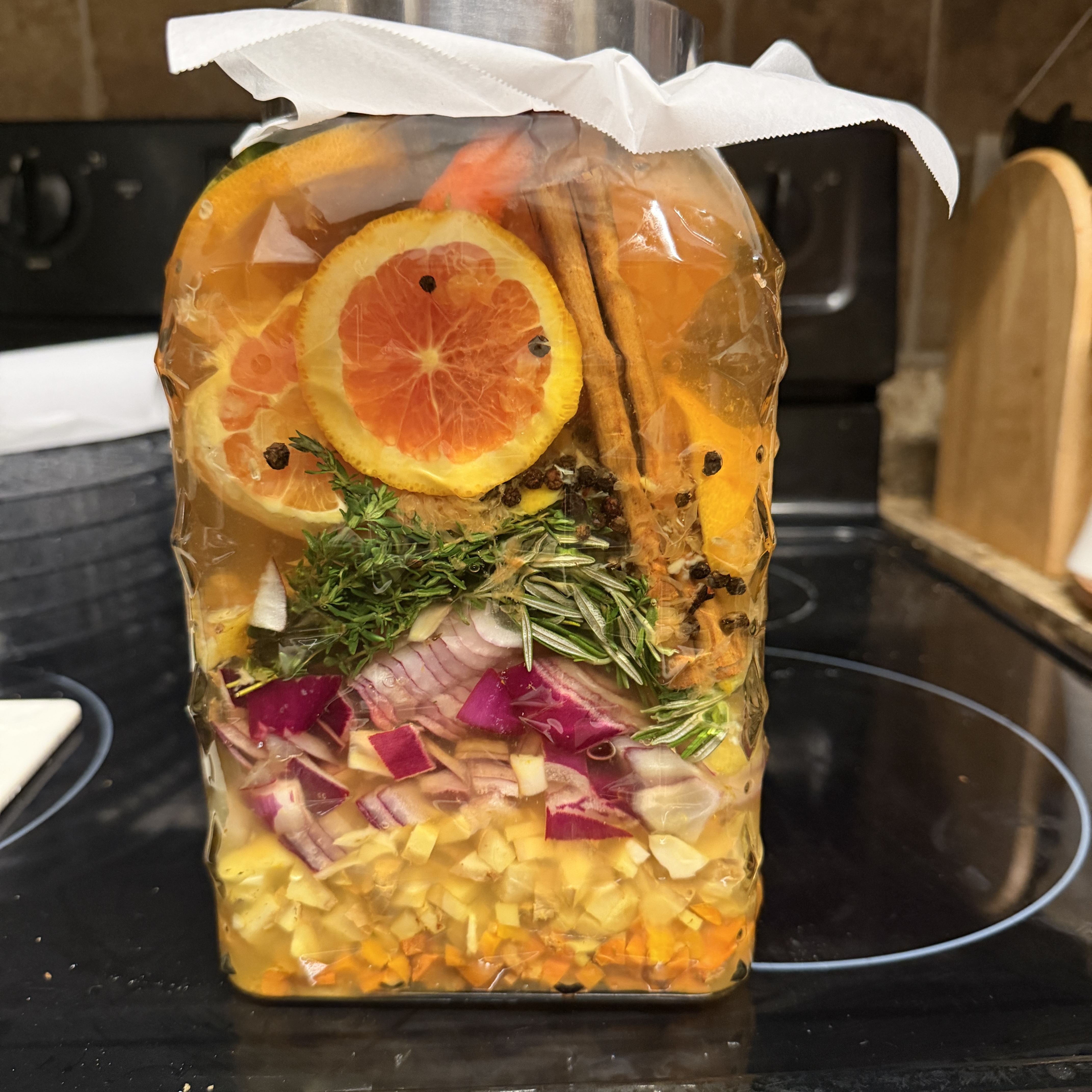
This week I made fire cider for the first time — the kind of thing that sits exactly at the intersection of all four of those words. It’s a folk remedy, it’s fermented, it’s built from what you have on hand rather than what a store sells you, and it assumes you’d rather understand how to take care of yourself than default to someone else’s version of the answer. It fit into the same week as a jar of something else preserving on the counter, which is more or less how my kitchen runs now.
The Ending Is a Fact, Not a Crisis
Here’s the part that actually convinced me the crone era isn’t a 2026 development.
In 2000, my grandfather was in a coma. The adult members of the family took shifts sitting with him. Eventually the hospital raised the question of turning off life support, and the decision landed on my grandmother, who couldn’t make it. It passed to her two daughters, who couldn’t agree with each other. As the oldest grandchild, it would have come to me next. When I understood where things stood, I said it plainly: if the decision comes to me, I will turn the machines off. His life was over. Keeping the equipment running past that point wasn’t kindness. It was practical, humane, financially sane, and true, all at the same time.
I’ve since told other people, in other families, that I’ll be that person for them too — the one who says the sentence out loud when everyone else is too tangled in their own grief or love or guilt to say it. That’s not coldness. It’s that I don’t carry the same emotional fog most people carry around death, so I can see the decision clearly enough to make it.
This week alone, Dolly Parton died, Tim Curry died, and Gloria Steinem died, all in their eighties or nineties, and the reaction online was somewhere between shock and outrage, as if any of that should have been avoidable. It wasn’t. Bodies end. Most of what we call medicine is organized around postponing that fact indefinitely, which is, by definition, insane — doing the same thing repeatedly and expecting a different outcome, when the outcome has never once been different for anyone. The mind isn’t bound by that. Whatever people mean when they talk about someone’s spirit or their work outliving them, that part isn’t made of the tissue that’s going to fail. The body is a different category, and I’ve never had trouble telling the two apart.
I have benchmark ages where I stop and take stock of where I am — not to fix a number for my own death, but to check whether I’m still living the life I actually want. The next check-in is sixty, a little over nine years out. Between now and then, the job is to make sure that when I get there, I can genuinely be at peace with however much closer I am to the end. That’s not morbid. It’s the only planning that’s ever made sense to me.
The maiden-mother-crone framework predates the religion I was handed at birth by a long way. So does the version of me that walked out of a women’s retreat rather than answer to my mother’s name, that had already decided to turn off a machine when two grown women couldn’t, that decided a rose quartz and a communion wafer are making the same unprovable claim and only one of them gets protected. I didn’t arrive at any of this in 2026. I just spent forty-nine years assuming it needed a better explanation than the one I already had. It didn’t. It needed a name, and the name is crone — not a phase I’ve entered, but the thing I was doing the whole time, before anyone had agreed to let me do it.