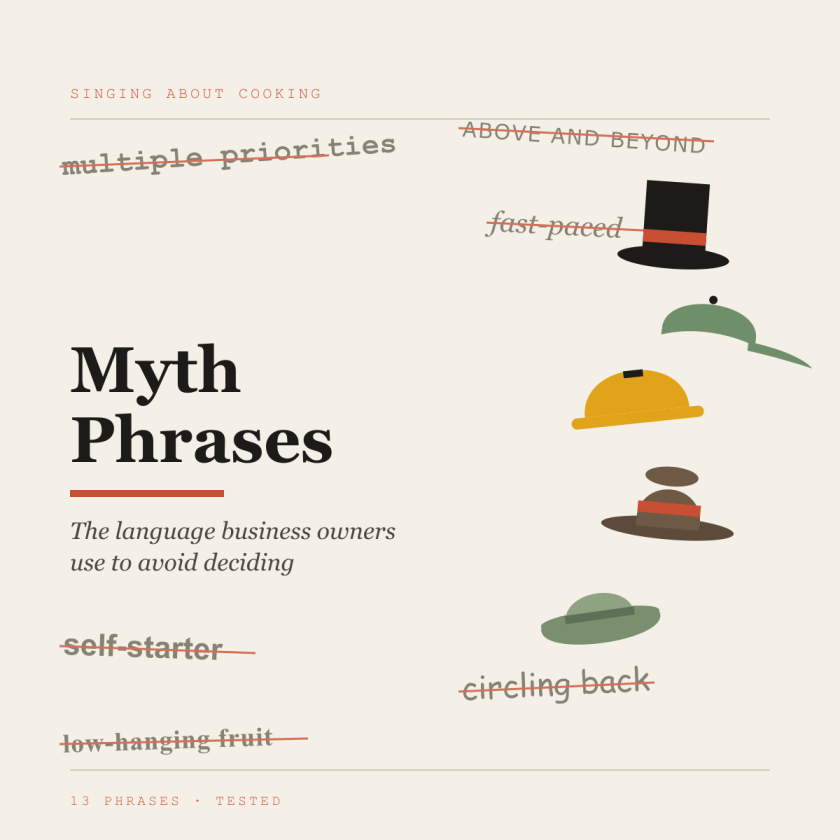
Thirteen common business phrases — from “multitasking” to “self-starter” — tested against one question: good strategy, or an impatient entrepreneur avoiding a decision?
Some phrases show up in business so often that nobody questions them. I’m calling them myth phrases. They sound like descriptions of real conditions. Most of the time they’re excuses dressed up as strategy. The test for each one is the same: is this actually a good, deliberate business decision, or is it an impatient entrepreneur refusing to sit still long enough to choose?
“Multiple Competing Priorities”
This phrase comes from business owners who can’t choose. Some are scattered. Some have ADHD, and that plays into it. Some legitimately see several ways to reach a goal and can’t tell which is fastest, most sustainable, or lowest-friction. Whatever the reason, they can’t pick, so they say they have multiple competing priorities.
If two, three, or four things all sit at priority one, you have nothing at priority one. Skip that line and go to priority two. There’s probably only one item there, and that’s the one that matters, because it’s the one you can actually focus on.
Strategic or impatient? It’s never strategic to have four priority-ones. A real strategy produces a ranked list with one thing on top. “Multiple competing priorities” is what you say when ranking feels like loss — like admitting the other three don’t matter as much. That’s not a planning problem. That’s an attachment problem.
“Multitasking”
You cannot literally do two things at once. You cannot chop onions and fold underwear at the same time. When you say you’re cooking and doing laundry, what happened is this: you put the laundry in (task one), washed your hands, and started chopping onions (task two). Then you set the onions to cook and took a few more steps while the washer ran for 30 to 45 minutes. You alternated. You never did both at once.
Mental tasks work the same way. You cannot think about two things at the same time. You can alternate. I can say “candle, crystal, candle, crystal,” but I cannot say both words at exactly the same time with one mouth, one set of teeth, and one set of vocal cords.
Strategic or impatient? Multitasking isn’t a skill, so claiming it isn’t a strategy — it’s a cover story for not sequencing work. I prioritize efficiency. I want the most done in the least time so I can go do nothing. My Facebook memories still turn up posts like “door to door, an hour and 30 minutes, seven things done”: groceries, meds, a drop-off, a Marketplace pickup. That wasn’t multitasking. I picked a route — farthest stop first, work back toward home, straight line out, straight line back. My grocery list follows the store layout: produce, packaged goods, freezer, checkout. That’s organization. It’s structure and planning, done in advance, so the execution looks fast. Multitasking, as a word, erases the planning and pretends the speed happened by magic. It didn’t. The planning is the work.
If “multitasking” appears in a job description, run. Or, if you enjoy malicious compliance, ask in the interview: “Can you give me an example of how multitasking shows up? Who is literally thinking two things at once, speaking two things at once, or standing in two places doing two different things?” Let them explain that they mean something else.
“Fast-Paced Environment”
Usually sits right next to “multitasking” in the same listing. It’s code for wanting someone younger, who can be manipulated into accepting multiple priorities, attempting multitasking, burning out fast, and quitting. They’ll be cheap, so it’s fine.
Strategic or impatient? This one isn’t even the entrepreneur’s impatience — it’s institutionalized impatience, baked into hiring. A genuinely fast-paced business has fast, clear decision-making. A business that advertises “fast-paced” as a selling point usually has no decision-making at all — just constant reaction to problems nobody planned for. Speed without direction is just chaos with a better reputation.
“Low-Hanging Fruit”
We say low-hanging fruit when we mean the easy, gullible clients. The phrase makes targeting the least-informed, least-able-to-push-back customer sound like smart resource allocation instead of what it is.
Strategic or impatient? There’s a real version of this — the quick win that funds the harder work. That’s legitimate triage. But look past the immediate sale. A gullible client is gullible because they can’t evaluate what they’re buying, which means they also can’t evaluate whether it worked. Short term, that looks like free money: low effort, fast close, no pushback. Long term, it’s the client most likely to feel misled once they figure out what happened, most likely to leave a bad review, most likely to chargeback or demand a refund, and least likely to refer anyone, because they don’t have the standing in their own network to vouch for a purchase they’re privately unsure about. “Low-hanging fruit” measures effort to close. It doesn’t measure what that client costs you six months later. Most of the time “low-hanging fruit” doesn’t mean efficiency. It means picking a mark and not pricing in the cleanup.
“Above and Beyond”
Unpaid work presented as a virtue. The job or contract already defines what “and” covers. “Beyond” is whatever nobody wants to pay for. And this is the phrase that implicitly allows for a performance review policy where a 3 out of 5 is the average performance score across the company and no one ever gets a 5 – because there’s always something “beyond” whatever you just did that was “beyond.”
Strategic or impatient? Neither, really — this is about the entrepreneur’s unwillingness to scope the work correctly the first time. If the work is required, it belongs in scope and in price. If it isn’t required, it’s a favor, and a favor has to be voluntary to be a favor. “Go above and beyond” is a request for free work wearing a compliment as a disguise.
“Other Duties as Assigned”
This is “above and beyond” with a contract clause attached. It’s the line at the bottom of a job description that lets a boss expand scope indefinitely without ever expanding compensation to match. Every task that doesn’t fit cleanly anywhere else gets filed under it, forever, with no renegotiation trigger.
Strategic or impatient? It’s the same unpaid-scope problem as “above and beyond,” just written down in advance and pre-authorized. At least “above and beyond” has to be asked for, in the moment, by a person who can be pushed back on. “Other duties as assigned” removes the asking. The scope creep is already signed off on before the job even starts.
“Wearing Many Hats”
Said about small-business and startup roles like it’s a perk. What it usually means is one salary covering several jobs that should be several salaries, or at least several line items in a budget.
Strategic or impatient? There’s a real version early in a business, when there’s genuinely no budget for five separate hires and one person has to cover the gaps out of necessity. That’s a resourcing constraint, not a myth. It becomes a myth the moment the business can afford to split the roles and doesn’t, and keeps calling it a hat collection instead of understaffing.
“We’re Like a Family”
Said in onboarding, said in the culture deck, said right before someone is asked to skip their kid’s recital for a deadline. Families don’t fire you. Families don’t performance-review you. A business relationship that’s actually like a family would include job security and unconditional loyalty in both directions, and it never does.
Strategic or impatient? Not a business decision at all — it’s a manipulation tactic, dressed as warmth, used to get people to accept conditions (unpaid overtime, blurred boundaries, guilt-based retention) that they’d refuse if the relationship were correctly described as transactional.
The caveat here is that some families are exactly like that, and it’s not a compliment. Toxic families fire people too — they just call it being cut off, written out of the will, or uninvited from Thanksgiving. Members quit those families constantly — it’s called going no contact, and it’s the same severance as walking out of a bad job with no notice. And plenty of families run performance reviews already, they just don’t use the term: the running commentary on your weight, your choices, your partner, your parenting, delivered as “concern,” is a performance review with worse boundaries and no HR department. So “we’re like a family” isn’t even false advertising. For a lot of people, it’s an accurate description of exactly the dynamic they’re being asked to recreate at work — and that’s the problem, not the slip-up.
“Self-Starter”
A job posting phrase that means: there is no training program, no onboarding documentation, and no manager with time to manage you. You’re expected to figure out the job by doing it, with the risk of early mistakes placed entirely on you.
I worked for one company in my past that explicitly stated – coached management to believe – that rockstars in a particular line of roles would “train themselves.” Turns out this was code for will seek out and pay for themselves to go through training because the company didn’t actually value that job. This same company also directly advised specific hourly/salary ranges form 2000-2020 for this role that aligned more with a 1970s female secretary idea of compensation.
Strategic or impatient? Impatient — and worse than that, it’s a PIP that started before day one. A real PIP at least has the decency to come after a failure, with documented specifics about what went wrong. “Self-starter” skips all of that and front-loads the failure into the job description itself. The employer never defines what success looks like, never explains the unwritten systems, never hands over the context that would let a new hire actually start fast. Then, three months in, the gaps in that undocumented knowledge get read back to the employee as a performance problem — as if not knowing the thing nobody told them were a character flaw instead of a training failure. “You should have figured that out” is the employer taking their own lack of specificity and repackaging it as the employee’s lack of initiative. The job was never “start without guidance.” The job was “read our minds, and if you can’t, that’s on you.” That’s not autonomy. That’s liability transferred from the employer, who had the information, to the employee, who didn’t.
“Quick Call” / “Quick Question”
Never quick. The word “quick” is doing the work of avoiding the real ask, which is: an unscheduled interruption, scope undefined, duration undefined, on someone else’s calendar, right now.
Several years ago, as a thank you to one of my favorite coaches, I was honored to share a pink, sparkly hourglass gift, and she posted about this very topic:

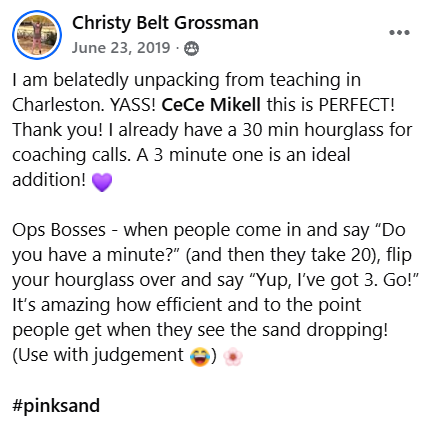
Strategic or impatient? Impatient, specifically about scheduling. If it were actually quick, it wouldn’t need the word in front of it — it would just be asked. “Quick” is a pre-apology for taking more time than the asker is willing to name up front.
Some leaders have made a bit out of this, and it’s worth telling on them. There are managers who keep a literal hourglass or a phone timer on their desk and start it the moment someone opens with “got a minute?” or “quick question.” It’s played as a joke, a little team legend, ha-ha-look-how-busy-I-am. But it’s not a joke, it’s a confession. A person who needs a physical prop to track whether a conversation stayed under sixty seconds has already told you the real answer to “got a minute?” — no, and they resent being asked. The honest version of that interaction is a closed door, a “not now,” or a scheduled time later today. The hourglass version lets them perform open-door availability and punish you for using it, in the same gesture.
“Just Circling Back”
An unanswered request, restated, with “just” doing the work of pretending this is light and easy rather than a second ask after the first one got ignored. It lets the sender avoid naming what actually happened: nobody responded.
This phrase always brings to mind the 10-foot long spiral telephone cord I grew up with on the single house phone landline. Specifically, I remember the kinks – because in this analogy, that’s what stops the cycle.

Strategic or impatient? Not strategy at all — it’s conflict avoidance. A direct version would say “you didn’t respond to my last message, following up.” “Circling back” removes the accountability from both sides: the sender doesn’t have to say they’re chasing something, and the recipient doesn’t have to acknowledge they dropped it.
“Hustle Culture”
The myth that constant motion is the same thing as progress, and that exhaustion is proof of commitment rather than a sign the business lacks process. Hustle gets treated as a personality trait to admire instead of a symptom to investigate.
The other version of this phrase carries IMO more insidious implications – specifically “the side hustle.” The “side” part has always bothered me in it’s diminution of value, importance, validation to the person running it. It’s a very “female” thing to do, which aligns since it’s usually women who need to make more money – both single and partnered women – to achieve financial equity with their male counterparts. Especially in a hetero marriage, it’s the woman giving up her time and energy on a “side hustle” or additional part time (or second full time) job to bring more money into the marriage. In this way, “side hustle” skews “female,” making this is hot button gender equality issue for many.
Strategic or impatient? The clearest case of impatience on the whole list. A business running well doesn’t need anyone to hustle, because the work is sequenced, scoped, and resourced correctly. Hustle is what fills the gap when none of that happened. It’s not dedication — it’s the cost of not planning, paid in someone’s hours.
“At a High Level”
A way to sound informed without committing to anything specific. It means the speaker hasn’t done the work, doesn’t have the numbers, or doesn’t want to be held to the details.
Strategic or impatient? Impatient, almost every time. A high-level summary is useful when it’s a deliberate compression of detail you already have. It’s a myth phrase when it’s the only altitude the speaker has ever flown at. Ask for the next level down. If the answer is another “at a high level,” there is no next level. The summary was the whole thing.
The Common Thread
Every one of these phrases lets a business owner, or a business, skip a decision and call the skipping a method. “Multiple priorities” skips ranking. “Multitasking” skips sequencing. “Fast-paced” skips process. “Low-hanging fruit” skips accounting for long-term cost. “Above and beyond” and “other duties as assigned” skip scoping and pricing the actual work. “Wearing many hats” skips hiring. “We’re like a family” skips honesty about the relationship. “Self-starter” skips training. “Quick call” and “quick question” skip scheduling. “Circling back” skips accountability. “Hustle culture” skips the planning that would make hustling unnecessary. “At a high level” skips the analysis.
None of them are strategies. They’re all the same impatience, wearing a dozen different outfits.
The test is always the same: ask for the literal, concrete version. Ask who’s doing what, in what order, for how much, and with what detail. If the phrase collapses the second you ask that question, it wasn’t a decision. It was a way of avoiding one.

