Posted in Cooking

Quickie Leftover Dinner–Chicken and Rice plus a bonus Refresher Course on Gravy Basics

So last week, I had made oven poached chicken and had some of the chicken thighs leftover. Some other time (is it bad that I can’t remember?) someone else had made some rice, and put the leftovers in the fridge. And then everyone but me went on a cruise to the Bahamas, and I got stuck trying to figure out what to do with the bits and pieces of meals left in the fridge for when they got back this week.
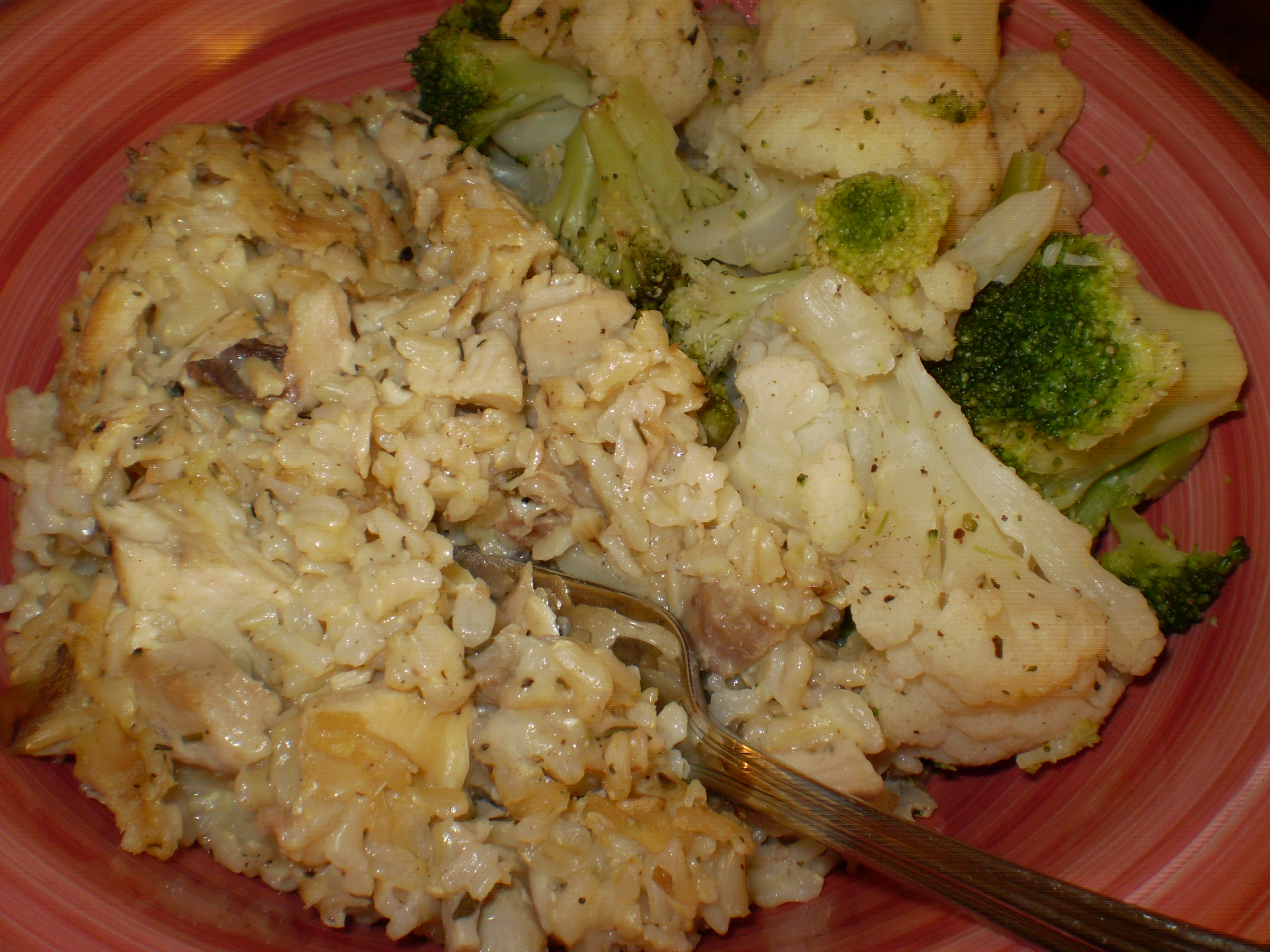
Creamy Chicken and Rice with a side of Pepper Vinegar Spicy Broccoli and Cauliflower

So…chicken…rice….hmmmm…how about chicken and rice. Duh!

So this is a refresher course in basics…and what to do when your pantry doesn’t have some of the basics.

Assumption #1: Everyone knows the ingredients for chicken and rice. Right?! It’s cooked chicken, rice, and gravy.

Ha! Bet I stumped you on the gravy. Why? Because since I was a kid, everyone has just used “canned gravy” otherwise known as cream of mushroom or cream of chicken soup. What is cream soup? Flavored gravy.

Assumption #2: Everyone has the ingredients for a basic cream gravy, even during the 2011 snow or snice storm; the term “snice” was coined by my friend Sue Sneed to describe the actual precipitation result in Atlanta.

What are the ingredients for a basic cream gravy? Butter, flour (wheat or rice), milk, and water. Yes, alternatives such as heavy cream and fresh stock will make better tasting gravy, but we’re talking basics here.

How do you make soup out of cream gravy? Use mushroom stock and add mushrooms for cream of mushroom. Use chicken stock and add chicken for cream of chicken. Use vegetable stock and add cooked celery (pureed) for cream of celery. You get the idea, right?

Assumption #3: Everyone knows how to make gravy or a white sauce. Yep, that’s where I lost you. Why? Because gravy has been a “bad” food for several decades now, identified as all fat and no nutrition. Thus, gravy-making from scratch is nearly a lost art in the regular person’s house.

You can look up any gravy recipe, and if you look closely and compare, you’ll see that it’s all about ratios…yes, math. You’ve got a

  • 1:1 for thin gravy or cream soup
  • 1:1.5 for medium gravy
  • 1:2 for thick gravy
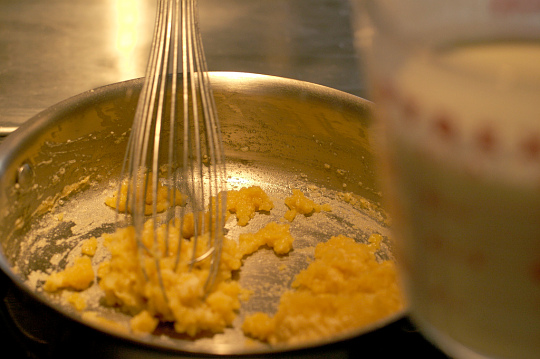
Roux…the flour and butter mixture that thickens sauces

The ratio describes the number of tablespoons of butter compared to the number of tablespoons of flour. Then you’ll add the number of cups of liquid (equal parts milk and water) to result in the number of cups of finished gravy. The liquid gets you the mass, while the butter-flour mixture (sometimes called a roux) gets you the thickness (photo from RisingWolfEats.blogspot.com).

Oh, yeah, this is also called a white sauce, which is the base for nearly every french sauce and cheese sauce out there (yes, that includes mac and cheese!!). But in a white sauce, usually only milk is used as the liquid.

And when you get good enough with the basic sauce, you can start to make gravy out of drippings: roasted turkey drippings, fried chicken or steak drippings, breakfast sausage drippings, bacon drippings, and more!

Assumption #4: Everyone has cream of something soup in the pantry. Yep, the Sandra Lee shortcut way of making gravy, which, of course, is why the soup label has recipes on it, showing you how many ways gravy can transform simple basic ingredients into a delicious, creamy casserole combining any yummy combination of meat, rice/noodle, grain, veggies…and gravy.

Okay, you’ve got all that; you don’t need me to tell you how to make chicken and rice, right?

Well, in the spirit of the refresher course, here goes:

  • dice, shred, pick off the bone 2 lbs of cooked chicken*
  • 4-5 cups of partially cooked rice (I use brown)
  • 2 cups gravy (aka 2 cans of cream soup, your pick of flavors)
  • salt, pepper, other seasonings you prefer (I’m a thyme girl)

Mix all the ingredients well in a bowl and pour it into a baking dish. Top with some grated cheese or bread crumbs or cracker crumbs or sliced almonds or fried onions (like green bean casserole), whatever you like to give it a little crunchy top. Bake at 350 for 30 minutes. Done!! This recipe is for a 9×13 dish and makes 8 substantial servings.

*Since Weight Watchers PointsPlus values white and dark meat chicken the same, I don’t bother separating them; and I LOVE dark meat…so rich and flavorful, and fat is essential in a healthy and balanced diet.

Weight Watchers PointsPlus: 8.25 points per serving

  • 2 lbs cooked chicken = 16 points
  • 5 cups brown rice = 20 points
  • 1 can 98% fat free cream of mushroom soup = 5 points
  • 1 can 98% fat free cream of chicken soup = 5 points
  • alternate to canned soups: 2 cups white sauce is 9 points (skim milk and water) or 11 points (whole milk and water); be sure to adjust points if you use homemade stock since it will have fat-points. NOTE: it’s the same points to use a homemade, full-fat roux as nearly fat free canned stuff…please go for homemade when possible.

Total points of casserole = 66 points = 8.25 points per serving
Posted in Cooking

Shepherd’s Pie

Shepherd’s Pie

Naturally, my first dish is quite possibly my best, but definitely a favorite of all of the families I’ve ever cooked it for. Shepherd’s Pie, or cottage pie, is more truely a “technique” than a recipe.

So what’s the difference between a technique and a recipe? Well, it’s simple really: a technique is a way of putting types of ingredients together while a recipe is a very specific collection of ingredients that blend together to make a whole new substance and flavor. Hmmm, maybe this will work better: if you can still identify the ingredients separately, then you have just made a technique; when the finished dish resembles nothing like the individual ingredients, then you’ve just made a recipe.

So back to Shepherd’s Pie: leftover meat, vegetables, potatoes. Yup, that’s it. Literally. So how does this work? Tonight’s Shepherd’s Pie is very traditionally American in the meat and potato layers, but perhaps a bit different in the middle veggie layer.

See, just a drizzle of olive oil, not even coating the bottom of the pan.

So start with a sprinkling of olive oil in your hot hot pan and toss in one rather large onion, roughly diced. Of course, if you like a finer textuer, use a fine dice. Whatever. You might also use an earthily flavored oil (rosemary, garlic, sage) as well as shallots and/or garlic at this stage. (NOTE: if you use fresh garlic, wait til you are almost done cooking the onions so you don’t risk burning it).

What you want to do is carmelize the onions, or turn them brown; at least, that is my preference. Others may just sweat them until they are clear.

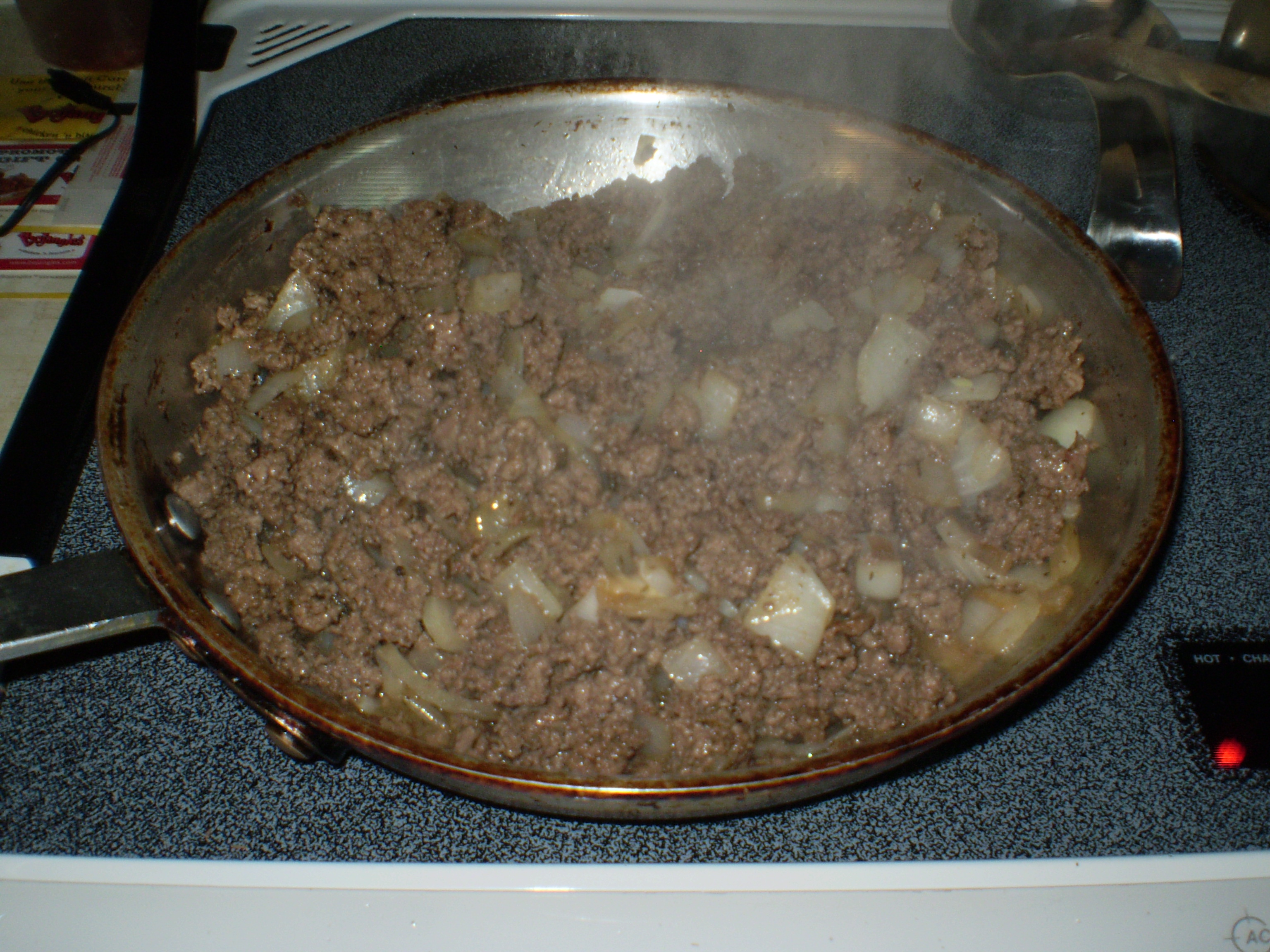
When you get the onions where you like them, crumble in 2 lbs of meat. Here’s where that technique thing comes in handy. Secret: it doesn’t matter what meat you use, whether it’s ground, shredded, chopped, fresh/raw, or leftover from last week, as long as you like it. In the US, ground meat (beef or lamb) is the most traditional.

Onions carmelized, meat browned, worchestershire sauce simmering nicely

Okay, so I tossed in 2 lbs of 12% lean ground beef, sprinkled that lightly with salt and liberally with pepper and thyme. Use a spoon and break it up, browning it completely and mixing it well with the onions as it cooks. When you’ve nearly got all the pink out of the pan, sprinkle in about a quarter to a half cup of worchestershire sauce (use this GF/CF/SF recipe). This will help to deglaze the carmelized onion bits and stuck on browned meat from the bottom of the pan. I like to let the whole mixture simmer in the sauce for about 5 minutes for that delicious sauce to get into all the meat and keep it moist.

Okay, the first layer is done and ready for the baking dish. Now, because two of my family hate vegetables and the other two love them, I make two 9×9 pans of pie. Only one will get the next layer of veggies.

How pretty is that! See how the cut sides of the brussels sprouts are all browned…perfect!

So, true to form, tonight I used some fresh veggies that are coming to the end of their shelf life in the veggie crisper: some brussels sprouts (aka baby cabbages) and baby carrots. Brussels sprouts are super easy to cook and come out tasting like sweet cabbages when cooked in the skillet. Just cut off the root end, peel off any yucky leaves, slice the whole little head in half and place in the skillet (yes, with a drizzle of olive oil) cut side down. And just leave them there, place each new one as you clean and cut it. Yes, I said it, just leave them sitting there, alone, untouched, unloved. Trust me, you won’t regret it. After you’ve cut up the carrots and thrown them in the pan, stir it all around a bit. Oh, yeah, don’t forget the salt and pepper…just a light sprinkle.

Okay, all done with that layer, so onto the meat it goes in the pan. Just the one pan, remember, for the veggie lovers.

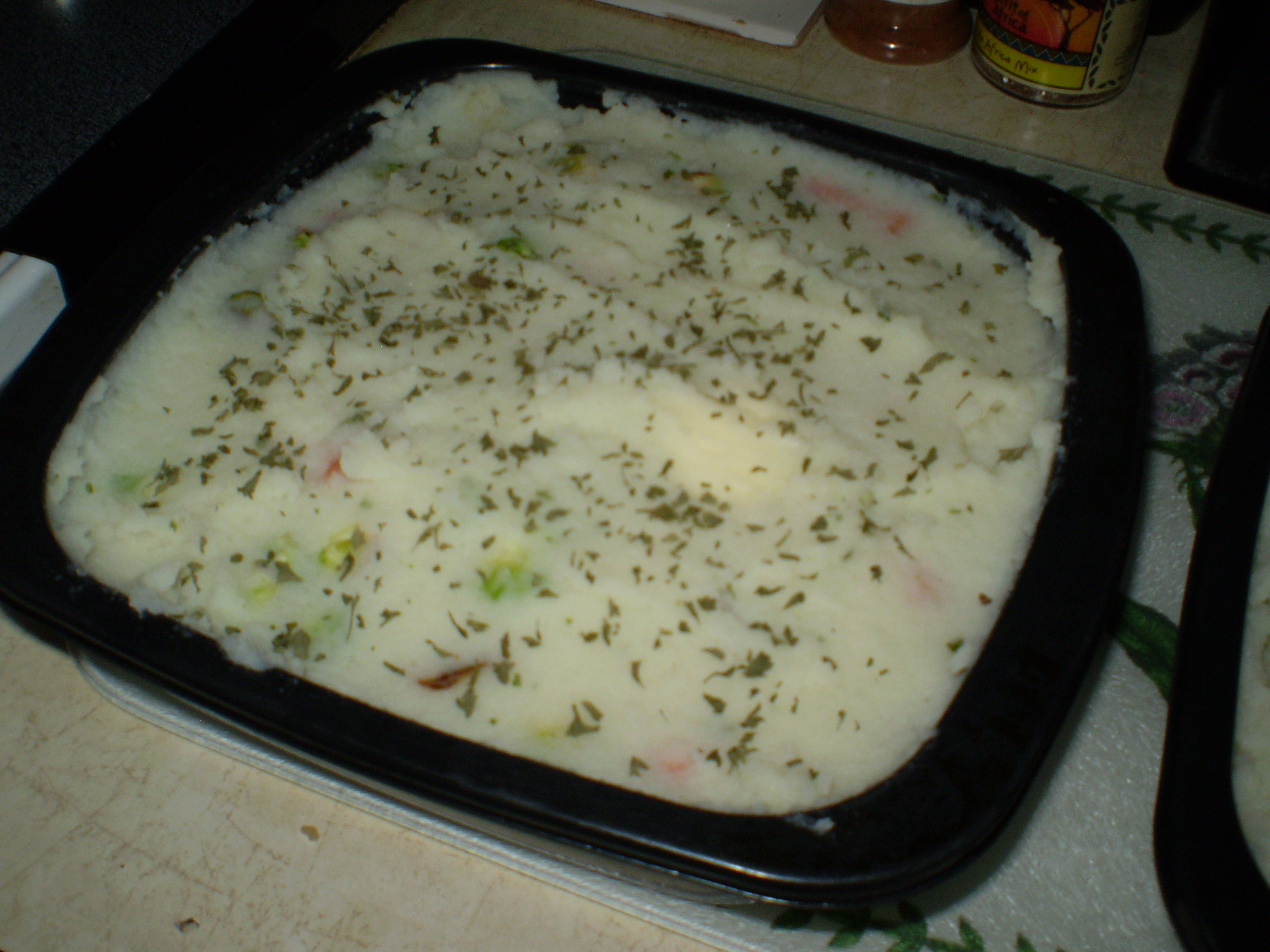
All finished with three layers of yumminess and parsley on top!

The final layer is mashed potatoes. Well, tonight, I’m taking a page out of Sandra Lee’s semi-homemade book and using instant potatoes: Betty Crocker butter and chive instant potatoes, to be exact. Now since you are going to bake all of this when the layers are done, don’t even bother with boiling water, etc. Just mix hot tap water with the other ingredients and mix up the potatoes. Spoon them into the pan(s) and use your spoon to smooth them out into a nice layer.

Now mashed potatoes are the simple, American way to prepare this dish, but originally, it was made with thinly sliced or even shredded potatoes. I haven’t tried it, but I imagine some major goodness in doing a crispy hashbrown-ish top layer, frying up the tiny diced or shredded potatoes in a thin layer in the skillet and just sliding onto the top before baking. I think I would serve that with some sour cream and chives on the plate.

If you are a garnish kind of person, go to town. I’ve enjoyed a number of toppers including roasted garlic, various herbs (parsley, chive), different cheeses, but my favorite topper has always been horseradish chedder…mmmmmmmm.

Last step: shove the whole pan in a 350 degree oven for 30 minutes.

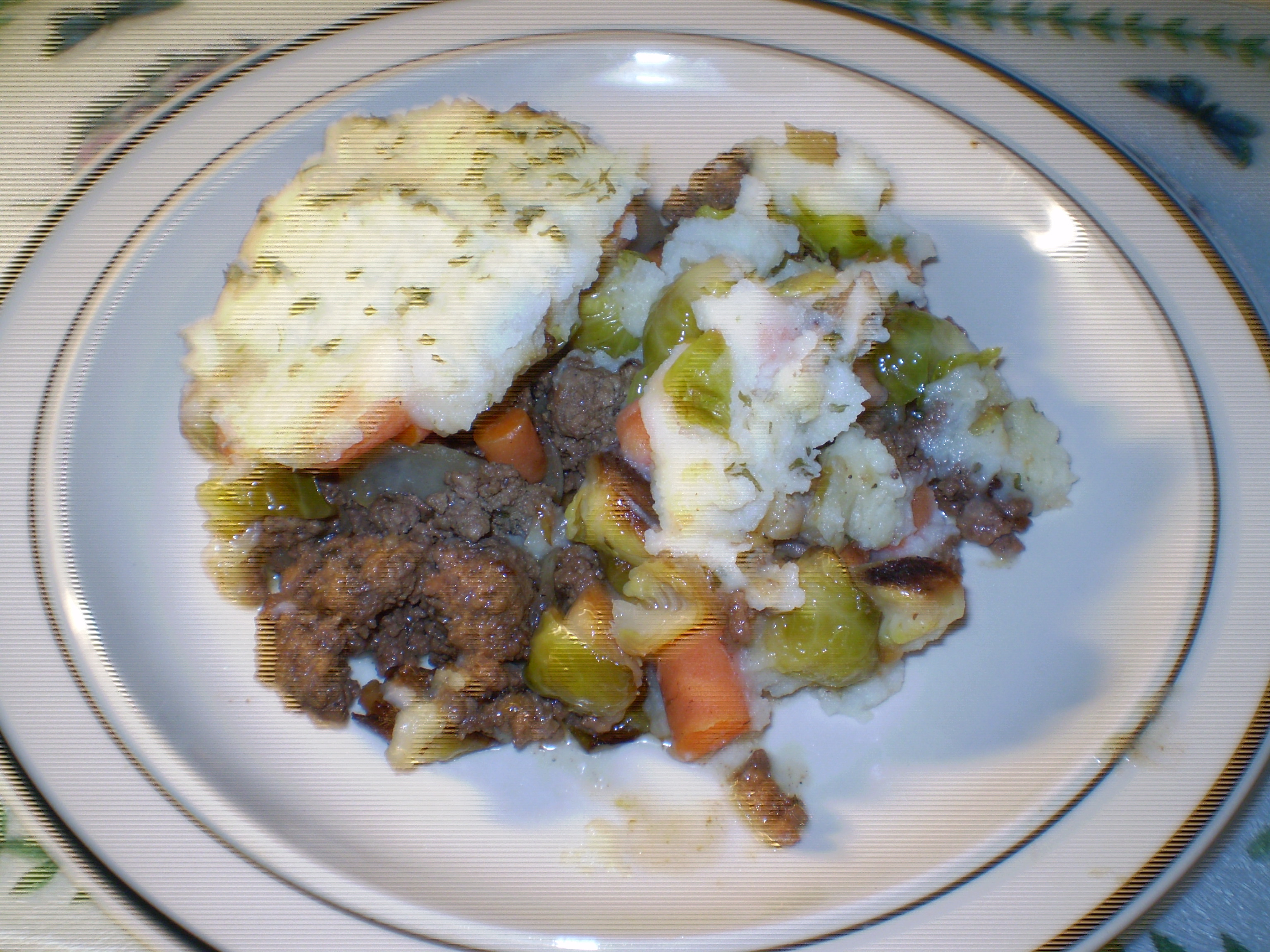
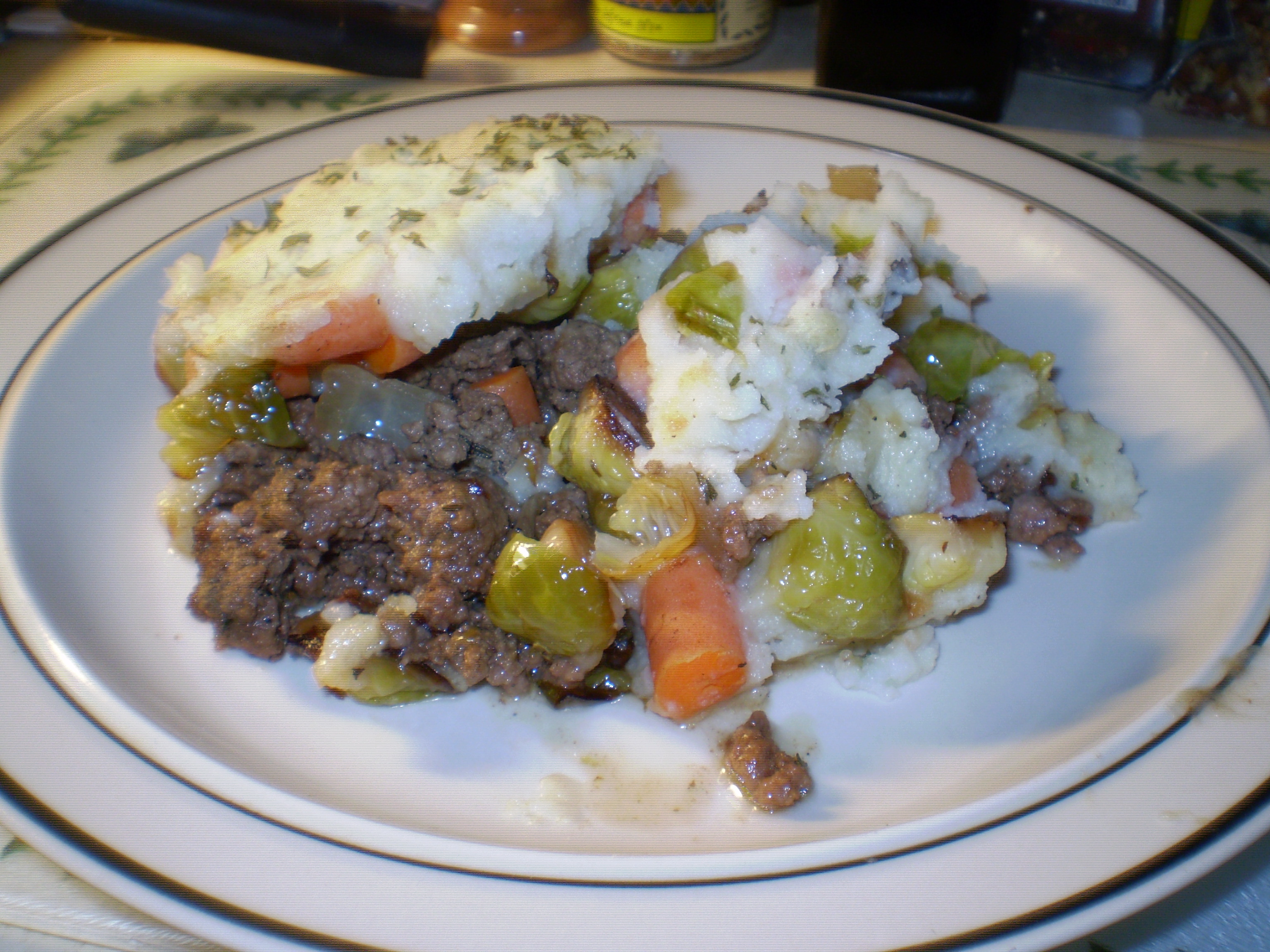
All the yumminess oozing out of the pie!

Now see all that juicy, saucy yumminess just oozing out onto the plate. Imagine the full, rich flavor of the beef complimented by the tangy worchestershire sauce, the lightly sweet brussels sprouts and carrots (now that they are fully roasted), and the smooth, buttery potatoes. This supper is well-paired with a Guiness beer or a spicy Malbec wine.

Casserole Reminder: make ahead of time and freeze until you are ready for it. This is a casserole, people. And all casseroles can be made up in double batches so you can freeze one for a later date. Same amount of effort for double the reward!!!

Weight Watchers PointsPlus: this makes 8 servings with each serving being 7 points.

Ingredients List:

  • 1 very large onion
  • 2 lbs meat
  • fresh or frozen veggies of your choice (need 2-3 cups worth)–briefly sautee or microwave-steam fresh veggies, place frozen directly onto cooked meat
  • 4 cups mashed potatoes (that’s 8 half-cup servings)
  • seasonings and toppings of your choice