Posted in Being Healthy, Cooking, corn free, gluten free, nut free, soy free

Comforting Beef Stroganoff Casserole

Recently, I found myself craving something beefy and comforting, so I put out a call for ideas on Facebook. Boy, did my girlies come through for me. Beef Stroganoff. It has a rich history as a classic Russian dish. And wouldn’t you know it, it’s got its own website! But essentially, this dish is beef cooked in a creamy mushroom sauce.

Having spent a delicious month in St. Petersburg, Russia, in 1993, I know that, at least at that time, most Russians didn’t have regular access to good cuts of beef, and I learned that both of my Russian families made their beef stroganoff about the same way: cooking down wild, handpicked mushrooms and onions, adding some beef in to brown, deglazing with some water (making a bit of broth), and cooking this for several hours on low, then adding in some sour cream at the end to thicken up the sauce.

Sounds like the perfect crock pot recipe to me, but I wanted something a little more compact since I’d be at work all day and wanted my family to be able to put dinner together themselves. So I settled on a casserole that achieves the same purpose and delivers 4 healthy servings an no leftovers to junk up the fridge.

Ingredients (in order of preparation)

  • 1/2 bag of egg noodles, cooked and drained (for gluten free and corn free, use Lehman’s Gluten Free Homestyle Egg Noodles)
  • 2 large green peppers, roughly chopped
  • 1 large onion, roughly chopped
  • 8 oz sliced portabella mushrooms, chopped (alternatives: white button or baby bella)
  • 1 lb beef, chicken, or pork (cubed beef is traditional; ground is a great, less expensive alternative)
  • 1 can cream of mushroom soup (for gluten free and corn free, use Pacific GF cream of mushroom soup or my homemade recipe)
  • 1 cup sour cream (or milk if you’re out of sour cream)
  • 1/4 t kosher or coarse sea salt
  • 1/2 t ground pepper

You can see I’ve gone with a little help from the pantry rather than a totally-from-scratch recipe.

So I start with cooking the noodles. When they are drained, pour them into a casserole dish, lightly sprayed with cooking spray if you’re worried about sticking, which is not usually a problem.
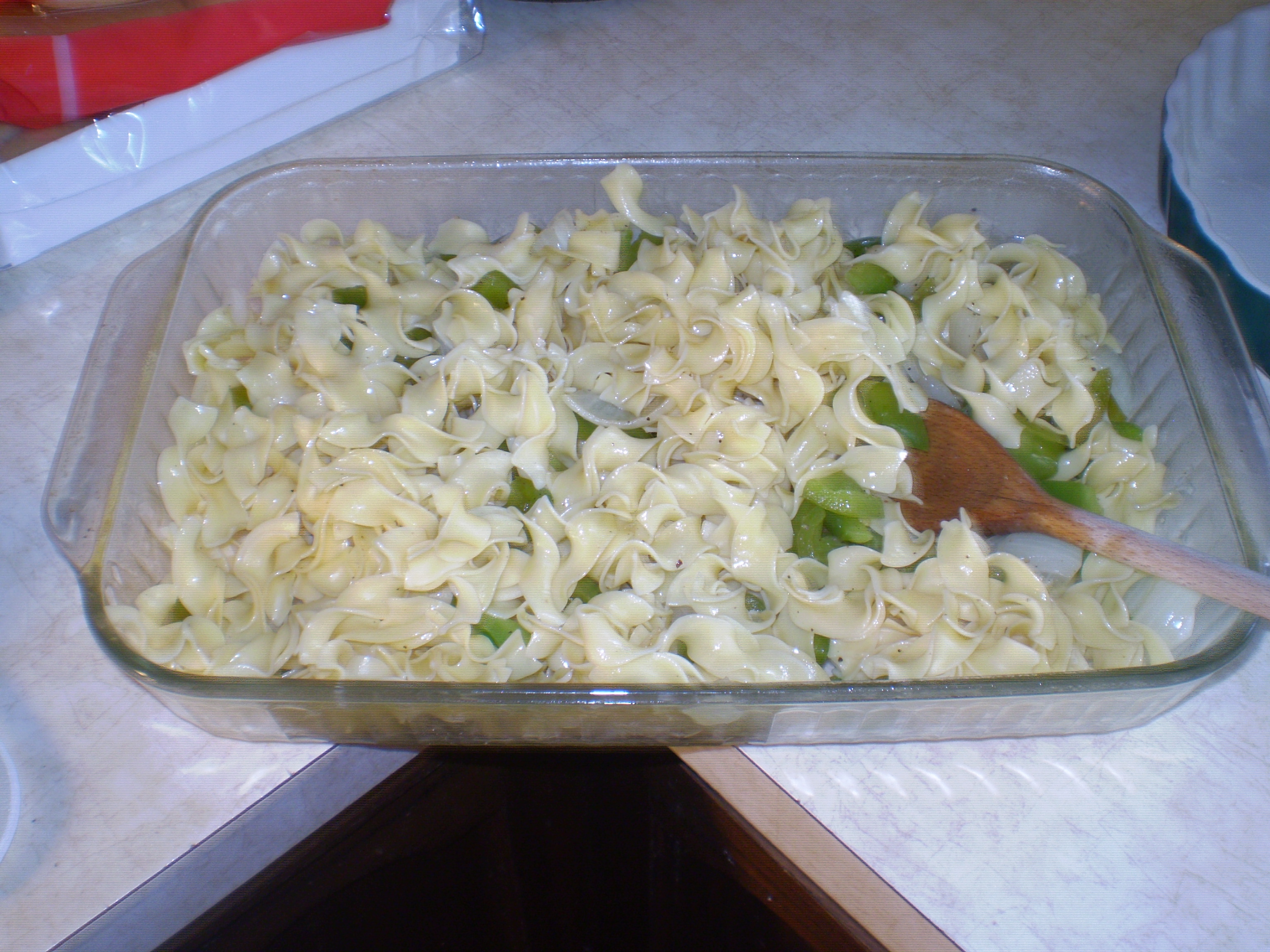
Next I move on to the veggies…on medium heat and with 1 t of your favorite cooking oil, sweat the water out of the mushrooms and then add the peppers and onions for a quick saute; I’ve stopped cooking veggies in oil. I do these separate because I want to make sure they keep their crunch. If I put them in with the meat and sauce, they would cook down and have no texture left to liven up the casserole when it’s heated. Before they start getting brown, dump them in with the noodles and give it all a quick stir.
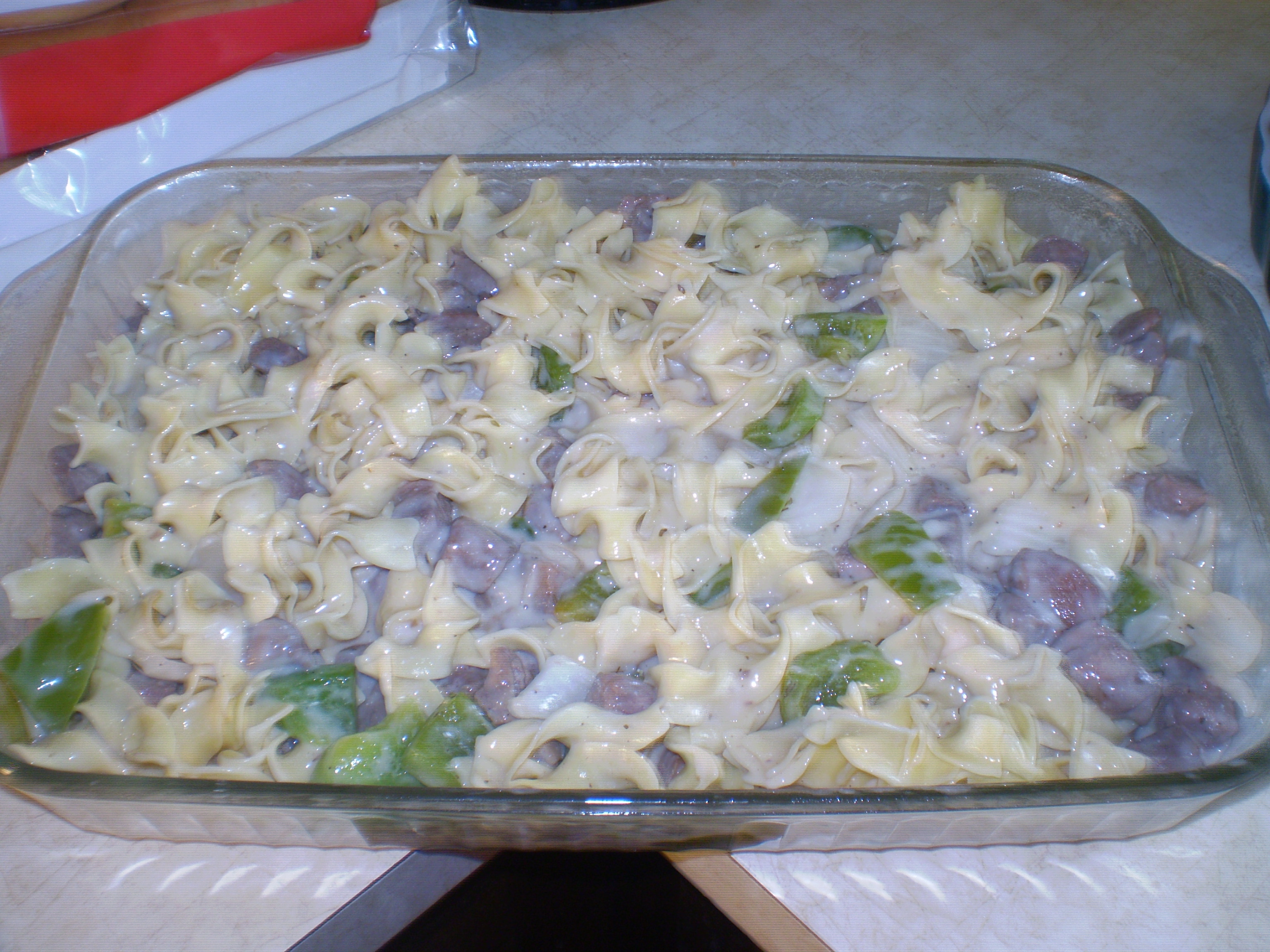
The last part is just as quick. We had some venison stew meat already cut up, so I tossed that into a pan with a little olive oil. When it gets just barely cooked through, dump in the cream of mushroom soup and sour cream, stir, and simmer for maybe 10 minutes, mostly to make sure the sauce comes together. Then dump this in with the noodles, peppers and onions, stir, and viola! Beef Stroganoff Casserole.

Now, certainly, you can pop this in the oven to finish and serve it up in about half an hour.

But I needed this as a make-ahead. And here are the instructions I’ll leave for the family to follow tomorrow:

To have dinner ready to eat by 6:30 pm, start at 5:45 pm

  • Preheat oven to 350°
  • Take the casserole out of the fridge and stir slowly and carefully
  • Cover the casserole with aluminum foil
  • Put the casserole in the oven for 30 minutes
  • Take the foil cover off and put in for another 15 minutes

As I’ve got Harris Teeter brown and serve rolls to go with mine, I’ll add the rolls during the final cook since they take 12-15 minutes. My folks will also be cooking up some sauteed squash and onion to go with this casserole.

For 8 nutritional servings or for 6 fuller servings, double the noodle, beef, and soup quantities; I also fully double the veggies, but that can be too much for many. Do not double the sour cream; there’s no need.


Posted in Being Healthy, Cooking, corn free, gluten free, nut free, soy free

Butternut Squash Bliss

This weekend, my friend Sarah offered me her entire crop of butternut squash…because she didn’t know what to do with them. Sarah, you don’t know what you’re missing! This delicious squash has a simple, light, nutty butter flavor of its own but also provides a wonderful base for sweet or savory additions.

As we are on the cusp of Fall and the morning and evening temperatures are cooling, I’m ready to start on soups, and butternut squash soup is hands-down my favorite! Luckily it’s also the one I can’t seem to screw up despite the fact that I don’t measure…ever!

Here’s what you’ll need for my savory version of the soup:

  • Butternut squash: peeled, seeded, and diced
  • Sweet onion: peeled and quartered
  • Carrots: cleaned and chopped
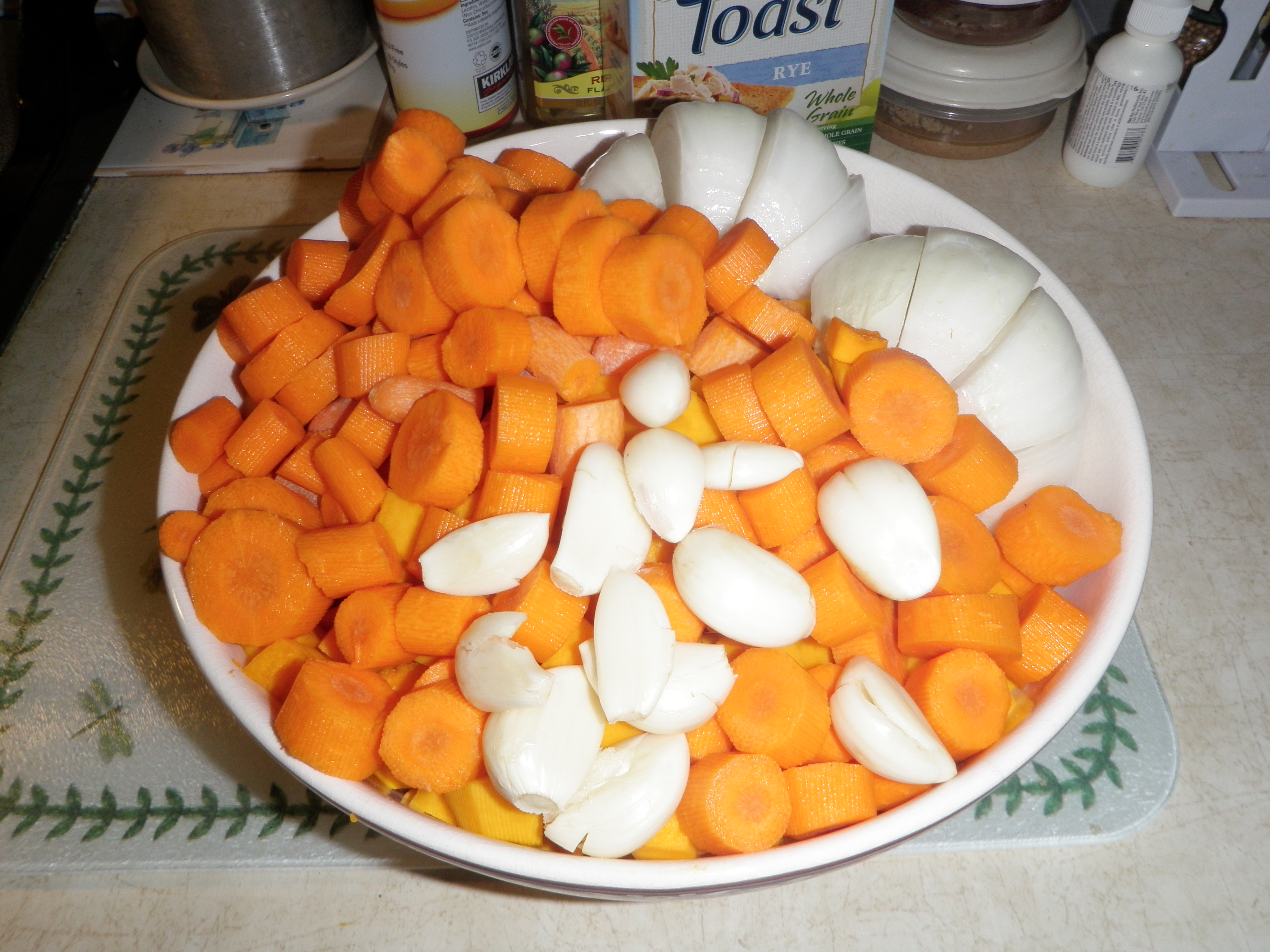
  • Garlic: one whole pod peeled (not one clove, but the whole pod of 10-12 cloves)
  • Stock or Cream: up to 8 cups, depending on your preference
  • Spices: Salt, Black Pepper, Ginger, Cumin, Coriander Seeds

Get all the veggies cleaned and cut. I usually do this while watching a movie, a method I “developed” from my days living in a tiny Brooklyn flat with no kitchen counters. If you’re using fresh ginger, peel, dice, and add that to the roasting mix.

Spread them all out on cookie sheets, making sure everything is in just one layer. Dust with salt, pepper, and spices; use as much or as little as you like. Roast at 400°F for 45 minutes. Turn off the oven and let them sit for another 15 minutes.

Dump all the veggies carefully into a large stock pot. Here’s where I’ve got to talk you through some options.

Option 1: Stock or Cream

The difference between a soup or a bisque is the use of stock or cream as your thinning or thickening agent. There are a few other options besides cream for a bisque, but that’s the traditional one. Vegans can choose vegetable stock or soy or rice milk. For the least flavor interference, use homemade vegetable or chicken stock. For a richer, velvety flavor, use beef stock. For the sweeter version of this soup, use ham or veal stock. And you can always use just plain water, especially if you are looking for a thicker consistency and not worried about having to use too much.

Option 2: Blending Method

If you’ve watched chefs on cooking shows make soup, you’ve seen the two methods: blender or immersion wand. Both can achieve the same level of smoothness, but the traditional blender will get you there faster; just make sure the veggies have cooled to room temperature before using the traditional blender. Me, I like the convenience of the immersion wand because I can pretty much put all of the veggies in at one time and both see and feel the consistency as I’m blending; it offers a level of control that you don’t get with the traditional blender.

I like my soups with a strong “mouth feel,” which usually translates into thick or stew-like. I know it makes the blended soups look like baby food and/or baby poo, which, by the way, reminds me to tell you that this is exactly how to make your own baby food; studies show that children who eat the same food and same seasonings in their baby food as their parents have on their plates aren’t as picky during their formative years, making meal time much easier to deal with.

When my Mom insists on the sweeter version of this soup, it goes something like this:

  • Butternut squash
  • Carrots
  • Onion
  • Cream
  • Ginger, Nutmeg, Cinnamon, Brown Sugar (during blending)

This version comes out similar to sweet potato soufflé (aka sweet potato casserole) with Thanksgiving spices and sweetness. I just don’t happen to like that very much.

Note for Sarah: other ways I use butternut squash:

  • Oven or deep fried fries…similar to sweet potato fries
  • Winter Veggie Salad with b. squash, zucchini, carrots, onions (or mix with orzo or rice or risotto)
  • Mashed butternut squash
  • Ravioli or Lasagna filling
Posted in Being Healthy, Cooking, corn free, gluten free, nut free, soy free

Greek Penicillin–Greek Lemon Chicken Soup

There’s this new local soup and sandwich shop Ladles in Sweetgrass (the new Harris Teeter off Hwy 17 N) that serves up a fantastic Greek Lemon Chicken Soup…not tart, but fresh lemon flavor, hint of garlic, and just oh so comforting…even in the hot Lowcountry summer, which has gotten an early start.

But it’s not always convenient to go get it. And I needed something to make for my lunches this week that would make a little extra for one of our dinners. And…I’m a soup fanatic. Love it….hot or cold weather…but not really many cold soups.

So…what makes Greek Lemon Chicken Soup special? Well, to tell you the truth, it’s basically homemade chicken noodle soup with a special touch right at the end. Here’s how it goes.

Ingredients:

  • 6 large chicken breasts, skinless and boneless (about 4 lbs)
  • 64 oz (8 cups total) chicken broth (homemade is best; for corn free, use Pacific Organic Free Range Chicken Broth or Harris Teeter Organic Chicken Broth)
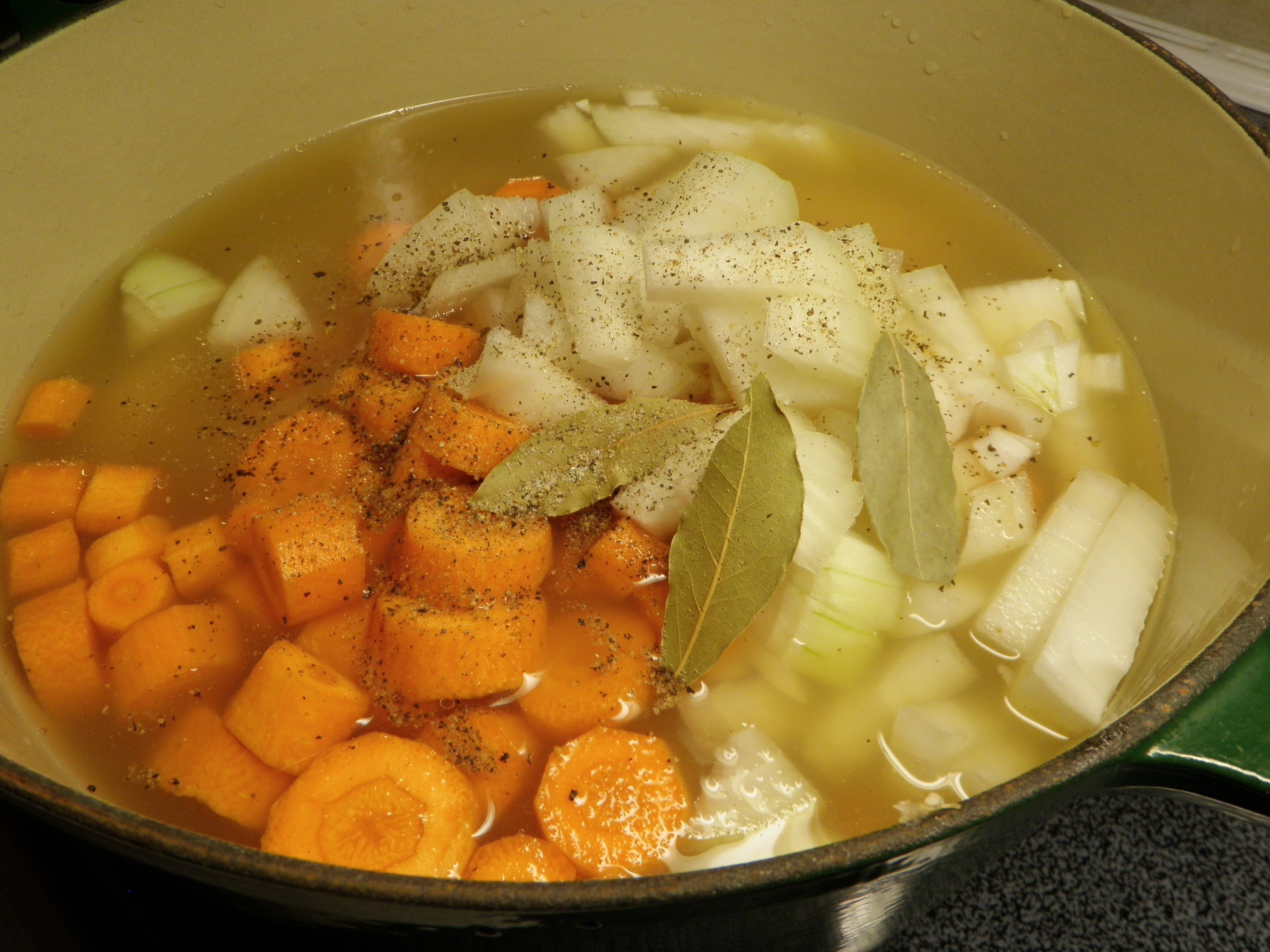
  • 4-6 large carrots, cleaned and roughly chopped
  • 1-2 large sweet onions, roughly chopped
  • 3-5 cloves of garlic, roughly chopped
  • 2-3 bay leaves
  • salt and pepper as desired
  • 2 cups Israeli couscous (little tiny pasta balls)–or 2 cups white rice which is more traditional and naturally gluten free
  • 3 eggs
  • juice and zest of 2 large lemons (alternate: 1 cup lemon juice)

Place the chicken, carrots, onions, garlic, bay leaves, and salt and pepper in a stock pot; cover with 32 oz of chicken broth (about 4 cups). Bring to a boil, then cover and simmer for 30 minutes. This is to cook and flavor the chicken.

Remove the chicken and add the couscous and another 32 oz of chicken broth (about 4 cups). Cover and simmer while you shred (or chop) the chicken.

Add the chicken back in and stir well.

At this point, you have a fantastic and well-flavored Chicken Noodle Soup…and might very well choose to stop here.

Or…you can make and add the “Greek” part.

Whisk together three eggs and the juice and zest of two large lemons (about 1T zest and about 1/2 cup juice) in a large bowl. Be sure to use a large bowl, much larger than you think you need, because next you are going to add 2 cups of soup broth while whisking.

Get 2 cups of hot broth out of the soup pot; it’s okay if there’s some onion or couscous in it. I dip the broth out with a soup ladle and into a large measuring cup with a pour spout. This will come in really handy as I pour it into the egg mixture.

Now, take the measuring cup of broth in your left hand and your whisk in your right hand (or vice versa if you are left-handed).

Start whisking away gently.

Dribble the hot soup broth into the egg mixture very slowly, whisking the whole time.

It will take about five minutes, so be patient and DO NOT rush this  step. This is called “tempering” the eggs, warming them up without cooking them so that when you add the mixture to the soup, it will become naturally creamy from all of the proteins!

When you’ve incorporated all of your broth, take the soup off of the heat and add the mixture to the soup. Taste and see what you think.

If you want more lemony taste, add some more lemon juice.

NOTE: this recipe is based off of one posted by Whole Foods for Greek Lemon and Chicken Soup.