Posted in Being Healthy

How Many Calories Do I Need Each Day? Yes, this is about METABOLISM

Why am I fat? The answer du jour…for about the past 10 years…has been “I have a slow metabolism.”

BULLSHIT.

Your body has a metabolism…a specific number of calories necessary to maintain your basic body funtions: breathing, blinking, making saliva in your mouth, sending visual messages from your eyes to your brain so you know what you’re looking at, peeing, pooping, smelling, laughing, talking, walking from your desk to the snack machine at 2:57 pm at the office.

This means that your metabolism CANNOT be slow or fast; it needs what it needs. You don’t get to determine what your body needs, but if you have the correct information, you CAN make new choices about how to feed your metabolism to effect changes in your body.

If you think you can’t lose weight because you have a “slow metabolism,” you are making excuses for yourself. Yes, I am aware that I am oversimplifying, but I’m trying to make a point here. Take responsibility for and control of yourself and your lifestyle. This includes taking responsibility for knowing and managing any health conditions you have because they ALL affect your weight; don’t feed me lines about your thyroid or PCOS or menopause as if you can’t do something about that.

Other unacceptable excuses: I don’t have time, I have kids, It’s too expensive. These are all excuses for

  1. not knowing what you need to know (which takes all of 10 seconds to discover)
  2. not acting on what you know “because it’s hard” <insert whine here>

Ladies: put your big girl panties on!

Gents: your choice…get a girdle or put your big girl panties on!

What do you need to know to make the right choices? Geez, that is so easy a caveman can do it. You need to know how many calories your body’s metabolism requires each day to keep you alive and perform basic activity functions. Yes, there is a complex mathematical formula for this. Yes, it looks very cool when all the proper symbols are aligned. No, there is NOT going to be a math test. It’s as simple as clicking on this link to a calulator for your Basil Metabolic Rate. Enter your current weight (be shockingly honest), your height, your age, and your sex. Mine comes out like this:
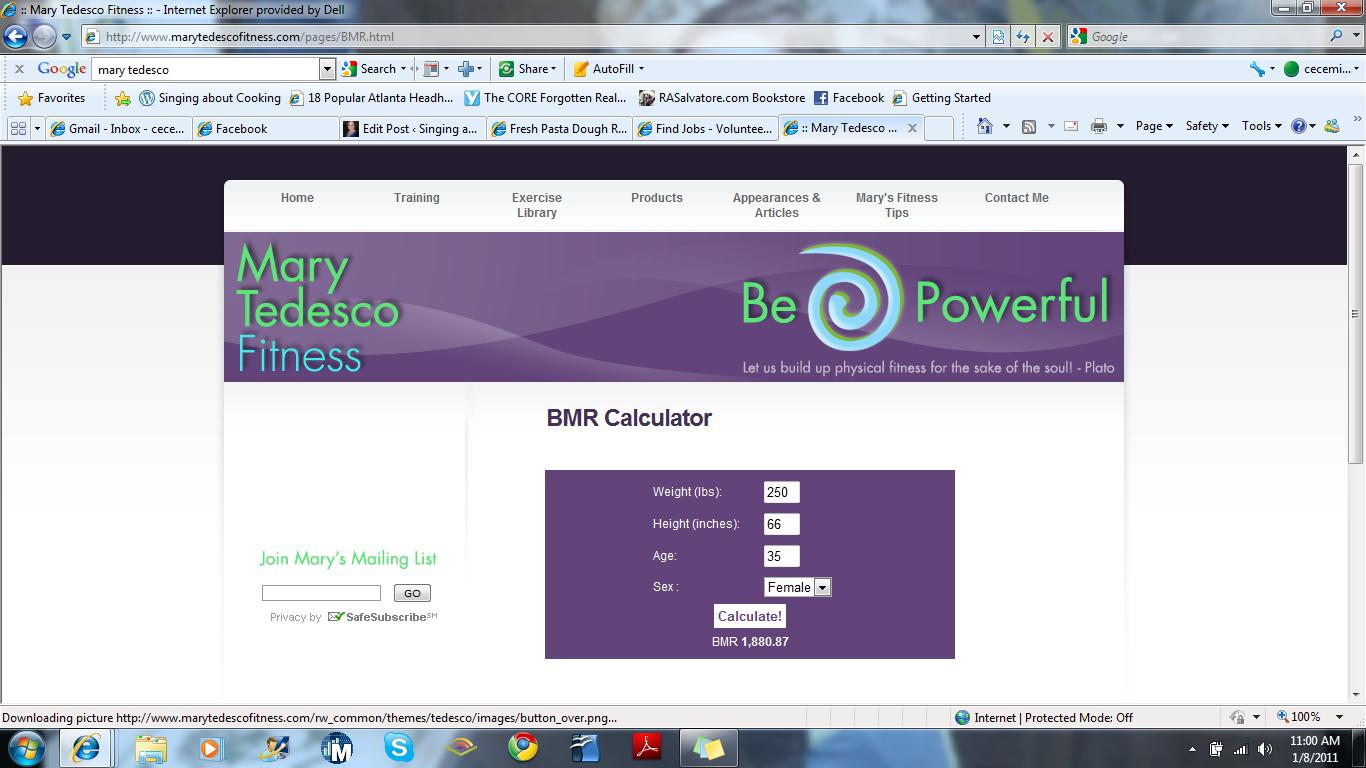
For me to stay exactly as I am, I must consume a total of 1880.87 calories each day; no exercise required.

For me to lose weight, I must consume less than 1880.87 calories each day through a combination of food intake and exercise burn off.

Now, let’s match up a diet and exercise plan to support weight loss. We all should know by now that I’ve chosen Weight Watchers, originally on the Points plan (with 31 points of food a day) and now the PointsPlus plan (with 38 points of food a day). On the old Points plan, each point was roughly equivalent to 50 calories, so that plan (and the nutritional formula) came out to a 1550-calorie-a-day diet. The new PointsPlus plan does not include calories in the formula, so I’m still looking for an explanation of a calorie equation that makes sense, but if we assume the same 1:50 ratio (which is not a rational assumption), the PointsPlus plan comes out to a 1900-calorie-a-day diet.

Dang, it’s a good thing I simply cannot eat 38 points of food on a normal day (special occasions on any version of the plan are exceptions). I average a consumption of around 30 points a day, uhum, just like the old points plan. So I’m still working on a 1500-calorie-a-day diet, which supports weight loss.

Add to that the fact that I exercise at my optimal fat-burning heart rate for 30-45 minutes every day, I’m burning 600 calories of that intake. On Weight Watchers, that 600 more calories I get to each on days when I work out, or roughly 12 more points. And, no, that does not mean I eat 42 or 50 points a day, even on a special occasion day.

Oh, I guess I should say how I know how many calories I burn during a workout. I use a SportLine Solo Fitness Watch that accepts age, height, and weight information and uses that in combination with heart rate data before, during, and after my workout to calculate and track my calories burned. Typically, my main aerobic workout is running (well, technically, jogging at a 13-minute mile pace for you die-hard runners), and I have now three years of data from several sources: my fitness watch, the treadmill (where I enter the same info), the elliptical machine, and my group of friend/trainers at my gym. I can get in 3 miles on the treadmill in 45 minutes or on the elliptical in 30. All of these data sources give me internally and externally consistent data to show that for every 15 minutes I spend at my ideal working heart rate (145-160), I burn 200 calories. (NOTE: the Cooper River Bridge Run takes me 1.5 hours to jog, which means I burn 1200 calories on the run itself and then another 400 calories on the mile power warm-up walk from the house to the start and then from the finish to the ferry to go home; that’s 1600 calories in one morning.)

Okay, so now you are ready to hit me with the trick question: if I need 1880 calories a day to stay alive, how does 1500 calories plus exercise get me by.

Short Answer: ensure that as many of those 1500 calories a day are supplied with super power foods (clean protein, fresh fruit and veggies, high fiber carbs, healthy fats) rather than empty calories (Doritos, cheese puffs, easy mac and cheese, hot tamale candies).

Long Answer: subscribe to my blog 🙂 I will keep talking/writing about this!
Posted in Being Healthy, Cooking

Cooking Four Dinners at Once


Rich with aroma and flavor…a dense, satisfying dinner!

My dilemma:

No one in my family eats the same thing, which makes dinner prep sometimes challenging. One of my family does not eat salmon, which means any time I cook salmon, I have to also cook some other major protein for him.  Tonight, chicken is the compliment. Luckily, I’m in the mood for a preparation that I can use on both: oven poaching. Another eats only certain carby dishes and no veggies, while I want to keep a good balance of carbs and veggies. And, guess what, I can and will do this with only three dishes: 1 entree (2 meats), 1 carby side, and 1 veggie side.

Okay, the game plan:

    1. poached salmon and poached chicken breast (both currently frozen)
    2. potatoes au gratin (Betty Crocker box mix)–for the boys
    3. frozen peppers and onions sauteed with some fresh onion and purple cabbage over egg noodles–for the girls

Step 1. Put the fish and chicken out to thaw…or not. Since oven-poaching is the regular person’s way of saying steam or even en papillote, you have probably done this before…with frozen meat since the water and juices help with the cooking.

Light and fruity

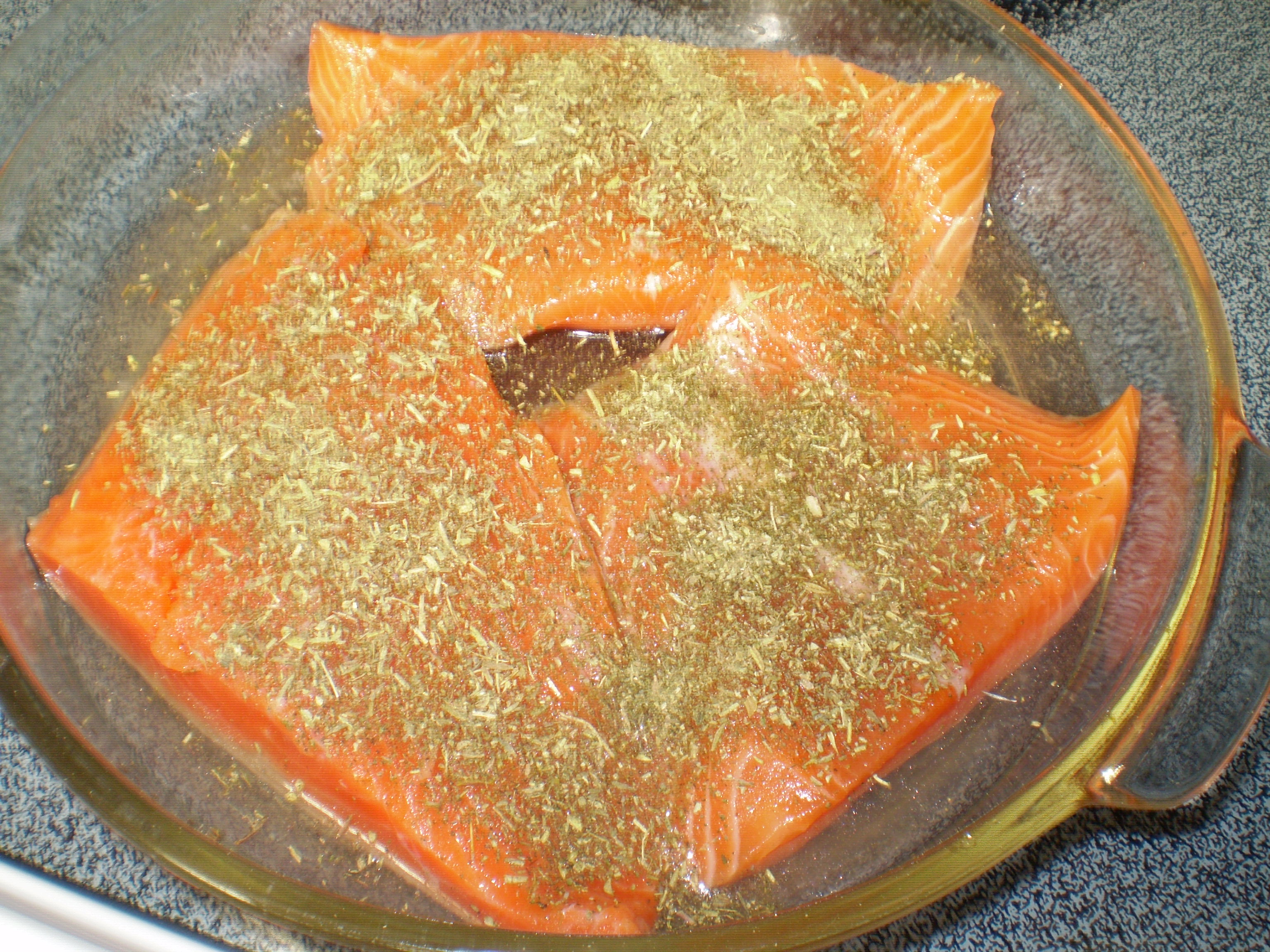
Step 2. Choose a flavor combo. This will determine the liquid and herbs you use throughout the meal, but most importantly in the pan or baking dish with the fish/chicken. Tonight, I have decided to finally open and use one the bottles of Rose Merlot I recently purchased on my trip to Long Island to visit Rachel, Al, Carter, and Samuel. Rachel and I have always made at least one of our visit days a Long Island vineyard day. This past November, I found this Rosé Merlot at Palmer Vineyards on the North Fork of Long Island; Palmer can ship wines to the following states: AK,DC,IA,ID,IL,MN,MO,NH,NY,OH,RI. With the lightness and fruitiness of this wine, I will pair the classic Herbs de Provence, a combination of thyme (dominant), fennel, savory, basil, and lavender (only in the US).

Alternative combos that I like:

  • lemon juice and basil/oregano/garlic
  • balsamic vinegar and garam masala (or curry and coriander)
  • pineapple juice and cayenne pepper
  • soy sauce and ginger/dry mustard
  • apple juice and all-spice (think pork chops that will be paired with butternut squash or pumpkin


You can barely see the wine, but it’s there, with a liberal dusting of herbs de provence. That’s two boneless breasts, two bone-in thighs, and two bone in legs

Step 3. Prepare the poach.

Since the salmon and chicken will need different cooking times, I use two 9×9 baking dishes. Since most of the liquid bases are acidic (I guess you could use water?), I try to use glass or ceramic baking dishes, but if I have to use a metal one (because everything else is dirty), then I am careful to line it with aluminum foil so that the acid doesn’t leech anything out of the metal and into my food.

Simply pour in about 1/4-inch of liquid. For a 9×9 pan, this is usually about 1/3-1/2 cup of liquid. Place the meat in a single layer in the dish (yes, touching sides is okay) and season as lightly or liberally as your palette desires.

Cover the dish very tightly with aluminum foil and bake at 350 degrees: salmon for 30 minutes, chicken for 40 minutes.

NOTE: this is a fantabulous way to cook just one meal at a time and cut down on dishes to wash. Just prepare your one piece of meat in a parchment or aluminum foil pouch, no pan at all.

Step 4. Set water to boil on the stovetop and get crackin on the Betty Crocker potatoes au gratin. Sure, I can and do make these from scratch, but I have a 6:30 meeting tonight, and my family doesn’t care if it comes out of a box.

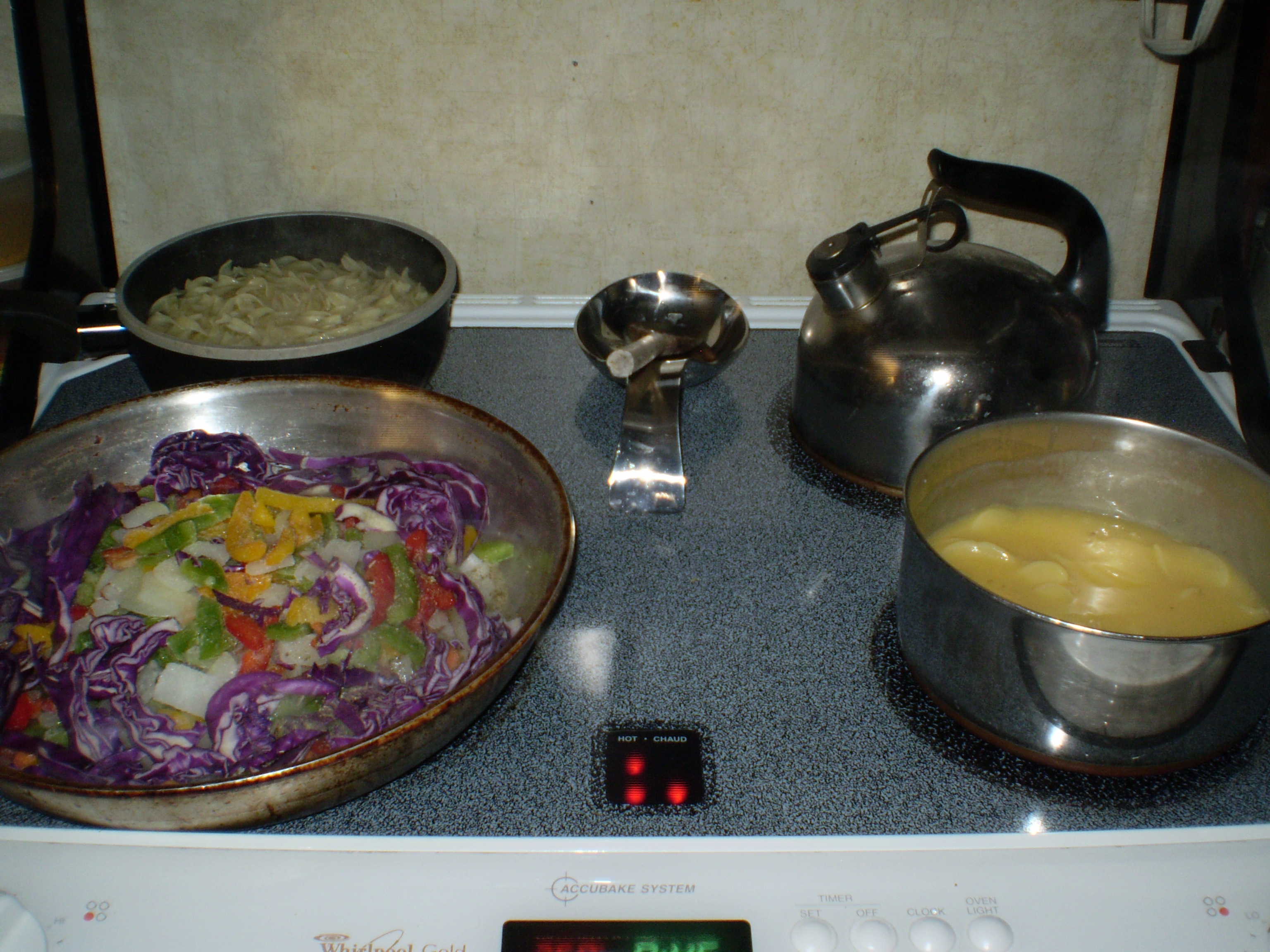
Noodles in the back, veggies and potatoes in the front

Now, the directions offer both oven and stovetop directions; I am choosing the stovetop preparation tonight because the oven temp and cooking times vary so significantly for the meat and potatoes that one or the other would be…well, yucky, to be technical. The stovetop directions require only boiling time and 15 minutes of simmering. And since I’ll already be at the stove doing the veggies (coming up next), it’s an efficiency of effort that I can’t pass up.

So, Betty Crocker potatoes au gratin, prepared just as the directions say. Once you get to the simmering step, you should be ready for the next step.

Step 5. Drop the egg noodles into the other pot of boiling water and cook just as your package’s directions say…around 8-10 minutes. Go ahead and set up the strainer in the sink now.

Step 6. Drop your veggies into the skillet with just a drizzle of olive oil. Fresh veggies go in first since they need a little more softening; the frozen ones were blanched before freezing, so they only need to thaw. Tonight I’m using fresh onions and carrots. And I’ll let them just sit still in the skillet for a few minutes with their salt and pepper and herbs de provence sprinkle, until I’m convinced they are getting a little soft…and they start to get a little brown…not actually carmelized but just a hint of starting. That’s when it’s time to drop in the frozen peppers and onions and pop the lid onto the skillet. Trap in the heat and let the water from the frozen veggies steam the combo with the lid on. Chop up the purple cabbage ( just a quarter head we had leftover from cole slaw a few weeks ago) and drop it on top at the last minute. Snap the lid back on for about 3 minutes…and you’re done.

I like to mix my noodles and veggies in the skillet together, but if you need to keep them separate for pickiness sake or figuring out nutrition, you can mix them on your plate.

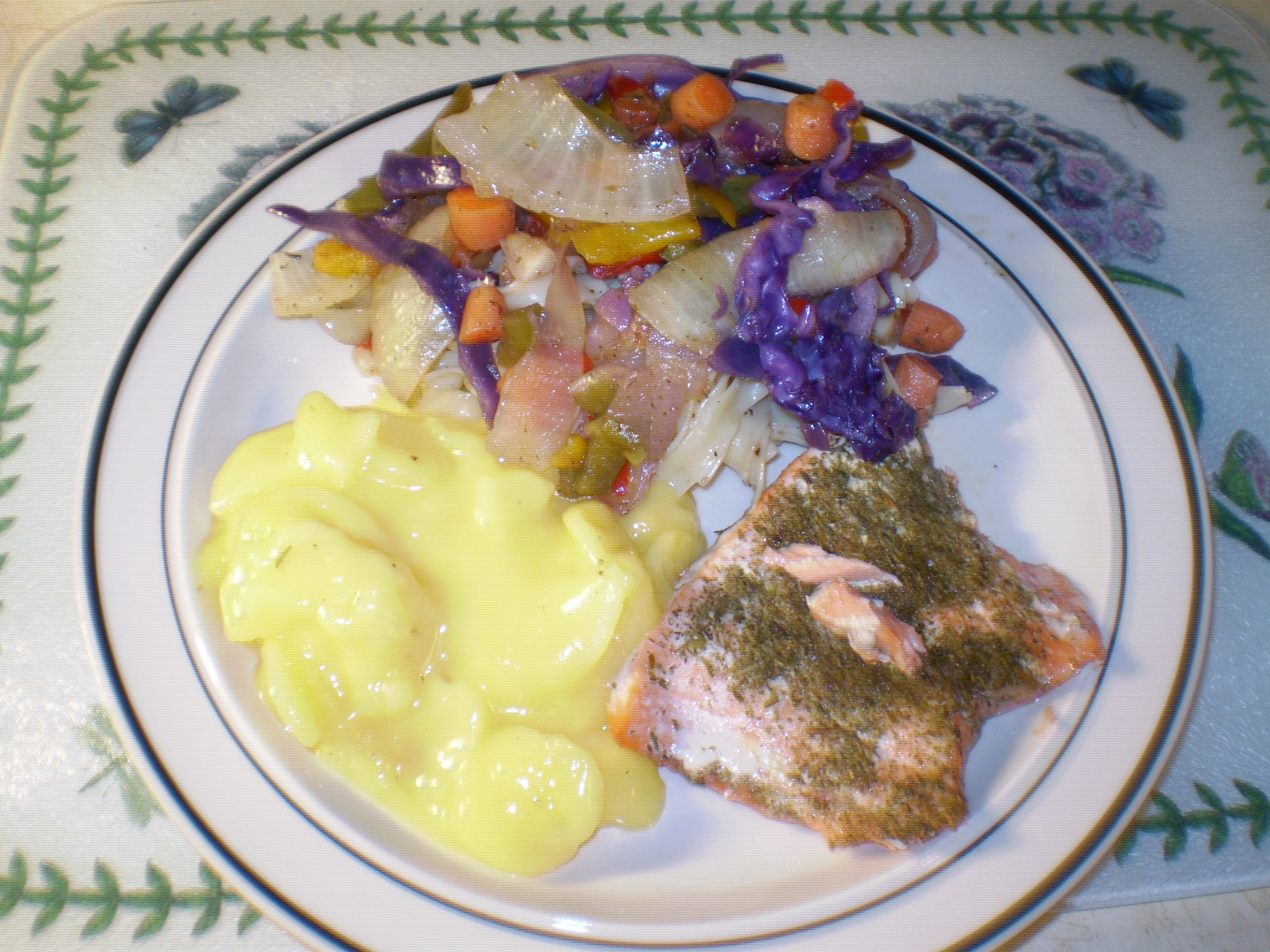
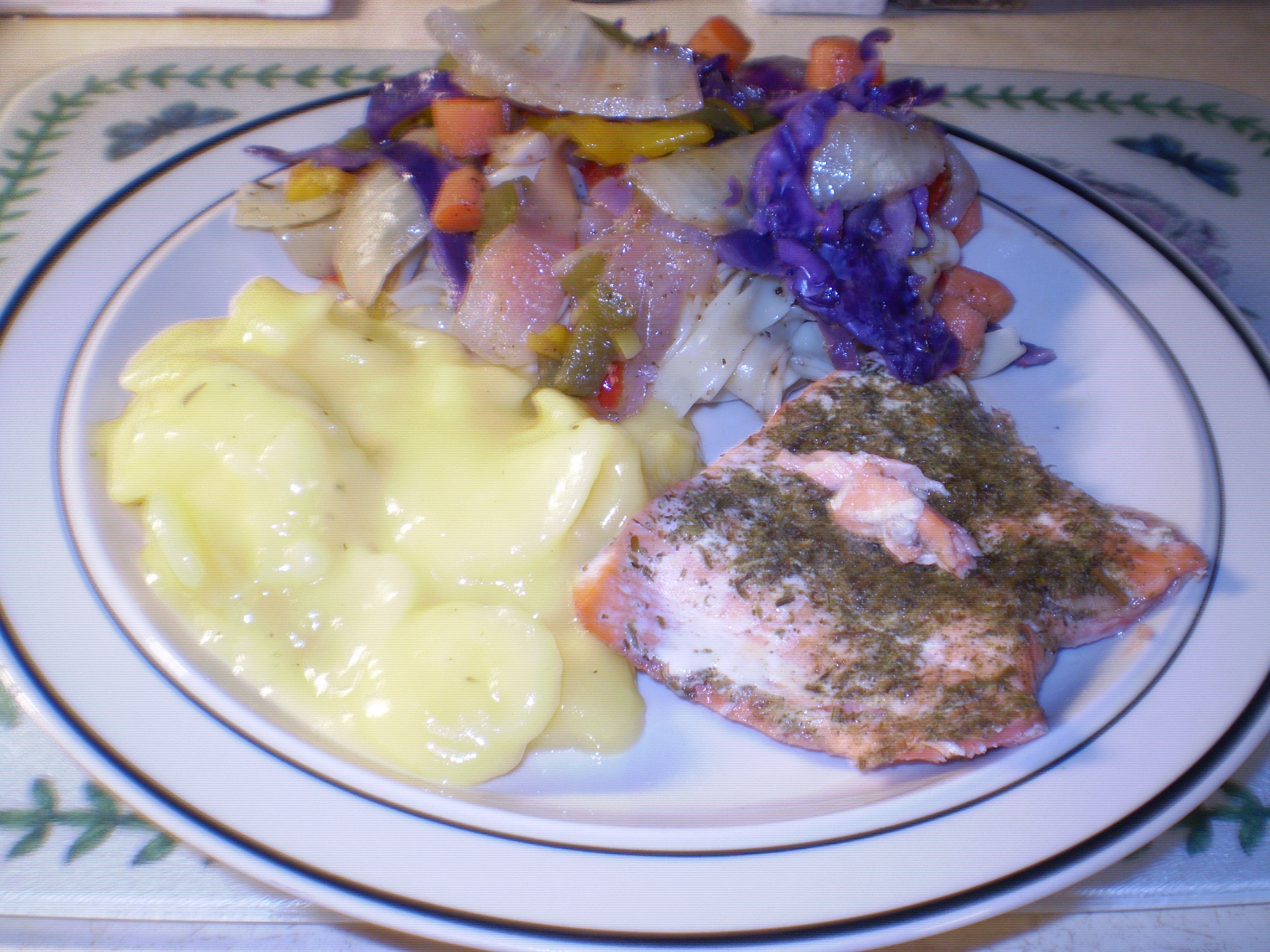
My plate…a little bit of everything…with the leftover chicken ready for tomorrow night 🙂


All done. Ready to plate:

  • For brother: salmon and potatoes au gratin
  • For dad: chicken, potatoes au gratin, and veggies and noodles
  • For mom: salmon and veggies and noodles
  • For me: salmon, potatoes au gratin, and veggies and noodles

That’s four specialized dinner plates making four people happy and full coming out of one 45-minute dinner preparation, which is pretty normal when you consider all the chopping and pulling out pans and stuff.

Weight Watchers PointsPlus: for this meal, I’ll break down each item:

  • 3 oz poached chicken breast = 3 points
  • 3 oz poached salmon = 4 points
  • 1/2 cup Betty Crocker potatoes au gratin = 4 points
  • 1/2 cup egg noodles = 4 points
  • veggies = FREEEEEE!

So my dinner = 12 points